On March 24, 2020 Prime Minister Narendra Modi announced a nationwide lockdown in India to prevent the spread of Covid-19 infections. What has changed in the last two years? Here are four charts which answer this question.
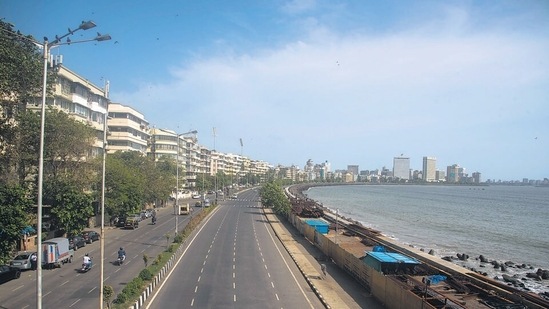
A deserted view of Marine Drive during lockdown in Mumbai in April 2020. (Pratik Chorge/HT photo)
In absolute terms the first lockdown was the hardest, but a relative comparison shows different results.
How stringent was India’s lockdown when it was first imposed, and what has been India’s unlock progress compared to the rest of the world?
A good way to answer these questions is to look at the Oxford Stringency Index data. The Index is a composite measure of nine response metrics: school closures, workplace closures, cancellation of public events, restrictions on public gatherings, closures of public transport, stay-at-home requirements, public information campaigns, restrictions on internal movements, and international travel controls.
A comparison of quarterly Oxford Stringency Index scores using data from www.ourworldindata.org shows the second quarter of 2020 (April-June) saw the hardest lockdown in India in terms of number of regulations, with the average score being 89.8. India was ranked 16 among 185 countries in that quarter with the median score being just 74.5. After this quarter, India’s lowest Stringency Index score was in the quarter ending December 2021: 46.8. A comparison of quarterly ranks with other countries, however, shows that India has had the largest number of comparative restrictions in the first quarter of the current year, with its rank being five among 185 countries. To be sure, data for the current quarter is available for different time periods for different countries. For India, the latest available data for this quarter is till March 14, 2022.
A comparison of global median scores with India’s shows that restrictions have always been higher in India.
Mobility levels have largely improved except during second and third waves
The first and harshest lockdown imposed in the country decreased visits to places of retail and recreation, workplaces, transit stations, parks, groceries and pharmacies; and increased the time spent by people at home. Thereafter, the average mobility in the first four categories (called non-essential mobility here for simplicity) increased, then decreased again substantially during the second wave in May 2021, but remained below pre-pandemic levels until October last year. Since October, it has remained around or above pre-pandemic levels despite a third wave.
But the economic picture could be slightly more complicated
As restrictions are removed and mobility improves, the biggest question is what is happening to the economy? Here the answer might be more complicated than what some indicators such as the Nomura India Business Resumption Index (Nibri) suggest. Nibri – it comprises Google mobility indices, Apple driving index, power demand and the labour force participation rate, and considers 23 Feb 2020 as the base for all the series – rose to another record high of 126.4 for the week ending 20 March from 122.8 in the previous week, 26.4 percentage points above its pre-pandemic levels.
But indicators such as Nibri do not capture the persisting weakness in key factors such as consumer sentiment in the economy. Latest data from RBI’s Consumer Confidence Surveys (CCS) shows that consumer sentiment was significantly below pre-pandemic levels until January 2022. The lag in consumer sentiment recovery despite removal of restrictions and improvement in formal sector trackers such as Nibri shows that large parts of the economy might have incurred economic pain which has left long-lasting scars. The Indian economy’s ability to reposition itself in a sustainable high-growth trajectory will depend on the healing of such scars to a large extent. It will be interesting to see whether consumer sentiments have improved significantly when the next round’s data is released in April 2022.
Follow India news real-time updates and the latest news covered on Hindustan Times, featuring today's critical updates on Sonam Wangchuk LIVE and more across India.
Home/India News/Two Years Since Lockdown: Covid Has Changed How India Moves, Lives, Works, And Consumes

 E-Paper