
 E-Paper



Cracker bursting, stubble fires drag down Gurugram’s air quality
An increase in stubble burning and extensive use of firecrackers, despite a ban in the National Capital Region, on Diwali dragged down the air quality in the city to the ‘severe’ levels of the Central Pollution Control Board’s classification, with an air quality index (AQI) reading of 472 on Friday


An increase in stubble burning and extensive use of firecrackers, despite a ban in the National Capital Region, on Diwali dragged down the air quality in the city to the ‘severe’ levels of the Central Pollution Control Board’s classification, with an air quality index (AQI) reading of 472 on Friday. This was also the worst air quality recorded around Diwali since 2016, as per the CPCB data.
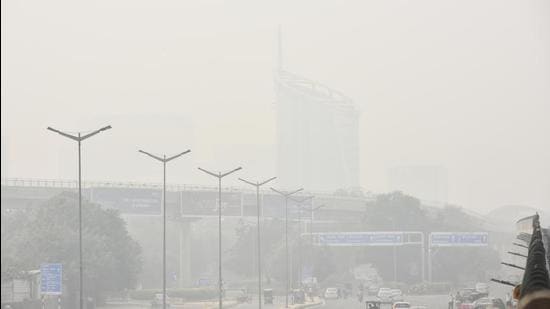
On Thursday, Gurugram’s AQI was 395 (‘very poor’), which was already on the brink of ‘severe’ levels, also the worst reading recorded on Diwali since 2016, according to the data. The air quality in the city started deteriorating on Thursday evening, with levels of particulate matter having a diameter of 2.5 microns or less (PM2.5) increasing and reaching severe levels of concentration after 9pm.
Officials of the Haryana State Pollution Control Board (HSPCB) attributed the spike in pollution to the bursting of crackers in the city, while experts pointed to an increase in stubble fires.
Despite a complete ban on the sale and use of all kinds of crackers in 14 Haryana districts located in the National Capital Region (NCR), there was widespread use of crackers not only in the city but also in neighbouring Delhi and NCR districts of Uttar Pradesh.
S Narayanan, member-secretary of HSPCB, said, “Along with unfavourable weather conditions, the spike in air pollution levels is mostly due to bursting of crackers across the region. I am yet to get the complete report on how many challans were issued for bursting of crackers and the exact impact, but looking at the 24-hour average, it can be concluded that this is due to bursting of crackers. In the past 24 hours, increase in farm fires in the state have also been marginal, with around 100 cases increasing, but the change of air quality today (Friday) is quite steep compared to Thursday; so it is mainly crackers that have contributed to it.”
The official said that on Thursday, the state recorded 228 farm fires and on Friday, there were 331 cases of farm fires.
A weather bulletin issued on Friday evening by the Air Quality Early Warning System for Delhi-NCR stated, “The contribution from firecrackers, biomass burning and unfavourable weather conditions brought AQI in severe category.”
The air quality, however, is likely to improve on Saturday and Sunday, due to a prediction of strong winds, and remain in the ‘very poor’ category, with PM 2.5 as the primary pollutant. The contribution of biomass burning is also likely to increase as winds will be westerly from Friday onwards.
Experts said that the bursting of crackers intensified the accumulation of pollutants in the lower levels of the atmosphere.
Sachin Panwar, a city-based independent air quality scientist, said, “Cracker bursting intensified the PM2.5 accumulation at the lower atmosphere in night hours, which lead to peak values of PM2.5 crossing 1,000 micrograms per cubic metre (ug/m3) mark at most of the locations in the National Capital Region. But as the relative index AQI has a maximum limit of 500, which means whether it’s 501 or 50,001, the air is hazardous. Smog was also visible in the morning and poor wind allowed particles to stay afloat in the breathing space, as dispersion is not fast. These toxic compounds can cause severe health hazards.”
Meanwhile, Kuldeep Singh, the regional officer for HSPCB for Gurugram (north) said that two additional sensors were installed in sectors 48 and 25 for monitoring air quality levels seven days before and after Diwali.
“To understand the exact impact of different factors, such as vehicular emissions and dust, two additional sensors have also been set up where we are monitoring all the parameters. This year, we saw that with decrease in temperature and wind speed late evening around 11pm, the air quality index levels started increasing. The pollution levels were higher during the night hours compared to day hours on Thursday,” said Singh.
Stay updated with all the Breaking News and Latest News from Mumbai. Click here for comprehensive coverage of top Cities including Bengaluru, Delhi, Hyderabad, and more across India along with Stay informed on the latest happenings in World News.


