
 E-Paper



Gurugram admin razes illegal farm houses in Aravallis, more action to follow
Officials said that some residents tried to stop the demolitions but failed as the documents they produced were not verified

 Prefer HTon Google


The Gurugram district administration demolished 12 illegal farmhouses constructed in the protected Raisina area in the Aravallis, officials aware of the matter said, adding that the operation involved six heavy earth movers, an armed contingent of police personnel, and magistrates.
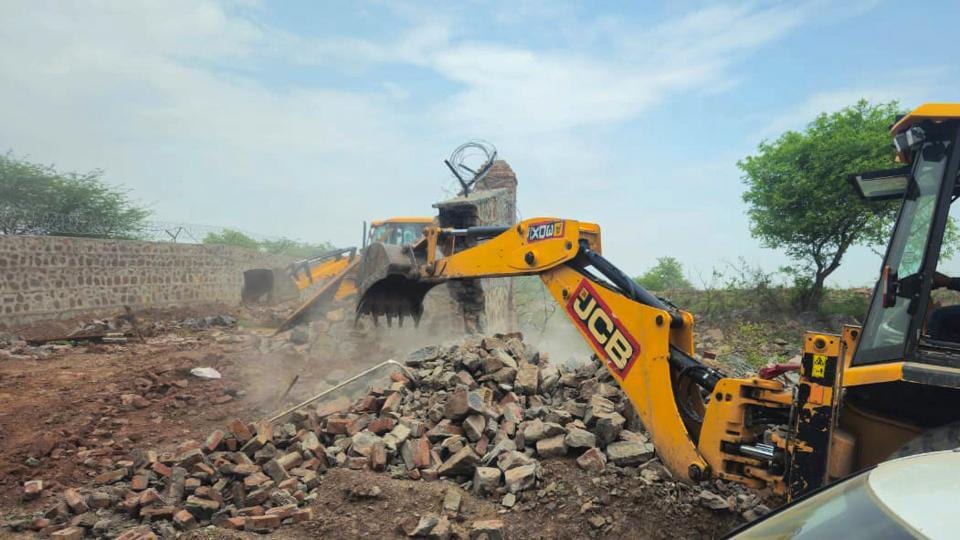
Gurugram deputy commissioner (DC) Nishant Kumar Yadav said that an extensive survey was conducted, and notices were served to parties carrying out construction in the protected area. “They were given seven days to file their replies. The construction of all those parties whose replies were not satisfactory were demolished in the drive carried out on Friday,” said Yadav.
The development came three days after HT reported about the concerning rise in the construction of illegal farmhouses over the past year in the Aravalli region, belying forest department claims of no new construction or illegal mining (the two are related because stones mined illegally from the Aravalli range are used in the construction). At least 25-30 acres of the protected land were freed from illegal constructions during Friday’s drive.
Officials said that some people tried to obstruct the demolitions which was unsuccessful as the documents they produced were not verified. Yadav added that more notices have been issued and further demolitions will be carried out if the responses do not meet the criteria.
The operation was led by sub-divisional magistrate Sonu Bhatt, along with municipal council executive officer Suman Lata, legal assistant Sandeep Rathi, municipal council engineer Narendra Taneja, and police personnel from Bhondsi police station. Rajesh Tiwari, block development and panchayat officer of Sohna, served as duty magistrate.
Previously, HT reported that around 800 illegal constructions had sprung up in the eco-sensitive Aravallis, contradicting the forest department’s claim that no such activities were occurring. Illegal construction and mining in the area are prohibited under the Aravalli Forest Conservation Act and Punjab Land Preservation Act (PLPA).
Officials plan to install CCTV cameras and deploy drone cameras for regular aerial surveillance with the assistance of the Faridabad administration. The forest department and local authorities will also monitor construction workers entering protected areas to stop illegal activities, officials added.
The Supreme Court’s ruling on July 21, 2022, stated that land notified under Section 4 of PLPA should be treated as forests, with provisions of the Forest (Conservation) Act, 1980, applicable. This includes certain areas in Faridabad’s Anangpur, Ankhir, Lakkarpur, and Mewla Maharajpur villages.
Haryana minister of state for environment, forest, and wildlife Sanjay Singh had said that since the beginning of this year, there has not been a single case of illegal mining. He added that the department conducts surprise checks and visits the Aravallis for random checks, but has found no illegal construction activity. “There are no illegal constructions taking place in Aravallis, no mining in the area between Gurugram and Nuh. Our enforcement teams are visiting the spots; people know we will take strict action against them so they are cautious now,” he said.
Yet, during field visits last week, HT found at least 50 spots where illegal construction activity is going on in the Aravallis and spoke to the contractors, security guards, and labours, but nothing has changed.


