
 E-Paper



NGT plea seeks to quash Haryana’s narrowed definition of ‘forest’
NGT to hear plea against Haryana’s forest definition that could allegedly strip Aravallis of protection, contradict SC rulings, and weaken climate commitments.

 Prefer HTon Google


The Haryana government’s August 18 notification narrowing the definition of “forest” has been challenged before the National Green Tribunal (NGT), with environmentalist and retired Army officer Devender Singh Bamel seeking to quash the move for violating Supreme Court rulings and endangering the fragile Aravalli ecosystem.
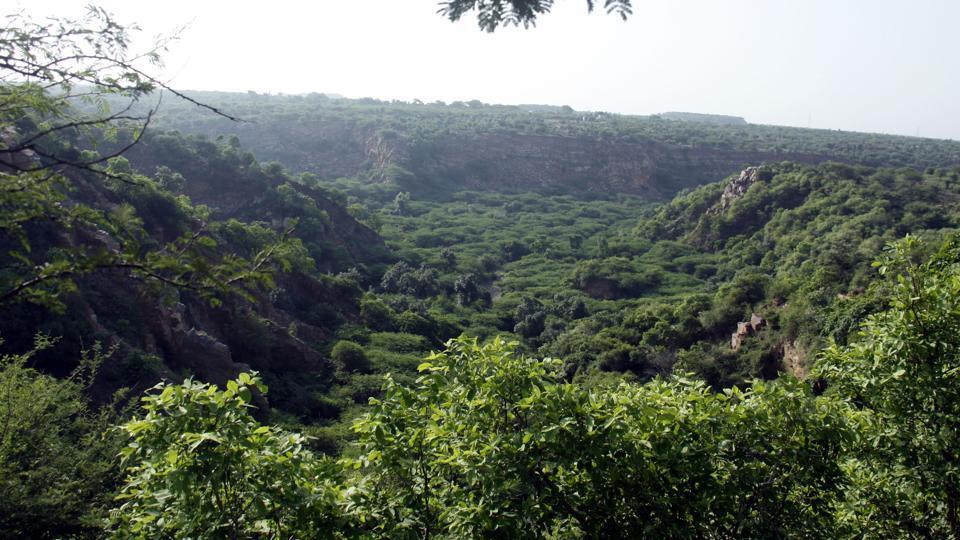
Filed on September 5, the petition argues that the state’s restrictive definition poses a “grave risk” to the environment, as large swathes of scrub and open forests in the Aravallis—already under pressure from mining, urbanisation and real estate expansion—would be excluded from statutory protection. The NGT has issued notices to the state government and its forest department and listed the matter for hearing on December 1.
To be sure, before the August 2025 notification, Haryana had never formally codified a rigid, technical definition of “forest” under the “dictionary meaning” principle. There were no prescribed thresholds for area, canopy density, or contiguity. The latest notification marks the first time the state has attempted to lay down such criteria in precise terms.
According to the August 18 notification, only patches of at least five hectares in isolation, or two hectares if adjoining notified forests, with a canopy density of 40% or more, will be considered “forests.” Linear plantations, orchards, and agroforestry areas have been excluded. The petition argues that these thresholds drastically reduce the scope of protection, potentially stripping more than 80 sq km of Gurugram’s open forest of legal safeguards.
Officials said nearly 13,928 acres of unprotected Aravalli land in Gurugram and Faridabad are at risk of losing legal protection under the new definition. These parcels currently lack notified forest status, and under the new criteria—requiring higher canopy density and larger minimum sizes—many scrub and open forest patches would no longer qualify. Environmental analysts warn the impact could be much wider, estimating that 75–80% of the potential “deemed forest” area across the Aravallis may be excluded. That means only a fraction of landscapes earlier covered under the Supreme Court’s broader “dictionary meaning” approach would retain legal recognition as forests.

To be sure, in 2019, the forest advisory committee (under the Ministry of Environment, Forest and Climate Change) clarified that states do not need permission from the Centre (MoEFCC) to define what constitutes unclassified land as forest.
Bamel contends the notification is arbitrary and directly contradicts the Supreme Court’s 1997 ruling in TN Godavarman v Union of India, which directed states to adopt the “dictionary meaning” of forests, irrespective of ownership or size. “This notification is in blatant contravention of the Supreme Court’s ruling in the Godavarman case,” said Naveen Bamel, counsel for the petitioner. “Haryana already has the lowest forest cover in India. Every word of this notification is against the law of the land. It will only benefit real estate developers while undermining India’s climate commitments and setting bad precedents for other states. Once this comes into effect, 67% of Haryana’s forests will no longer be considered forests.”
The petition points out that Haryana issued its notification 18 months after the Supreme Court, in a February 19, 2024 order, reaffirmed the Godavarman principle that forests must be identified in their natural sense, beyond technical thresholds. By setting narrow criteria, the state risks excluding vast tracts of the Aravallis, where dry scrub and open forests dominate.
Haryana has the lowest forest cover in India, just 3.65% of its geographical area, according to the 2023 State of Forest Report. Much of this consists of open forests with canopy density between 10 and 40%, which the new rules leave out. Environmentalists have cautioned that the notification could undermine India’s international climate commitments under the Paris Agreement and jeopardise projects like the Aravalli Green Wall Project, a 1,400 km ecological corridor launched earlier this year to combat desertification.
The petition has urged the NGT to strike down the August 18 notification, direct the state to frame its definition in line with Supreme Court rulings and Ministry of Environment guidelines, and appoint an expert committee to study the ecological fallout, including impacts on biodiversity, desertification and Delhi-NCR’s air quality. It has also sought an interim stay to prevent immediate loss of forest protection.
Environmentalists have welcomed the NGT’s intervention, warning that if allowed to stand, Haryana’s move could set a dangerous precedent for other states to dilute forest protections nationwide. Vaishali Rana, activist with the Aravallis Bachao movement, said Haryana’s move to narrow the definition of forests risks erasing centuries-old ecosystems. “Already under pressure from urbanisation and real estate, the Aravallis cannot survive if areas with sparse cover are stripped of protection. The step may benefit developers today, but for citizens and nature it’s a blow to our ecological future.”


Stay updated with all the Breaking News and Latest News from Mumbai. Click here for comprehensive coverage of top Cities including Bengaluru, Delhi, Hyderabad, and more across India along with Stay informed on the latest happenings in World News.


