
 E-Paper



Bigger than Trump visit, Delhi riots? Capital braces for CJP protest with 26,000 central forces
Two months ago, the demand was for then education minister Dharmendra Pradhan to resign over the NEET-UG paper leak.

 Prefer HTon Google


Everything is slightly different about the protest this time – the demonstrators, the demand, and also the preparations to contain them. Security forces have mounted one of the largest ground deployments yet. The police have issued media advisories (but also met with counter-advisories). They are having to use body-worn cameras amid allegations of misconduct and are also facing challenges from multiple groups on multiple fronts.
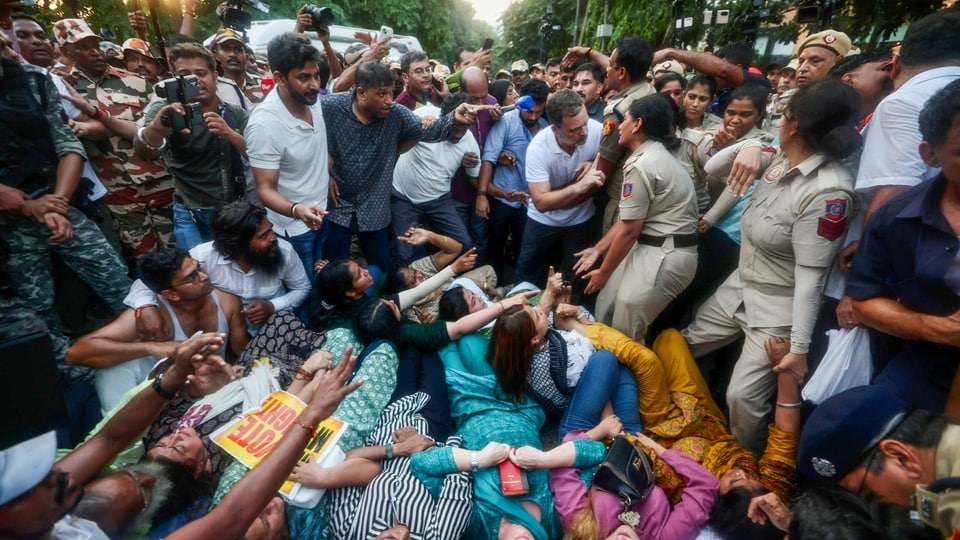
Two months ago, the demand was for then education minister Dharmendra Pradhan to resign over the NEET-UG paper leak. Now, the focus is on Chief Election Commissioner (CEC) Gyanesh Kumar. HT looks at the six ways Jantar Mantar 2.0 is different.
First, the numbers
The deployment of more than 26,000 personnel from the Central Armed Police Forces (CAPFs), to work alongside the Delhi Police, is the largest since the February 2020 assembly elections, the visit of US President Donald Trump and the Delhi riots — all of which occurred in the same month.
HT reported on Thursday that the Ministry of Home Affairs has approved at least 110 additional companies of the CAPFs – CRPF, BSF, SSB, ITBP and CISF. These companies have arrived from Jammu and Kashmir, West Bengal and Chhattisgarh, and join the 111 companies already stationed in Delhi. Each CAPF company has a sanctioned strength of 120-130 personnel, of whom around 75-80 are generally deployed. All 221 companies combined will operate alongside the Delhi Police.
“In February 2020, we had less than 200 companies that had come for the elections. I remember this because the elections and US President Donald Trump’s visit along with the Delhi riots happened around the same time. The extra forces had come in for the elections and were later kept for Trump’s security arrangements. In fact during the riots, a large section of the CAPF companies were deputed there and could be brought to control riots in North East Delhi only after he left,” a police officer said, seeking anonymity.
Multiple groups mobilise as CJP readies for Saturday
As the Cockroach Janta Party (CJP) prepares for a fresh round of protest at Jantar Mantar on Saturday, several other groups have also started mobilising, adding to existing challenges for security agencies.
Also Read | Jantar Mantar crowd swelled after food deliveries: Delhi Police’s key lesson from July protests
Various lawyers’ groups have announced a similar march from Patiala House Court to Jantar Mantar. “Appealing to all lawyers to gather in large numbers at gate number 4 Patiala House Court at 11 am on October 10, for our march to Jantar Mantar,” advocate Mehmood Pramod said on social media.
Bharatiya Kisan Union (BKU) leader and spokesperson Rakesh Tikait, too, has announced his support to the CJP and is likely to travel to Delhi for the protest.
Meanwhile, Congress MPs Rahul Gandhi, Priyanka Gandhi Vadra and other opposition leaders have been staging protests at various venues — Jantar Mantar, the Election Commission headquarters, Akashvani Bhawan, Rajghat and Connaught Place — keeping the police busy and guessing.
With former West Bengal chief minister Mamata Banerjee also set to join the Opposition’s protest, the leaders are likely to march towards Rashtrapati Bhawan on Friday. It isn’t clear how all of them will mobilise and where on Saturday.
Also Read | Delhi Police avoid name tags at Jantar Mantar protests to prevent social media targeting
Fresh challenge for cops
The possibility of protesters arriving in Delhi by road, rail and air has added another layer to the security arrangements. It is unclear when, and by what route, prominent CJP faces will reach the Capital. The police plan to stop activists as soon as they enter the city through airports, railway stations or bus terminals, even though protesters have threatened to protest wherever they are stopped. The CAPF personnel are likely to be deployed at all three types of entry points.
“Currently, prohibitory orders are only in the New Delhi area. Depending on the situation on Saturday, it is likely that such orders to ban assembly of four or more people will be enforced outside airports or stations too,” a second police officer said, also seeking anonymity.
Additionally, across the New Delhi area, police have already installed CCTV cameras and loudspeakers broadcasting recorded messages that urge people not to protest or gather in large numbers.
Protesters with highest threat perception
When opposition leaders were detained and taken to Kingsway Camp by bus on Tuesday night, CRPF personnel were on board as well. They were neither protesters nor had they detained the leaders in the bus. They had been picked up from the same spot where Rahul and Priyanka were detained by the Delhi Police.
Even as the police forcibly detained the two leaders, CRPF personnel have to ensure that the protectees are not harmed in any way or taken to a location unknown to them.
Also Read | Mamata Banerjee may join CJP protest against CEC Gyanesh Kumar at Jantar Mantar on Oct 10
Despite having Z-plus security by the CRPF, the two Congress leaders are among the dignitaries with the highest threat perception. Until November 2019, Rahul and Priyanka, along with their mother and then Congress president Sonia Gandhi, were protected by the Special Protection Group (SPG) – India’s elite security agency.
In 2019, the Centre replaced the Congress leaders’ SPG cover with Z-plus security provided by the CRPF, while retaining the SPG exclusively for the Prime Minister’s security. The CRPF currently provides Z-plus security to around 25 dignitaries, including Union home minister Amit Shah.
“It is a part of the security drill of the VIP unit that personal security officers (PSOs) have to be on the bus in which the protectee is being taken during detention. If you look closely at the photographs from the last few days, you will see PSOs inside the bus. We also have to ensure that when the police are detaining the protectees, no harm comes to them from the police or anyone in the mob,” a senior CAPF officer, who asked not to be named, said.
Police’s advisory for the media vs advisories for the police
This time, the Delhi Police have also issued a media advisory. Titled ‘Guidelines for Journalists’, the advisory released on October 5 lists the dos and don’ts for journalists covering the protests.
Journalists have been directed to display their valid identity cards at all times and avoid obstructing police operations. During tense situations, journalists covering and recording proceedings at the site have been advised to maintain a reasonable distance and position themselves in a manner that clearly distinguishes them from the protesters.
The advisory was issued against the backdrop of the police claiming that most people on the ground were influencers rather than accredited journalists. Over the past few days, police personnel have also been checking the identity cards of those covering the protests, with some people reportedly being detained for not being associated with accredited media organisations.
But the police advisory has not gone without controversy. Citizens and various media groups have issued their own advisories for the police, with many urging personnel to wear their badges or name tags while on duty. Several police personnel have been spotted without name tags, prompting concerns over their identification and accountability. The citizens also urged the police to stop assaulting them for holding peaceful protests and respecting women (a woman has accused a police officer of molestation).
Liquor vends shut, decision on schools pending
The Delhi excise department on Thursday ordered the closure of all liquor vends across the city for the next two days. Deputy commissioner(Excise), who issued the order, cited inputs from the Delhi Police and as a preventive measure aimed at maintaining law and order as the reason behind the decision.
A Delhi police officer said that shutting down vends during the elections is common but it is for the first time that the order has been issued for the whole city for a single protest at Jantar Mantar.
Also Read | Check bus travel, ask PG owners to dissuade students: Cops' plan for CJP's anti-EC stir at Jantar Mantar
“Yes, this decision was taken after a meeting on Thursday morning. There are inputs that mischievous elements can try to disrupt the law and order at a challenging time such as this. Area-specific closures of liquor shops have happened in the past such as during the 2020 riots, when shops were closed in some sub divisions parts of North East Delhi or the 2014 Trilokopuri riots when it was closed in some stations of Mayur Vihar. In my nearly two decades career, this is happening for the first time,” a senior police officer said. The police are yet to decide on the functioning of schools in the New Delhi area on Saturday, and could make a possible announcement in this regard on Friday.
Body-worn cameras and additional photographers
Following allegations that the police personnel molested journalists and social media influencers covering the protests, the Delhi Police began using body-worn cameras on Tuesday.
The forces deployed in the New Delhi district are currently using at least 150 such cameras as part of efforts to document events and address allegations of misconduct and even record what they do as evidence.
Police officers said that while traffic police personnel have long used body-worn cameras, it is for the first time that the devices have been deployed on such a large scale for protest management.
Body-worn cameras are also generally used by the army’s special forces, the NSG and CRPF during operations, as well as by prison guards and BSF personnel. For the latter groups, the cameras help document interactions and activities while on duty, including at border posts, prisons and traffic signals.
The Delhi Police has assigned the crime branch to investigate allegations of molestation against an assistant commissioner of police (ACP). Police have also accused protesters of targeting women police officers and taking advantage of the crowd to assault them.
In addition to body-worn cameras, police teams have hired photographers, over and above their own personnel, to document events and preserve footage and photographs as evidence.


