
 E-Paper



Kinnow growers, traders worried over labour post-harvesting
Punjab leads the country in the cultivation of kinnow, with the Abohar belt of Fazilka district alone contributing up to 60% to the state’s total production. The fruit is cultivated on nearly 33,000 hectare in Punjab

 Prefer HTon Google


Bathinda With uncertainty looming large over the availability of trained migrant workers for the kinnow season that starts from November, farmers say traders are hesitant to finalise a contract for wholesale purchase. A bumper crop is expected this time.
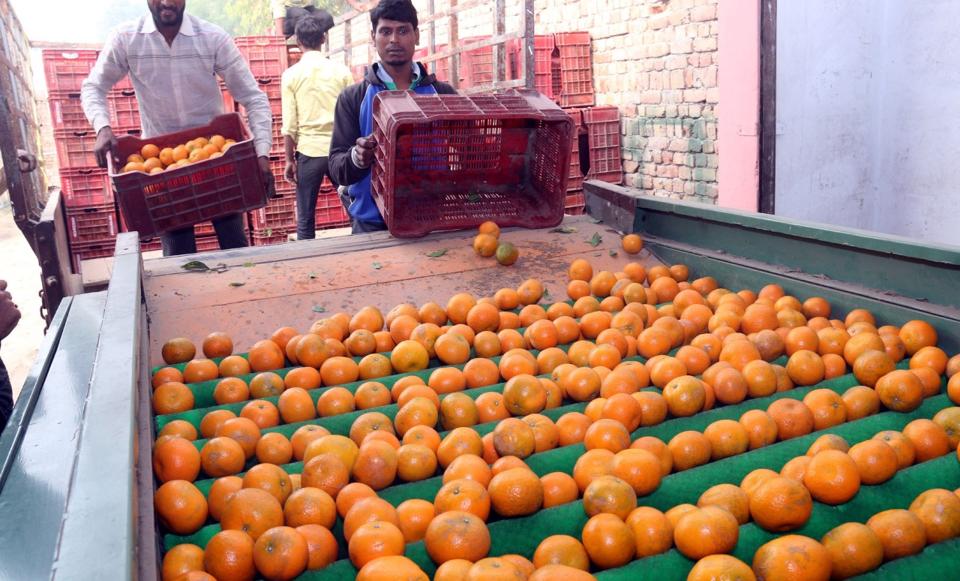
Harvesting is done by farm workers from districts of Punjab and from Sriganganagar in Rajasthan, but the real worry for industry is labour of sorting, grading, waxing and packaging. For this, fruit growers in Abohar, the hub for kinnow cultivation in India, mostly rely upon workers from Azamgarh in Uttar Pradesh and workers from Gujarat and Bihar. The kinnow industry employs around 8,000 such workers.
State award winning kinnow farmer Arvind Setia said workers from Azamgarh are experts in harvesting fruits like apple and kinnow, and each year they gather at Delhi’s Azadpur mandi, before proceeding for kinnow harvesting.
“Workers come from Delhi to Abohar in trains. This season, planning has been hit due to pandemic restrictions. As overall climatic conditions remain friendly, we hope for a good yield. An organised plan is needed for workers’ safe movement to Abohar,” said Setia.
Punjab leads the country in the cultivation of kinnow, with the Abohar belt of Fazilka district alone contributing up to 60% to the state’s total production. The fruit is cultivated on nearly 33,000 hectare in Punjab. Last season, the Abohar belt produced more than 5 lakh tonne of kinnow.
Kinnow harvesting begins during Chhat Puja to meet the demand for unripe fruits in Bihar, Uttar Pradesh and few other states. “As Chhat Puja this year will fall after November 15, we have time to start harvesting. Accommodating the large population of migrant workers amid covid threat is a challenge. Workers who come must be tested for covid-19,” said another farmer.
Shivam Setia, a trader, says, “The grading machine sorts kinnows according to different sizes, but the process greatly requires human intervention. Maintaining social distancing at machines that are small in size and in places, where this equipment is installed will be a challenge.”
Punjab Agri Export Corporation (PAEC) general manager Ranbir Singh said the state government was working on providing logistic support for kinnow growers. “PAEC has five common facilitation centres in Fazilka and Muktsar districts, whereas washing, grading and waxing will be done at 75 paise/kg. We will also provide packaging on demand-based orders from farmers. A newly-established facility in Abohar is equipped with a state-of-the-art features to process harvested kinnow. The plant has a capacity to handle 15-tonne fruit in an hour,” he added.
A second-generation orchardist Sagar Kumar said taking service of PAEC would cause additional financial burden on farmers because as per the existing practice, from harvesting to packaging, it came as a contract with private firms.


