E-Paper



City’s 200-year-old obelisk now lost to time
People say the locality, which is also known by the same name, came up due to encroachment since the area was once a Christian cemetery. The only remnant of the cemetery is the obelisk, which now stays masked by buildings even taller than it

 Prefer HTon Google


Few outside the old quarters of Lucknow would have heard of ‘Kallan ki Lat’. At the centre of a neighbourhood between Gwynne Road and Golaganj here stands the 60-foot-high obelisk installed on the grave of Colonel John Collins, a Resident of Awadh from 1804 to 1807.
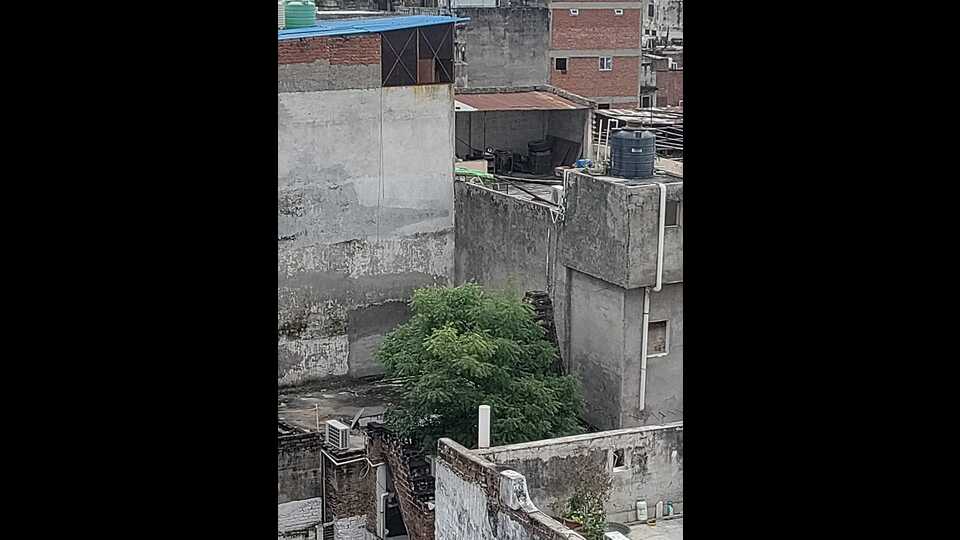
After over 200 years and encroachments blocking its way, a part of the city’s history seems to have been lost to time and narrates a story of neglect.
After Collins’s death, the tall structure became a landmark. Locals, then, referred to it as ‘Colonel ki Laat’, but with time, its name changed to ‘Kallan ki Lat’ or ‘Lat Kallan ki Lat’.
Old-timers said that the monument could be seen from a distance till the 1980s. They said the locality, which is also known by the same name, came up due to encroachment since the area was once a Christian cemetery. The only remnant of the cemetery is the 60-foot-tall obelisk, which now stays masked by buildings even taller than it.
“People say the whole area is Kallan ki Lat. But the actual obelisk is hidden, its approach blocked by houses,” said a resident. Only a few photographs taken from nearby rooftops in recent years prove that it still survives.
Heritage enthusiast Swapnil Rastogi said he first read about Collins’s grave in Parveen Talha’s book ‘Fida-e-Lucknow’. “When I went to see it, I found that one has to climb rooftops to even catch a glimpse. I managed to get a shot of the top of the monument and the engraving on the gravestone, buried inside a maze of houses,” he said.
Rastogi also pointed out that the obelisk is listed as a protected monument by the National Monument Authority, yet authorities have not stopped encroachments.
Historian P C Sarkar explained: “John Ulrich Collins joined the East India Company’s Bengal Infantry in 1770 and rose to the rank of Major after 24 years. He later became a Resident at Gwalior and was known for forcing the surrender of Wazir Ali, the fifth Nawab of Awadh, after Ali murdered George Cherry, a Resident of Benaras. Nicknamed “King Collins” for his strict nature, he served briefly as Resident at Lucknow before he died in 1807.”
“The obelisk over his grave was built by Nawab Sa’adat Ali Khan, who ruled Awadh at the time. At nearly 60 feet, it was once the tallest free-standing structure in Lucknow and gave the area its name. Over time, however, it was surrounded by shanties and later permanent houses, which now rise taller than the monument itself.”
Sarkar said the cemetery also contained the grave of Colonel Richard Wilcox, Royal Astronomer at Taron Wali Kothi, built by King Nasir-ud-Din Haider. “The obelisk is still there,” Sarkar said, “but its setting and visibility have been lost forever.”