
 E-Paper



Confirmed: It’s a tiger on Lucknow outskirts
A male tiger has been spotted near Lucknow, prompting increased monitoring by forest officials after a blue bull was hunted, raising local fears.


A male adult tiger is lurking on the outskirts of the state capital, forest officials confirmed. Finally, images of the big cat were captured on Monday, the fourth day of the forest department stepping up vigilance and monitoring after people of a village reported the hunting of a blue bull (nilgai) by a wild animal.
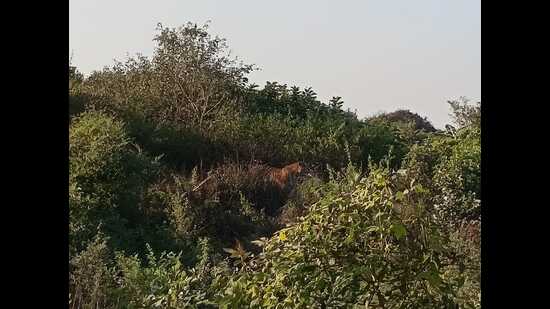
The fear of a tiger has gripped people here after a gap of 12 years as the last one that troubled them stayed in Rehmankheda for 108 days in 2012.
“A drone camera grab suggested that it is an adult male tiger,” said Sitanshu Pandey, the divisional forest officer (DFO) of Awadh range. The camera caught the wild animal in Gurudeenkheda village.
“Also, we have found more pugmarks with the help of the drone camera,” added the DFO.
Meanwhile, officials have increased monitoring in the area where the tiger was spotted with the thermal drone and camera traps. No human attack was reported ever since the animal was being chased by three forest teams.
Among the 12 camera traps deployed, a few were moved to the route where the tiger was spotted even as the drone camera, which is equipped with a thermal sensor, will be used during night hours as well to capture the big cat’s movement.
On Monday, forest staff were told about pugmarks found in Gram Sabha Karjhan. Upon reaching the said spot, the staff confirmed that they were of the tiger. Pugmarks found in Gohramau village were also confirmed to be of the animal. A team from Wildlife Trust of India too was in the area to coordinate with the state forest department.
“By using the drone camera day and night, we are trying to identify the path it took so far and its movement. Right now, we are not sure whether it is moving towards Rehmankheda or in the direction from where it came,” said Pandey.
“An ideal situation will be if the tiger returns to the forest from where it came. The second-best option is that it is rescued and left in a core forest area,” said a senior official of the forest department.
Lucknow, with over 45 lakh human dwellers, is fascinating for tigers also. The city is connected to a tiger corridor, which originates from Lakhimpur Kheri and passes through Shahjahanpur and Hardoi before reaching Lucknow along the Sharda Canal.
“Tigers, while on the move, stay longer at places with good prey base and habitat, and Lucknow has several such pockets, such as Rehmankheda. The killing of a blue bull (nilgai) is an example of why a tiger, if it at all is, may want to stay longer,” a senior forest officer, who has worked in the tiger and leopard corridors around Lucknow, had said earlier.
The last tiger seen around Lucknow was in 2022. The animal was approaching the state capital via Hardoi and was at the border when it went back. Forest teams were deployed, and increased activity and controlled fire in the area made the wild cat take the route back.
While tigers have just one route towards Lucknow, leopards, on the other hand, have several, including Unnao-Malesemau, Dubagga via River Gomti, and around Scooter India. Camera traps have recorded leopards at an average of once a week in 2021-22.
Also, forest staff had increased campaigning in half a dozen villages about the dos and don’ts in the wake of the tiger scare.


