
 E-Paper



‘Locked’ exit, extinguishers sans labels: Gaps in Lucknow hospitals’ emergency readiness
A day after the Jhansi incident, HT carries out a reality check of two major government health facilities in the state capital to check for their readiness in case of an emergency


At King’s George Medical University (KGMU) Trauma Centre, shoes, numbering dozens, laid before the fire exits of its Neonatal Intensive Care Unit (NICU). Over at Dr Shyama Prasad Mukherjee (Civil) Hospital, fire extinguishers hung on walls, but without any labels.
A day after 10 newborns were killed in a fire in Jhansi’s Maharani Laxmi Bai Medical College, a government-run facility, HT carried out a reality check of two of the major government health facilities in the state capital to check for their readiness in case of an emergency.
Not just shoes, people sitting before the exits blocked the seamless movement to and from the NICU at Trauma Centre. The unit is located in the building’s fourth floor.
Even more alarming was one of the gates of NICU, where critically-ill infants are treated, was locked. This could severely delay rescue efforts and endanger the lives of vulnerable patients during emergencies.
In the lobby outside NICU, 40-odd people loitered even as dozens of staff members entered and exited the ward frequently.
Dr. Somil Jaiswal, the in-charge of Trauma Centre, said all fire safety protocols at the hospital were being strictly followed in accordance with government regulations. He assured that fire extinguishers and hydrants located both inside and outside the building were regularly being maintained. “The hospital personnel undergo regular fire safety training, and a dedicated fire ramp is in place,” he noted.
Regarding the ‘locked’ exit door, Dr. Jaiswal said it was, in fact, not locked and was under the supervision of duty doctors at all times. He added that standard fire evacuation protocols were in place for ICUs to ensure swift action in the event of an emergency.
On hygiene on the premises, Dr. Jaiswal stated the hospital followed infection control protocols set by the hospital’s Infection Control Committee. He noted that stretchers were cleaned regularly under the supervision of the medical social service officer (MSSO).
The situation was equally concerning at Gandhi Ward, another building in KGMU. Two-wheelers were parked in front of the fire exit, blocking the designated emergency evacuation route. No hospital or security personnel were present to prevent the misuse of crucial spaces.
At Civil Hospital, fire extinguishers didn’t show labels that would have indicated their validity, raising questions about their functionality in an emergency. Additionally, water fire safety systems were being misused, with people using them as a storage box for their clothes and other belongings.
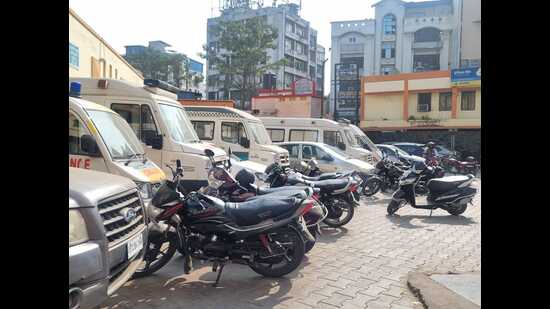
Ambulance accessibility was another major concern there. Vehicles were parked haphazardly around ambulances, blocking their movement. This situation could delay the emergency response times as the parked vehicles must be removed before any ambulance could be operated.
Dr. Rajesh Srivastava, the chief medical superintendent of Civil Hospital, said, “Fire extinguishers are refilled every year, and while there may be a delay of one or two months occasionally, we ensure they are well maintained. Most of the fire hydrants and water hoses have gone through maintenance.” He added regular fire safety protocols were being followed and the hospital staff were being trained regularly to handle fire-related emergencies effectively.


