
 E-Paper



Proposal to amend UP government’s policy to turn Ayodhya into solar city
Uttar Pradesh was considering changes in Solar Policy 2017 to provide more incentives to residents opting for rooftop solar panels in a bid to replicate the Ayodhya model in other cities of the state


Larsen & Toubro (L&T) is preparing a detailed project report (DPR) to transform the temple town of Ayodhya in Uttar Pradesh into a solar city, meeting its maximum electricity requirement including that of the Ram Temple Complex through green power, to be generated by rooftop solar panels, people dealing with the issue said.
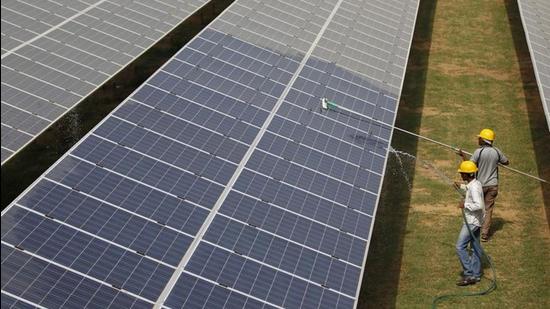
People mentioned above also said that the state government was considering changes in Solar Policy, 2017 to provide more incentives to residents opting for rooftop solar panels to replicate the Ayodhya model in other cities, especially those of religious importance.
“L&T is almost ready with the Ayodhya DPR, to convert the town into a solar city by installing solar panels on roofs of houses, government buildings, commercial and industrial establishments etc. This will be [done] on a pilot project basis in the first phase after which some other cities will also be identified for similar development,” Bhawani Singh Khangarot, director, Uttar Pradesh New and Renewable Energy Development Agency (UPNEDA) said.
An L&T survey found that Ayodhya’s 340,000 population, living in 81,000 households consume 281 million units of power annually.
“The NEDA is basically working on four things in Ayodhya, that is, solar generation from ground-mounted utility scale and solar plants, arranging solar cooking for community kitchens for devotees visiting the Ram Temple, fulfilling energy requirement of the Shriram Temple Complex from solar and other renewable sources,” Khangarot said.
Simultaneously, the NEDA has also proposed changes to the state’s solar policy, seeking more incentives to encourage people, government, semi-government and commercial bodies to install rooftop panels.
The NEDA has proposed enhancement of state subsidy on installation of rooftop solar panels in cities identified as future solar cities. Ajay Kumar, another NEDA official said that the enhanced state-subsidy should be in addition to the subsidy provided by the Central government.
“We have also proposed a net metering facility for government, semi-government buildings, commercial and industrial establishments that use grid-connected rooftop solar panels to generate power. The net metering will enable them to sell excess electricity to the UP Power Corporation Ltd (UPPCL)...,” he added.
Domestic and agriculture consumers already have the net metering facility. The UP Electricity Regulatory Commission (UPERC) did away with this facility for government buildings and commercial/industrial establishments in 2019.
The third proposal mooted by the NEDA seeks to solarise Nagar Nigams (municipal corporations) of identified cities. “According to the proposal, the Nagar Nigams will meet its energy needs for street lighting, water works etc from renewable power...,” Kumar said.
The amendment proposals, he said, have been sent to the government, which was likely to take a call on the issue soon.


