E-Paper



Yogi invokes Masuriyadin, hits out at Congress over freedom struggle legacy
“Rahul Gandhi should take note that Nehruji was not the only one who went to jail for the country’s freedom. Masuriyadinji also went to jail. He spent nine years in jail during his 66-67 years of life for spreading the spirit of freedom. Even after his release, he continued to raise public awareness,” Adityanath said at a public meeting at NRIPT ground.

 Prefer HTon Google


In what is seen as an attempt at Dalit outreach ahead of the 2027 Uttar Pradesh assembly elections, chief minister Yogi Adityanath on Thursday unveiled a statue of freedom fighter and four-time Congress MP Mahashay Masuriyadin Pasi in his birthplace, Prayagraj. The move brings a largely forgotten Dalit leader associated with the Congress back into the spotlight, while also giving Adityanath an opportunity to target the party.
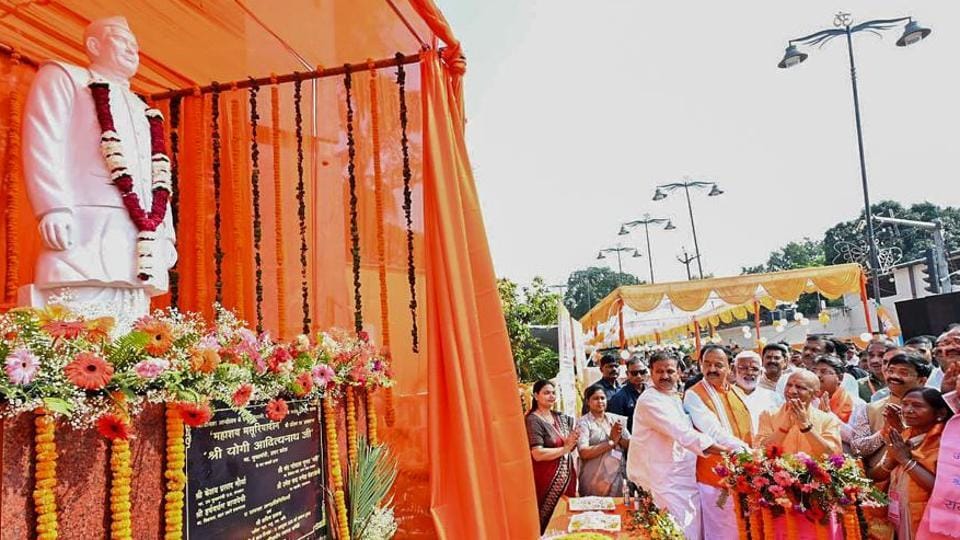
Unveiling the statue at Teliarganj crossing, the chief minister highlighted Masuriyadin’s role in the freedom struggle and his association with former Prime Minister Jawaharlal Nehru.
“Rahul Gandhi should take note that Nehruji was not the only one who went to jail for the country’s freedom. Masuriyadinji also went to jail. He spent nine years in jail during his 66-67 years of life for spreading the spirit of freedom. Even after his release, he continued to raise public awareness,” Adityanath said at a public meeting at NRIPT ground.
The chief minister said Masuriyadin, born on October 2, 1911, was elected to the Uttar Pradesh legislative assembly in 1946 and went on to become a four-time MP between 1952 and 1972. He recalled that Masuriyadin and Nehru were elected from the same constituency in 1952, when one seat returned two MPs.
Adityanath also announced two other initiatives aimed at honouring historical figures from the Pasi community. A women’s Provincial Armed Constabulary (PAC) battalion in Lucknow will be named after Uda Devi Pasi, who fought against the British during the 1857 uprising. An Industrial Training Institute (ITI) will be named after Bijli Pasi, a medieval ruler associated with the Lucknow region.
The three initiatives highlight the contributions of Pasi icons at a time when political parties are seeking to consolidate their support among Dalit communities in Uttar Pradesh.
Adityanath also highlighted Masuriyadin’s campaign against the Criminal Tribes Act of 1871, introduced during British rule, under which several communities, including the Pasis, faced discrimination and humiliation. He said Dr BR Ambedkar and Masuriyadin fought against the law and helped secure its abolition.
Announcing further recognition for the leader, the chief minister said Teliarganj crossing, where the statue was installed, would be named after Masuriyadin. He also asked the mayor to submit a proposal to name a prominent institution in Prayagraj after him and install a grand statue there.
“Society can progress only by honouring great personalities. Honouring the past can improve the present, and only by improving the present can the future be made brighter,” he said.
Historian and former Allahabad University professor Yogeshwar Tiwari said Masuriyadin had been jailed several times between 1932 and 1944 for participating in the freedom struggle. Tiwari said he took part in the Salt Satyagraha in 1930 and the national movements of 1940 and 1942.
Political scientist and former Allahabad University professor MP Dube said Masuriyadin was a prominent Dalit leader and a close associate of Nehru. The BJP’s emphasis on his association with the former PM, Dube said, could also challenge the Congress’s claim to the legacy of the freedom struggle.
Adityanath said his government had restored Bijli Pasi’s fort in Lucknow and was developing a women’s PAC battalion in Uda Devi’s name. He also referred to plans for an equestrian statue of the freedom fighter.
“Respect is not the inherited privilege of any family. Those who raised their voice for Dalits and the deprived and dedicated their lives to the nation and society deserve to be honoured,” he said.
The outreach comes as the BJP, Samajwadi Party and Congress seek to engage Pasi voters, while the Bahujan Samaj Party works to regain support among Dalits. The BJP has sought to consolidate its position among non-Jatav Dalits and non-Yadav OBCs, while the Samajwadi Party has promoted its PDA (Pichhda, Dalit, Alpsankhyak) coalition.
“The BJP, Samajwadi Party and Congress have all invoked Pasi icons in their Dalit outreach,” Dube said, adding that the commemoration offered an opportunity to link the community’s historical contributions with contemporary political representation.
Reacting to Adityanath’s announcements, Uttar Pradesh Congress president Aradhna Mishra said, “Remembering icons is a good thing, but the fact remains that in Uttar Pradesh, according to the NCRB data, the highest number of crimes are recorded against Dalit and Pasi community people. The government, beyond unveiling statues, needs to ensure people from these communities get the safety and rights they are currently deprived of.”
Deputy CM Keshav Prasad Maurya, Cabinet ministers Swatantra Dev Singh and Nand Gopal Gupta ‘Nandi’, mayor Ganesh Kesarwani, Phulpur MP Praveen Patel, MLAs and other public representatives attended the event. Masuriyadin’s daughter, Kamla Kumari, and grandson, Sachin Kumar, were also present.