
 E-Paper



5th straight day of heavy rain cripples Mumbai
The city received more than 200 mm of rain in just 11 hours between 4 am and 3 pm on Tuesday, according to the Brihanmumbai Municipal Corporation (BMC).


Mumbai: Heavy rain continued to pound Mumbai for the fifth consecutive day, with several areas recording over 300 mm of rain in the 24 hours ending 8.30 am on Tuesday. The relentless downpour led to rampant waterlogging, crippling public transport networks and disrupting life across the city.
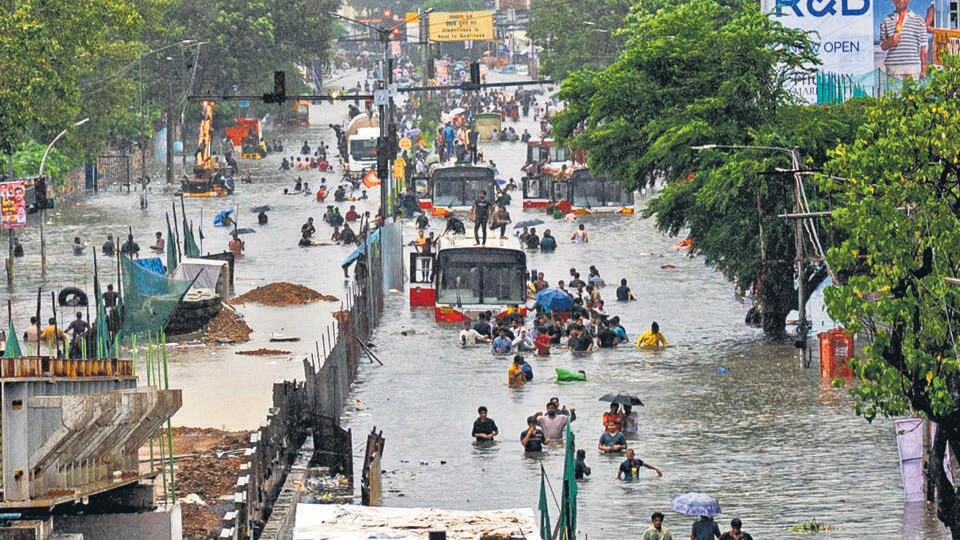
While the deluge did not claim any lives on Tuesday despite several cases of tree falls, wall collapses, and short circuits being reported, an unidentified man who fell into a nullah in Damu Nagar, Kandivali, was still missing at the time of going to press. Search operations were called off in the evening after it became dark, according to the Mumbai fire brigade.
The cumulative rainfall recorded at the India Meteorological Department’s (IMD’s) Santacruz observatory in the month of August so far is already 954 mm. With 12 days of the month still to go, this is already the second-wettest August Mumbai has seen in the last decade, with only the 1,240 mm recorded in 2020 topping it.
The city received more than 200 mm of rain in just 11 hours between 4 am and 3 pm on Tuesday, according to the Brihanmumbai Municipal Corporation (BMC). The high tide, reaching 3.75 metres at 9:16 am, added to the complications and caused the Mithi River to swell to dangerous levels, leading the authorities to move nearly 350 people from Kurla’s Kranti Nagar to safer locations.
LBS Road in Kurla had water over waist level, forcing commuters to push their bikes through. The nose of a bus was seen submerged in the water and a car lay bobbing on the road, even as people scurried to find shelter. “The water started collecting from 7 am and stayed till 2 pm,” said Asif Ghane, a resident of Kurla. “All vehicles passing, cars and buses, were failing, and people were getting stranded, especially those trying to reach Bandra Terminus.”
Central Railway suspended its local train services on the harbour line between Chhatrapati Shivaji Maharaj Terminus (CSMT) and Kurla stations due to a section of the tracks being submerged, officials said. More than 500 passengers were rescued on Tuesday evening after two overcrowded monorail trains on elevated tracks got stuck between stations, with over a dozen passengers complaining of suffocation, officials said. At least eight flights were diverted, and many were delayed at the Chhatrapati Shivaji Maharaj International Airport.
Incessant downpour
Rain had been pelting the city through the night and into the morning. In the 24-hour period ending at 8.30 am on Tuesday, Mumbai’s weather stations crossed the extremely heavy rainfall mark, logging 238 mm at Santacruz and 110.4 mm at Colaba. Several areas breached the 300 mm mark, including Dadar, Versova, Kandivali, Malad, and Magathane.
Schools, colleges, government and semi-government offices remained shut on Tuesday, while the Mumbai police appealed to residents to step out of homes only if necessary and also requested the private sector to allow work from home.
This turned out to be prudent, as waterlogging was reported in areas such as Gandhi Market, Sion, Hindmata, Dadar TT, and Wadala in central Mumbai; Veera Desai Road, Lokhandwala Circle, Mahakali Caves Road and Link Road in the western suburbs; Vikhroli, Powai and Chandivali in the eastern suburbs. The Andheri Subway and Malad Subway were shut fairly early, as was the Elphinstone Bridge due to flooding at the Parel side.
Vikhroli was one of the spots that saw the highest quantum of rainfall over the day (see box). The rain made a mockery of the newly inaugurated Vikhroli East-West bridge, which was waterlogged. The BMC temporarily evacuated residents in the landslide-prone areas of Vikhroli, Suryanagar, and Khindipada in Bhandup into an SRA building and provided food for them. A massive tree fell on 10-12 autorickshaws on Bhandup Lake road, but fortunately caused no injuries.
Over the day, from 8 am to 6 pm, several spots had received rainfall in excess of 150 mm, but none had crossed the 200 mm mark. The spots that recorded the highest rainfall included Vikhroli, Marol, Chakala, Andheri, Powai, Dadar, Sewri, Sion, and Wadala. Towards the evening, as the rainfall trickled with occasional bouts, the civic body had managed to drain out the water from the waterlogged spots, including Hindmata, Gandhi Market, Andheri Subway, Khar Subway, and more.
Forecast for next 2 days
The IMD expects the rain to subside starting Wednesday. The force behind the downpour in the last five days—a depression formed off the coast of Andhra Pradesh—has moved and reduced into a well-marked low-pressure zone.
“The weather systems that brought the heavy downpour have moved, so the situation in the city will be better,” said Sushma Nair, scientist at IMD. “The monsoon trough now passes through Diu, Surat, Nandurbar, and Amravati.”
Mumbai, Palghar, Thane and Ratnagiri have been placed under an orange alert (heavy to very heavy rainfall at a few places) for Wednesday and a yellow alert (heavy rainfall at isolated places) for Thursday, while Raigad continues to remain under red alert (heavy to very heavy rainfall at a few places and extremely heavy rainfall at isolated places) till Wednesday.

Stay updated with all the Breaking News and Latest News from Mumbai. Click here for comprehensive coverage of top Cities including Bengaluru, Delhi, Hyderabad, and more across India along with Stay informed on the latest happenings in World News.


