
 E-Paper



80 years of US-Indian dosti celebrated through music, dance, memories
Dosti House in Mumbai celebrated 80 years of US-India partnership, highlighting cultural exchanges and the role of art in strengthening ties.

 Prefer HTon Google


MUMBAI: Dosti House in Bandra-Kurla Complex, formerly known as the American Centre—which was then situated in South Mumbai—celebrated 80 years of US-India partnership on Tuesday evening. Opening its doors in 1944, the Centre has since worked on fostering a deeper friendship between the US and India.
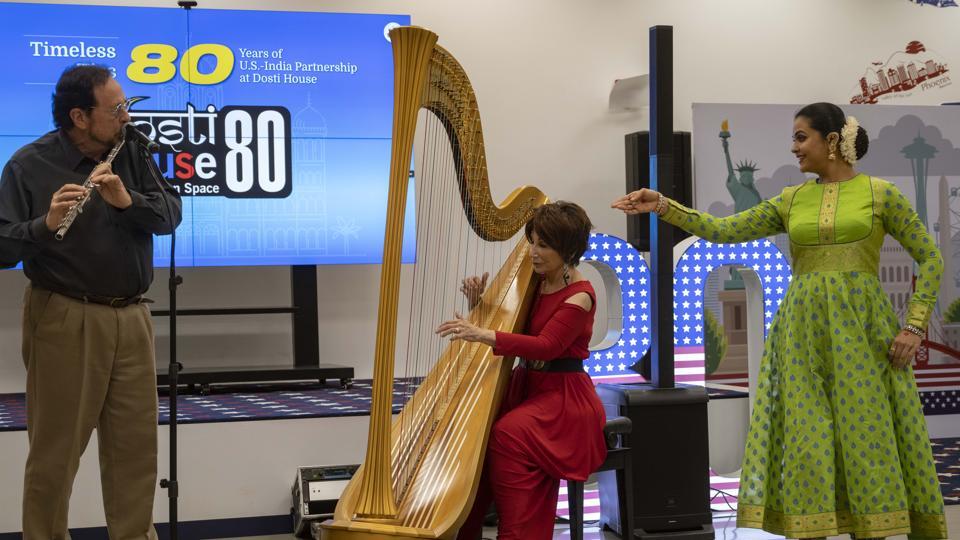
While Dosti House is primarily a library, it offers much more, serving as “an American space in India”. “Dosti House is a space where Americans and Indians can come together to exchange ideas. It’s our way of strengthening ties between our two countries,” said Greg Pardo, the spokesperson of the US consulate-general.
Among the events hosted at the space are cultural performances, panels on issues like women’s economic empowerment and human rights, training workshops for the youth in subjects ranging from entrepreneurship to film direction and more. The library also has the latest facilities such as 3D printers and virtual reality glasses. “We are leveraging innovation to create equitable opportunity for connectivity and learning,” said Gloria Berbena, minister-counsellor for public diplomacy at the US embassy.
For the 80-year celebrations, the library transformed into a space for bonding over art and culture and sharing memories and experiences. After a lively performance of Gloria Gaynor’s ‘I will survive’ by a band of diplomats, the event proceeded to the Indian experience at Dosti House. Justice Roshan S Dalvi, poet-author Rochelle Potkar, regular library visitor Priyanka Yadav and English literature teacher at K C College Kavita Peter spoke about their unique experiences at, and strong bond with, the library.
Justice Dalvi spoke about her love for books and shared stories of borrowing books from the space while Potkar detailed the story of being a writer at the fall residency of the University of Iowa’s International Writing Program. Yadav stressed on the energetic vibe of the library and Peter talked about the student visits she’d arranged to the library.
The highlight of the event was a performance by harpist Dr Susan Mazer, woodwind performer Dallas Smith and kathak dancer Aditi Bhagwat. The husband-wife duo played their instruments with energy and expertise, while Bhagwat interpreted their sounds and fit the Indian classical dance form into them.
Mazer said she started learning the harp in high school in Detroit, Michigan, which has the largest harp department in the country. “It’s a very seductive, beautiful instrument,” she said. “I wasn’t very good at it. It didn’t come naturally to me. It’s probably the most challenging thing I’ve done. And I’ve played for six decades.” After losing out on a job in an orchestra, she switched to jazz, which she also performed that day.
Through their music, the duo meditated upon the power of art to erase the barriers between nationalities and cultures and to build bridges between people, given the inherent universality of art. Smith has experienced this power of art to build connections first-hand, recalling his time at the Ali Akbar College of Music in California. “That’s where I met Zakir Hussain. Since then, I’ve looked at music as a way of creating a bridge between India and America,” he said. “Zakir played with all kinds of musicians. And that’s just an example of how art can erase boundaries and barriers.”
Bhagwat danced delicately and elegantly to the tune of the couple’s soulful and playful jazz. The dancer, who has been performing kathak for the past 35 years, had a simple process when putting kathak to jazz. “The first thing was to understand the music, respect culture and their musical sensibilities,” she said. “I tried to find similarities but I also highlighted the aspects that are so dissimilar that they deserve to be focused upon.”
The dancer actively works with a broad range of musical styles like flamenco, Korean music and lavni. She has also trained in Odissi for a decade, which affords her a greater flexibility and dictionary of body language to play with. “You can play with more creative nuances if you observe multiple styles and imbibe various disciplines,” she said.
Much like the performance that was a coming together of the two distinctly different art forms of jazz and Kathak, the evening itself was a celebration of India-US friendship. While consulates normally mean visas, politics and diplomacy, the event at Dosti House reminded one of the role of culture in binding these ties and connecting the common person with a different culture. “Art is basically the glue that holds our two countries together,” said Pardo. “We always talk about economic ties and security ties but the people-to-people ties are so important. Art is a window into somebody’s society, which binds those human ties together.”


