
 E-Paper



Diwali crackers raise AQI to 211, showers bring respite from heat
This was for the first time since the withdrawal of the monsoon on October 10 that the city’s overall AQI plummeted into the ‘poor’ category


MUMBAI: The large-scale bursting of firecrackers throughout the city in the intervening night of Monday and Tuesday, which was Day 1 of Diwali, significantly affected the air quality in many locations.
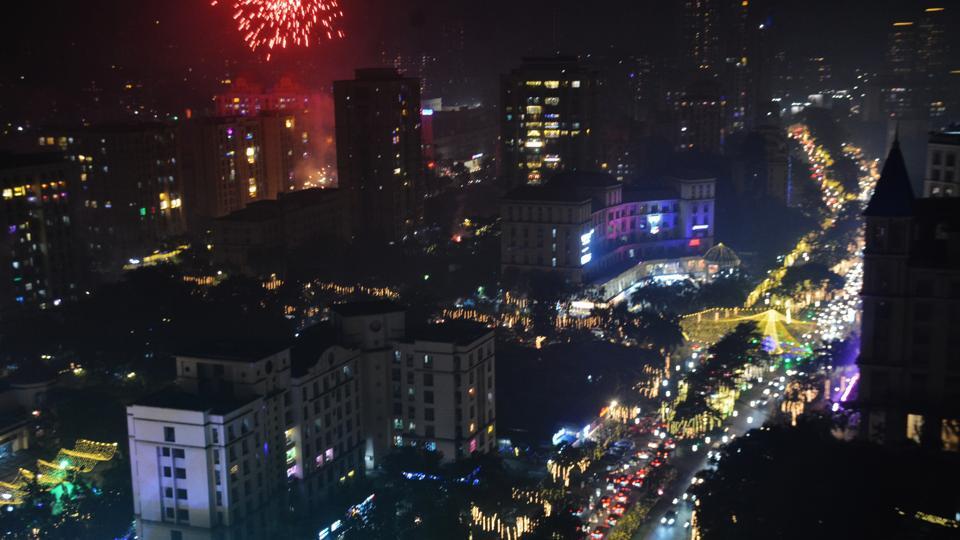
According to the 24-hour bulletin issued by the Central Pollution Control Board (CPCB), the average air quality index (AQI) in Mumbai stood at 211, which is in the poor category. This was also for the first time since the withdrawal of the monsoon on October 10 that the city’s overall AQI plummeted into this category.
The overall AQI was an average of the readings in 28 of the 30 continuous ambient air quality monitoring systems (CAAQMS) placed throughout the city. The grading in Bandra-Kurla Complex was ‘very poor’ for the second consecutive day, as it logged an AQI of 374, nearing the last category in the grading system of the CPCB. In fact, AQI levels in the commercial district touched 500 between 2 am and 4 am. Navy Nagar in Colaba too crossed the 300-mark, recording an AQI of 324.
Eleven stations were in the ‘poor’ category while the rest remained ‘moderate’. Mazgaon (294), Malad West (283), Deonar (269) were seen to be plummeting, closing in on the ‘very poor’ category.
The significant dip in air quality was expected due to the copious amounts of crackers being burst. “The crackers contain all the chemical compounds that are harmful to people and their health. They cause uneasiness, difficulty breathing and have several health implications,” said Sumaira Abdulali, founder of Awaaz Foundation, an environmental organisation. Many of the chemicals have been specifically banned by the Supreme Court and under the Hazardous Chemical Rules.
The city experienced post-monsoon showers on Tuesday, light drizzles that brought a relief from the incessant heat. An official from IMD Mumbai said that the trough and easterly winds across Maharashtra at the lower levels had caused moisture incursion and the higher temperatures had favoured thunderstorm development and rainfall over interior Maharashtra and Konkan. However, there was no immediate significant impact on the air quality.
According to the data from the BMC’s automatic weather system, Dharavi logged 19 mm of rainfall in the city, S ward in the eastern suburbs logged 15 mm, Powai logged 11 mm and Goregaon in the western suburbs logged 16 mm in one hour on Tuesday between 6 pm and 7 pm. According to the seven-day forecast of the India Meteorological Department, the sky will remain clear till October 24, after which there is a possibility of light showers and thunderstorms from October 25-27.
While the maximum temperatures in both the Santacruz and Colaba stations remained in the forecasted range of 35 degrees Celsius and 34.4 degrees Celsius respectively, the minimum temperature was 24.6 degree Celsius and 26.4 degree Celsius respectively.

Stay updated with all the Breaking News and Latest News from Mumbai. Click here for comprehensive coverage of top Cities including Bengaluru, Delhi, Hyderabad, and more across India along with Stay informed on the latest happenings in World News.


