
 E-Paper



Mayor’s Bangladeshi crackdown puts spotlight on Mumbai’s illegal hawkers,mafia and policy failures
While the mayor’s crackdown has triggered action against suspected Bangladeshi illegal hawkers, hawkers’ unions argue that the deeper issue lies in policy failures and non-implementation of the Protection of Livelihood of Street Vendors Act (2014)

 Prefer HTon Google


MUMBAI: The recent Bangladeshi illegal hawker drive launched by Mumbai mayor Ritu Tawde, a top priority crackdown aimed at identifying and removing illegal hawkers especially suspected Bangladeshi nationals from the city’s footpaths and public spaces, has brought Mumbai’s long-standing hawker crisis into sharp focus.
What began as a targeted crackdown on suspected infiltrators has opened up a Pandora’s box around illegal hawkers, hawker mafia networks, poor implementation of the Protection of Livelihood of Street Vendors Act, 2014, and the lack of administrative and political will to regulate the sector, even after a senior civic official attempted to put a structured identification system in place in February 2020.
BJP senior leader and whistleblower in the Bangladeshi hawker mafia issue, Kirit Somaiya clarified that the drive is aimed at illegal infiltration.
“Let me clarify. The objection isn’t against Bangladeshis but if they are infiltrators without the requisite documents, then they become a threat,” Somaiya told HT.
He said the Brihanmumbai Municipal Corporation (BMC) has a clear duty to identify such illegal hawkers and inspections have revealed organised hawker mafia networks operating with questionable documentation.
“We are separating two things. Illegal hawkers who are unauthorised and they are capturing all open spaces illegally. They are also coming out with structures like handcarts and it is BMC duty to rein them in,” he said.
Somaiya added that BJP corporators have demanded a mass cleanup of railway station areas and other key zones following citizen complaints.
“The issue is BMC doesn’t have an official register of licensed vendors. The BMC has created a myth that there are 32,000 licensed hawkers. They are deceiving the court and the people. Only some thousands have got licenses. The rest are illegal. That’s why the hawker mafia and BMC staff and police are all coming under pressure,” he added.
While the mayor’s crackdown has triggered action against suspected Bangladeshi illegal hawkers, hawkers’ unions argue that the deeper issue lies in policy failures and non-implementation of the Protection of Livelihood of Street Vendors Act(2014). Shashank Rao, president of the Mumbai Hawkers’ Union, said action against illegal immigrants is necessary but the broader context of hawker regulation must also be considered.
“Proper action needs to be taken against Bangladeshi immigrants. There are no two ways about it. If there are any such illegal hawkers or in any field they have to be identified and the government authorities have to take action. Whether they are hawking or anywhere else, illegal immigrants have to go,” Rao said.
Tracing the history of hawking in Mumbai, Rao said licences were first issued nearly four decades ago to around 15,000 vendors, including 123 at Fashion Street in 1970s. “These were earlier hawkers near the Gateway of India and Mumbai Hawkers’ Union moved Bombay High Court and they were then shifted near Museum in Fort and later to Fashion Street. Maximum people started with the cloth business which grew and now there are unlicensed hawkers there too,” he said.
According to Rao, the crisis stems from poor implementation of the 2014 Street Vendors Act and failure to conduct regular surveys.
“In 2014, a survey was conducted where 99,000 forms were given and 15,000 were recognised as hawkers. Later the list increased to 22,000 and now finally to 32,000. But the Act clearly states whoever is hawking has to be identified and given space and the state government should formulate a policy,” he said.
He pointed out that subsequently after the Elphinstone Road stampede in 2017, hawkers were to be kept 100 metres away from railway stations, hospitals and educational institutions, but implementation remained unclear.
“In Mumbai there are hardly any footpaths more than 10 feet. So where will these people sit?” Rao asked.
He added that the Act mandates surveys every five years, but none have been conducted since 2014. “So now BMC is claiming all are illegal. The point is BMC officials are not following the Act properly and the policy clearly states not to displace them but to protect their livelihoods,” he said.
Rao also highlighted the data mismatch, noting that as per the Act hawkers should be 2.5% of the city’s population.
“According to the 2011 census, Mumbai has 1.40 crore population. So ideally there should be at least 3 lakh hawkers allowed. But licensed vendors recognised are only 32,000,” he said, also citing the 2002–03 Tata Institute of Social Sciences (TISS) survey that identified 1.05 lakh hawkers.
Then came the PM SVANidhi Yojana during the COVID-19 pandemic which further exposed discrepancies in BMC data, Rao said.
“BMC gave letters of recommendation(LOR) to more than 1.65 lakh hawkers and 1.40 lakh took loans. But only 32,000 are recognised as legal vendors. They are just taking common people and hawkers for a ride and officials are misguiding the government,” he said.
He added that the issue should be viewed as a socio-economic problem as unemployment and lack of livelihood opportunities have pushed more people into hawking.
“Hawkers increase in number because they don’t have a job or livelihood. Even people from middle-class homes are now selling food and homemade wares.”
Rao also attributed the failure to resolve the issue to the entrenched hafta system.
“Because officers get hafta there is no intent to resolve this issue. Whenever Bombay High Court pulls up,a piecemeal action is initiated and after the drive illegal hawkers return again,” he said.
Veteran civic activist Aftab Siddique, who was part of the town vending committee in H West ward, echoed this view, saying, “Political parties, civic officials, police and the entire nexus benefit from illegal hawkers and the hafta system,” adding that during Ramzan, hawkers paid between ₹5,000 and ₹15,000 per box as hafta for ten nights.
Rao stressed that recognition and regulation are key to solving the problem. “The hawkers also want to run their livelihood peacefully. Unless you recognise them how can you discipline them? The common Mumbaikar is suffering because this issue isn’t streamlined. The first step is to recognise them as hawkers and then have dedicated hawking zones and then only can they be regulated. The BMC says they cannot erect so many pitches. It is their problem to carve out pitches,” he added.
The crackdown has also exposed other illegal hawker networks.
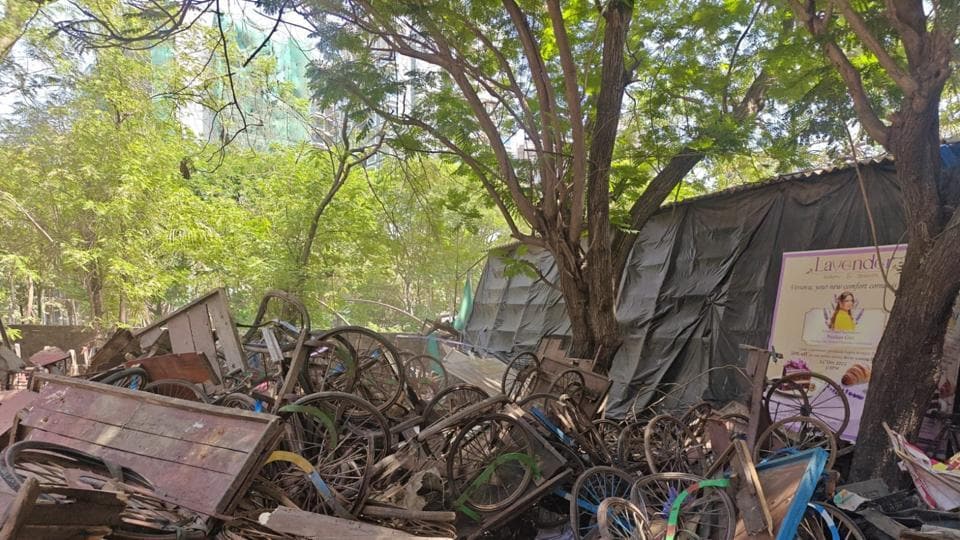
In K West ward, assistant municipal commissioner Chakrapani Alle said, “Some 200 handcarts were seized last week from Yari road, Versova and Seven Bungalows. Most handcarts were used to sell Chinese food, vegetables, fruits and readymade garments.”
A handcart puller from Andheri West, Abdul Rehman (name changed), said, “Handcarts are bought on rental at Rs400-Rs500 per day. A civic official from the ward in collaboration with a handcarts’ owner gives us a handcart on rent. We sell vegetables and fruits on it.”
A Linking Road unlicensed hawker Junaid Sheikh added, “I cannot afford a stall. I pay hafta to the local area footpath mafia to sell my wares. Rozi roti ka sawaal hai. Hafta dena padta hai.”
Licensed stall owners have also objected to being clubbed with hawkers.
Civic officials from license department opined about how even licensed stall owners were renting their stalls to third parties.
Faisal Qureshi, president of the Linking Road Stall Owners Association, said, “There are 4,120 licensed stall owners in the city and licensed stall owners do not give their stalls on rent to anybody else. Some stall owners are octogenarians who allow relatives to run stalls. There is no denial that a few cases exist but it isn’t in majority.” He added that stalls were legally purchased decades ago and stamp duty was paid there is no harm in renting it to third parties.
Retired former deputy municipal commissioner DK Jain, who attempted a comprehensive reform in 2020, said the intention was to introduce a smart identification system for hawkers.
“The intention was to devise a system with smart ID for hawkers where an illegal hawker could be immediately identified. BMC was to issue bar-coded identity cards to eligible hawkers and streets were bifurcated.Pink for garments, green street for vegetables and so on,” Jain said.
However, during the Uddhav Thackeray’s Maha Vikas Aghadi government’s tenure, the exercise was stalled after political parties objected over lack of corporator representation in the town vending committee, and the system was never implemented.
Despite the ongoing crackdown, Rao maintained that both issues must be addressed simultaneously.
Bangladeshi illegal immigrant hawkers should be identified and sent back, he said, but Indian citizens must be recognised as hawkers under the Street Vendors Act.
The 32000 figure must be relooked from a humanitarian aspect, considering the burgeoning population addressing the unemployment issue.
Experts say the final solution lies in full implementation of the 2014 Act through regular surveys every five years, recognition of hawkers based on population norms, creation of designated hawking zones and issuance of process of identity cards to hawkers.
As the mayor’s crackdown gathers momentum, the larger reality remains that Mumbai’s hawker problem is no longer just about Bangladeshi infiltrators or illegal vendors, but about a deeply entrenched system where policy exists, reforms have been attempted, yet the absence of administrative and political will continues to keep the issue unresolved.

Stay updated with all the Breaking News and Latest News from Mumbai. Click here for comprehensive coverage of top Cities including Bengaluru, Delhi, Hyderabad, and more across India along with Stay informed on the latest happenings in World News.


