
 E-Paper



Mumbai: Chimbai fisherfolk clash over infrastructure development
The ₹8.5-crore project, which involves expansion of an existing jetty, construction of two new boatyards and two new net mending shelters, has also drawn the ire of environmentalists who said the work is in violation of permissions granted under the Coastal Regulatory Zone (CRZ) rules.


Fisherfolk from Chimbai village in Bandra (West) have gotten into a heated dispute over the ongoing infrastructure development work along their waterfront executed by the fisheries department. The ₹8.5-crore project, which involves expansion of an existing jetty, construction of two new boatyards and two new net mending shelters, has also drawn the ire of environmentalists who said the work is in violation of permissions granted under the Coastal Regulatory Zone (CRZ) rules.
The Maharashtra Coastal Zone Management Authority (MCZMA) had, on February 26, 2019, recommended the fisheries department’s proposal for CRZ clearance while the construction work commenced in August 2019. The project is being funded by the Central government and involves developing “infrastructural post harvesting facilities” at 10 different fish landing sites in the state. A rapid environment impact assessment (EIA) report carried out for the same noted that the work would “fulfil long-standing demand of about 2,525 fisherfolk residents in Chimbai”.
While the project has faced opposition from a majority of fisherfolk, a smaller group of Chimbai residents — recently organised into the government registered Chimbai East Indian Koli Samaj Sanstha which claims to represent around 85 individuals — have supported the project. Revamping the existing infrastructure, they said, is necessary to revitalise trade in the village, particularly during the economic downturn after Covid-19.
Residents highlight environmental concerns
The majority of residents HT spoke with maintained that they have never made such a demand in the first place. “There are not even 150 fishing boats left here anymore. This project will only damage our small beach further,” said Prakash Chimbaikar, whose family has been fishing at Chimbai for at least three generations. “Because of the jetty expansion and blasting of rocks to make way for the boatyard, the water is already coming further into the village during high tide. The boatyard is being constructed over rocks that halt the water from reaching our homes. Even the jetty expansion has been done in a way which does not allow water to flow back out as quickly during low tide,” he added.
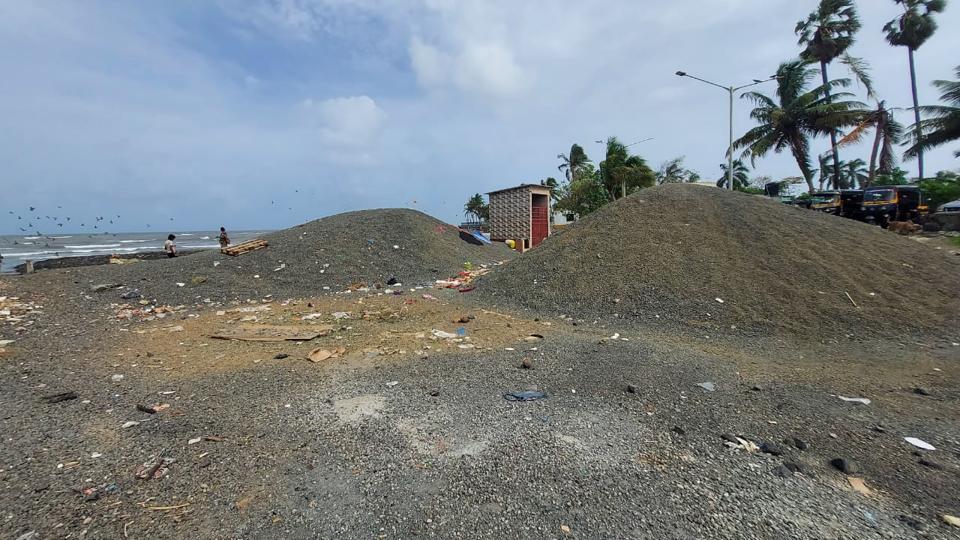
In a petition filed earlier this year before the National Green Tribunal (NGT) by Chimbai resident Maria Thelma against MCZMA, it has been noted that the scale of proposed amenities are “entirely disproportionate to the needs of the local community”, and are best “avoided at all costs due to the fragility of the geomorphic features of the intertidal rocky areas and mangroves in the region”. The petition also alleges that construction debris and raw materials are being dumped wantonly inside CRZ-I areas, which an HT team found to be true during multiple site visits in the past month.
Speaking to HT, Thelma also said construction material was being stored in a common area that was earlier used for net mending and fish drying. “Ever since the work began, we are not able to use the area for drying fish. The area also touches a mangrove patch. The contractor has made sheds there for his staff and parks his machinery on site. Who has allowed our common areas to be taken over like this? Where is the permission?” she said.
Project violates terms of clearance: Activists
The ongoing work in Chimbai has also come under the scanner of environmentalists who first wrote to authorities in January this year, pointing out lapses in the governance and execution of the project. The two proposed boatyards, as per the fisheries department’s layout plans, will involve reclamation of 45,000 sq ft of intertidal zone on the sea-ward side of Chimbai village, which is a CRZ-III area.
These areas are marked as no development zones as per the CRZ Notification, 2011, and exceptions may be permitted only for reconstruction of “dwelling units of traditional coastal communities”, as per the CRZ rules.
“About 190 metres of the 300-metre beach will be taken up by the project. This leaves very little open space left, and there has not been any detailed study on how the tidal influence will change. The way the project has been executed is quite shabby. Even MCZMA when granting clearance did not seem to be aware of the scale of the project. This increases room for violations which, as we can see, has already happened. Old, natural rocks which act as protective barrier between the sea and people’s homes have been destroyed,” said environmentalist Zoru Bhatena, who had first written to MCZMA in January this year, highlighting the project’s ecological impact.
A perusal of the rapid EIA report prepared for the project, too, shows glaring lapses in the consultant’s risk assessment methods. For example, the report uses tidal pattern data not of Chimbai village but that of Apollo Bunder in Colaba when assessing the project’s risks on flow of tide water. “This is a blunder. Changes in the tide can completely change how we park and anchor our boats. If the flow becomes more intense, our boats will get damaged in choppy weather,” said Brian Falcon, a fisherman from Chimbai.
Despite attempts, HT was unable to reach Narendra Toke director, environment and member secretary of MCZMA, for a comment. A fisheries officer privy to the project, requesting anonymity, said, “We have all permissions for the project. NGT has not stayed the work either, and has appointed a monitoring committee with members of the environment ministry and state pollution control board. Any queries should be taken up with them.”
Infrastructure needed to revitalise fishing community
Despite the attendant environmental repercussions, not all residents are opposed to the development. Daven Kandoriya, chairman of Chimbai Matsyodyog Vividh Karyakari Sanstha and president of Chimbai East Indian Koli Samaj, said the development was essential for reviving the practice of artisanal fishing among the local community.
“A boatyard will enable us to buy bigger boats, and we can also earn revenue by renting out the area for cultural events and festivals. We could start our own Koli food festival, establish a fish market and so on. It’s not as if we do not have adequate infrastructure today, but given the economic downturn and job squeeze, more people are coming back to fishing instead of doing other kinds of jobs. We need to be able to provide them with support,” said Kandoriya.
Alan Misquita, 40, a fisherman from Chimbai, said the village currently suffers from a shortage of public space where the community can gather to conduct trade and discuss related affairs. “What is being built will continue to belong to the entire community. We have also asked for a third dhakka to be built. Each of the three Koli communities — Catholic, Maharastrian and Kathiyawadi — can have their own fish landing. We are acting in everyone’s interest,” he clarified.
Asked if they were cognisant of the possible ecological ramifications of the proposed works, Kandoriya, Misquita and other members of the Samaj expressed faith in a recent order of NGT which allowed the work to continue while disposing Thelma’s petition. “The matter has been dismissed once earlier by the high court in January. If the courts had seen merit in their argument, we would have accepted. What some residents do not seem to understand is that if we cannot show enough infrastructure, tomorrow the village may get placed in some slum rehabilitation scheme. We are only trying to protect the koliwada,” said Valley Quadros, 46.


