
 E-Paper



Pandemic tested creativity, was an opportunity to learn, says Kakani
For the past two years, Kakani has been at the forefront of Mumbai’s Covid management and played a significant role in the city’s fight against the pandemic


Mumbai After two and a half years of handling the municipal corporation’s public health department through the pandemic, additional municipal commissioner Suresh Kakani will retire on Friday.
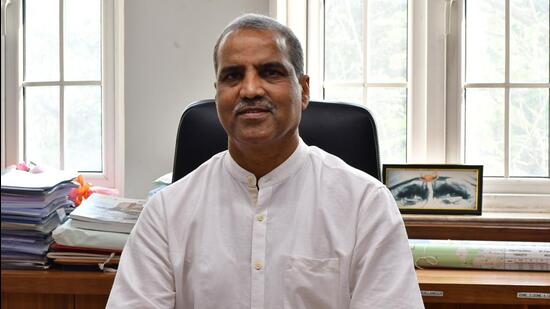
For the past two years, Kakani has been at the forefront of Mumbai’s Covid management and played a significant role in the city’s fight against the pandemic.
An Indian Administrative Service (IAS) officer of the 2003 batch, Kakani also worked in various government departments and as managing director of Maharashtra Airport Development Corporation. He was instrumental in the successful operation of Shirdi International Airport, commercialisation of Nagpur Airport, promotion of Purandar (Pune), Amravati and Chandrapur airports and completion of civil aviation policy.
In December 2019, he was appointed as additional municipal commissioner of the BMC, where he was handling the health department and played a crucial role in handling all three waves of Covid in Mumbai.
Q) Are we prepared infrastructure-wise and procedure-wise to handle the next pandemic?
A) Yes and No.
Yes, because we have all the systems in place. In 15 days, we can develop a hospital and use it for isolation (in-case of another pandemic). And no, because each pandemic is different and we are not sure what we may have to deal with next. For example, it may or may not require an isolation facility.
Few years ago, all our hospitals were flooded with malaria cases. In that case, jumbo hospitals won’t work. But we have learnt that makeshift hospitals can be created in no time, or semi-permanent facilities like Richardson and Crudas in Byculla, or Mulund jumbo facility or NCSI jumbo facility, can be makeshift hospitals. In case of a future pandemic, the last-minute rush will always be there, because we cannot keep our makeshift hospitals idle in a non-pandemic time.
Q) What did the crisis teach you about managing the city?
A) The pandemic has been an opportunity to prepare and learn. It tested our creativity. We managed to sail through it due to team effort, active governance, and timely tackling of all issues. Our most important learning is research, which equips you to stay ahead of the issue, helps you anticipate what is to come and prepare accordingly. We learned to always be ready.
We also made deliberate attempts to showcase to the world that yes, we have the capacity, and we are prepared. Instead of saying we are trying, we led.
Q) The biggest lessons from the first wave – in hospitals, management and data collection?
The first wave was the worst as nothing was certain. Nobody knew what the protocol was, what management was required, what line of treatment was needed to be followed. Nothing was ready and on board. The biggest lesson is integration. We could achieve this only because of integration of the primary, secondary and tertiary health centres. The second lesson is channelisation of efforts in the direction at hand and ideation.
Q) What changed after the first wave for us?
A) During the first wave, we did not know how many patients we were going to see. So, for the initial one month, our focus was on limited hospitals. Then subsequently, we tried to reclaim our peripheral and major hospitals. But even after roping them in, we could not substantially increase the number of beds as they were being used for non-Covid services. It was a difficult task to ask them to be discharged on such short notice.
Hence, the number of beds generated even otherwise were not more than 2,000, including peripheral hospitals. That’s how we came up with the idea of having field hospitals, and the first one at NSCI was built, then at BKC. As these two hospitals were successful, then we roped in Seven Hills, and NESCO, along with Mulund and Dahisar.
Initially these hospitals were quarantine centres, but eventually we realised ICU and oxygen requirement was increasing, and instead of shifting patients to major hospitals, we decided that jumbo centres will be given this facility. That became a game changer for us.
Q) As an officer heading the public health department of BMC, didn’t you have to bring a lot of discipline to handle the pandemic?
A) The collective experience and vision was responsible for the discipline. After struggling for the first one month, we were able to anticipate what could happen in Mumbai.
So, we started drafting our policies accordingly, in advance, and remained ahead while tackling the issues. And we focused on the implementation of these policies. We took some hard decisions too, such as lodging FIRs on hospitals who were overcharging, which all came together and contributed toward our standard operating procedure (SOP).
Q) Who are the people you could not have done this without?
A) It is not possible to name a handful or a few. It has been the collective effort of every person involved. For example, our community health volunteers were crucial in reaching out to every house as part of the ‘My family my responsibility’. The ambulance operators, war room officers, practically every one contributed majorly to this fight.
Q) What are your plans for the future?
A) I have the energy and enthusiasm to do more work. There will be more avenues. This was my first stint in the health sector. I have never worked in this sector before the pandemic. I was in infrastructure, disaster management and revenue. Every sector is a learning experience, and working keeps my energy very high. If you are learning continuously, then there is no scope to sit back and relax.
Stay updated with all the Breaking News and Latest News from Mumbai. Click here for comprehensive coverage of top Cities including Bengaluru, Delhi, Hyderabad, and more across India along with Stay informed on the latest happenings in World News.


