
 E-Paper



Parts of state see power outage owing to strike, shortfall in supply
The shortfall in power supply owing to the rise in demand caused by the soaring temperatures and the strike by power sector employees led to load-shedding in a few parts of the state on Tuesday


The shortfall in power supply owing to the rise in demand caused by the soaring temperatures and the strike by power sector employees led to load-shedding in a few parts of the state on Tuesday. The second day of the two-day strike by workers from the state-run power utilities passed off without any major disruptions in electricity generation and supply.
Vijay Singhal, managing director, Maharashtra State Electricity Distribution Company Limited (MSEDCL), said they had to conduct sporadic load-shedding to match the shortfall in power supply. Around 20-40 MW of load had been shed with power cuts of around half-an-hour to an hour in some places, he said. “Despite this, there was no major problem… we managed the show well,” Singhal added.
On Tuesday, the state had a power demand of 27,262 MW, of which 3,222 MW was from Mumbai.
Krishna Bhoyar, general secretary, Maharashtra State Electricity Workers Federation, said the second day of the protest saw participation of about 75% employees. He added that this had affected power generation at Maharashtra State Power Generation Company Limited’s (MahaGenco) units, forcing them to purchase electricity from other sources.
Dinesh Waghmare, principal secretary, energy department, however, said there were no disruptions in power generation at the MahaGenco plants. “There was no major impact [of the strike by the employees]. The system was normal.”
Bhoyar said, “Since we do not want to invite the ire of consumers, we ensured that there were no supply disruptions. This is because we are fighting this battle for them.”
The second day of the strike saw absenteeism between 42% and 77% at the MSEDCL depending on the category of employees, 31.41% at Maharashtra State Electricity Transmission Company Limited, and around 45% at the MahaGenco.
The striking unions claimed around 75% of employees in the generation, transmission, and distribution companies that make up the state electricity utility were on strike. The three companies have 85,000 permanent and around 42,000 contractual workers.
There were no disruptions in electricity generation and supply owing to the strike, the state government said.
The protest had been announced against the privatisation policies of the Centre and the state government and the moves to open up power distribution to private entities. However, the state has denied any plan to privatise the sector and has warned the striking employees of action under the stringent Maharashtra Essential Services Maintenance Act, 2017.
Energy minister Nitin Raut had called on the protesting employees to desist from strike considering the growing power demand caused by the rising temperatures, the ongoing board examinations in the state, and the standing crops which need to be watered. After the unions refused to call off their protest despite Raut’s overtures on Monday, the minister cancelled a meeting with them that was to be held the next day.
Eventually, Raut met union leaders on Tuesday evening, and after negotiations, the protestors announced that the strike was withdrawn. Raut promised them that privatisation would not be undertaken and no action would be taken against those on strike.
The MahaGenco generates 10,886 MW electricity across sources like thermal, hydro, and solar, which is 84% of its installed capacity. The balance 16% (2,080 MW) cannot be operationalised due to reasons like coal shortage at Bhusawal and Parli thermal power stations, technical issues, and paucity of gas at Uran gas turbine power station.
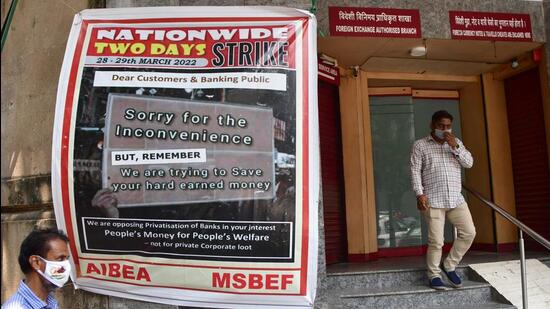
A joint forum of central trade unions had given a call for a nationwide strike on March 28 and 29 to protest the government policies affecting workers, farmers, and people. Their demands include scrapping of the labour codes, no privatisation in any form, scrapping of the National Monetisation Pipeline, increased allocation of wages under the Mahatma Gandhi National Rural Employment Guarantee Act, and regularisation of contract workers.
Power sector unions are upset that the draft electricity (amendment) Bill, 2021, seeks to delicense the distribution business and allow the entry of private electricity distribution companies. While introducing competition, the initiative will also dismantle the presence of public utilities in the sector.
They claim the state government wants to bid out power distribution in 16 cities and towns to private distribution franchisees, and is trying to involve private operators in running six hydroelectric power stations. They are demanding that recruitments be completed for around 42,000 vacant positions in the utilities and that the jobs of contractual employees be protected till they reach the age of 60.
A technical fault in an electric supply line led to power disruptions at Mazgaon and Ferbunder from 6.30 pm to 7.50 pm on Tuesday.
Stay updated with all the Breaking News and Latest News from Mumbai. Click here for comprehensive coverage of top Cities including Bengaluru, Delhi, Hyderabad, and more across India along with Stay informed on the latest happenings in World News.


