
 E-Paper



A perilous passage to India: How Bangladeshi immigrants make their way across the border
Illegal Bangladeshi immigration to India surges during rain, driven by job scarcity and political instability; migrants often face exploitation and arrest.


MUMBAI: If you know what to look for, you can almost time the surge of illegal Bangladeshi immigrants into India. Typically, it coincides with heavy rain and dense fog, which make the illegal border crossings easier. It’s a migration fuelled by desperation caused by the lack of jobs in Bangladesh. The numbers recently swelled due to the political instability in India’s eastern neighbour.
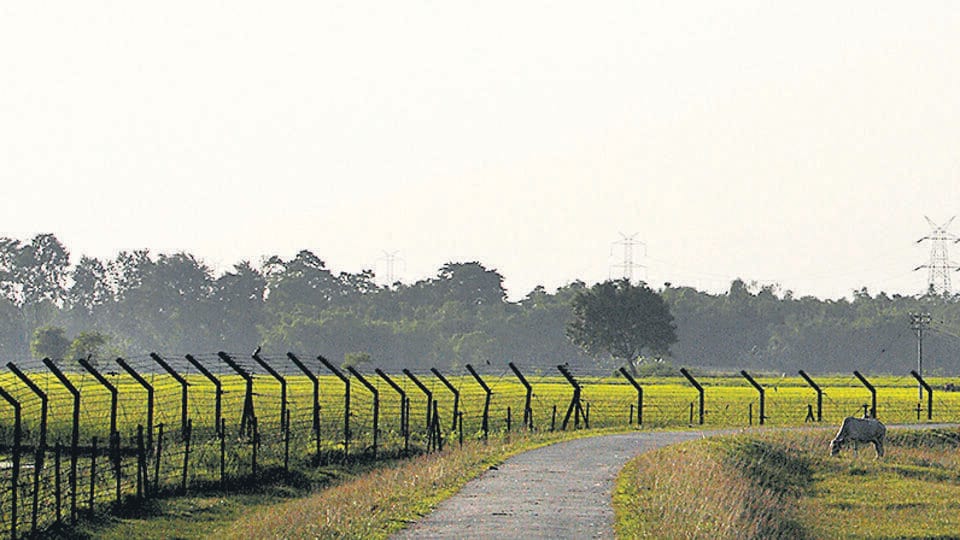
Sometimes the desperation has personal roots too. A 26-year-old woman arrested by the Pydhonie police from a brothel in Grant Road two weeks ago had made the arduous journey across the border because she had nothing left in her homeland. She was from Dhaka, she told the police, and moved to Mumbai illegally after the death of her husband.
“I did not have money for food. While I was searching for work, I met an agent who promised me a better life in Mumbai. I took up his offer. I knew I would be able to earn a livelihood somehow in Mumbai. I had seen the lifestyles of affluent people from the city online and in movies,” she had said.
So, in September, she packed a few clothes in a plastic bag and left for an illegal crossing by land. This involved walking across hilly and marshy terrain for two days, after which she arrived in West Bengal.
What happened next followed the pattern that most illegal Bangladeshi immigrants now use: she spent eight days in a ‘safe house’ run by the illegal agents. At the end of that period, her new documents arrived (in her case, an Indian Aadhaar card). At this point, most illegal immigrants strike out on their own.
The Pydhonie woman’s agent told her he had a job in mind for her. She should have known something was amiss from the start, when the agent didn’t charge her for the journey, and said he would recover the cost from her wages instead.
“It turned out that he had already sold her to a brothel,” said an officer from Pydhonie police station. She was rescued four months later, after the police received a tip-off that there was an illegal immigrant at the brothel being held against her will.
The woman’s time in India was short-lived, and she was glad to go home. But most illegal Bangladeshi migrants build entire lives here, using that first illegal government document as a starting point. They get jobs and bring families over too; they obtain Indian SIM cards, open bank accounts, acquire ration cards and even driver’s licences so they can get better blue-collar jobs.
This is how things played out for 30-year-old Shariful Fakir, alias Bijoy Das, who was arrested on January 19 for allegedly breaking into the Bandra home of actors Saif Ali Khan and Kareena Kapoor Khan, and inflicting multiple stab wounds on the former.
He reportedly crossed over into India via the Dawki River that flows through Meghalaya, six months ago. Police say that, by the time of his arrest, he had multiple Indian identification documents – and had even opened a bank account.
How the crossing is made
Thousands of Bangladeshi nationals illegally enter India every year, thanks to a stagnant economy and dearth of jobs in their home country. Add to that the demand for cheap labour in India, particularly in construction, including at high-profile project sites such as the Metro rail corridors, and it’s almost an invitation to make the border crossing, regardless of the cost and risks involved.
The cheapest route costs ₹8,000, and involves wading through alligator-filled marshes and rivers. The more expensive land routes are arduous too, crossing hill ranges along the border. But these are relatively safer.
The most expensive route costs ₹18,000 to ₹20,000 and involves crossing a fenced border point through buried routes such as tunnels and drainage lines. “Here, the risk is minimal,” a police officer from the Ghatkopar police told HT.
The cost of passage typically includes at least one illegal document (typically a PAN or Aadhaar card) and a week’s stay at a safe house while the illegal documents are being prepared and delivered.
Some pay extra for an Indian passport and then use that passport to pose as Indians and find work in the Middle East or even Russia, where Indian labour is more highly trusted, highly prized and more highly paid.
There are three key routes for the crossing itself: rivers, mountains and through a border crossing itself.
Of the five Indian states that border Bangladesh, West Bengal, is preferred over Assam, Mizoram, Meghalaya and Tripura, since more agents operate in this major hub. Also, employment is more easily available, there is a larger population to disappear into – and, vitally, there are key transport hubs that can quickly ferry the illegal entrants to other parts of the country.
Three border crossings
Five major rivers run through the India-Bangladesh border regions. These rivers are the most preferred route for illegal crossings, since there is barely any fencing to contend with, and security guards tend to be scattered on floating Border Security Force (BSF) posts, since the water bodies cannot be manned in their entirety.
The rivers are home to alligators, and so this route costs less too, about ₹8,000. The cheapest land crossing costs ₹10,000.
Shariful Fakir appears to have taken the cheapest route. “He told the police that the crossing took him two days through alligator-filled terrain, on an empty stomach, as there was no food available,” said a police officer who was part of the arrest team.
The second route cuts through hilly terrain, along a 4,000-km stretch of border that is also largely unfenced. In addition to an arduous trek, there are dense forests to navigate here, since only footpaths can be used and all roads must be avoided. A common route here involves a two-day trek through the forested Jaintia Hills, to arrive in Meghalaya. From here, the illegal immigrants are taking to safe houses maintained by agents in West Bengal.
The straightest land route is manned by the BSF. “Here, the crossings are mostly done at night and the illegals arrive in West Bengal,” said a police officer from the Ghatkopar police. He referred to a video posted by a Bangladeshi YouTuber showing how he had travelled from Sylhet in Bangladesh, via a nullah and beneath barbed wire, to arrive in India.
Across all three routes, weather plays an important part. “Illegal immigrants prefer to cross the border during thick fog and heavy rain, as these provide cover. But these factors also increase the risk to life,” said a police officer with the Mumbai Crime Branch.
Life in India
Typically, once they have documentation in place, illegal Bangladeshi immigrants work and live at construction sites, often in tin shacks, sometimes with families – but almost always with people they trust, who have arrived in the country illegally too. Women typically work in construction as well, or find jobs as house help close to the construction sites where they husbands work.
Police inspector Revansiddh Thengle of the Mumbai Police’s special branch says his team arrested 13 people in the first week of January, including four children, who were living in this manner, in Nallasopara. “The men worked at a construction site, while the women worked as house help. The group had entered India two years before their arrest, primarily in search of work,” Thengle said.
As construction and infrastructure projects boom across the Mumbai Metropolitan Region (MMR), their presence has grown too, said a police officer from the Mumbai Crime Branch.
In 2021, 96 cases were registered in Mumbai against Bangladeshi nationals, and 118 people were arrested. In 2022, that number rose to 105 cases registered, and 139 arrested. In 2023, it was 223 cases and 376 people arrested. In 2024, 216 cases were registered, and over 300 arrested.
It is hard to track them down since they deliberately minimise the risk of being caught by not mingling or even living alongside city residents, police say.
The men and women may move into slums, and find better jobs in commercial housekeeping services or as drivers, but here too, their personal networks remain largely confined to people who have also moved to India illegally, often from the same region in Bangladesh, a police officer added.
As a result, a majority of illegal Bangladeshi immigrants are arrested only after police are tipped off.
Concentrated raids in areas known to house illegal Bangladeshi immigrants – such as large construction projects and slums – have been relatively rare. These numbers are now being stepped up, Satyanarayan Chaudhary, joint commissioner of police, law and order, told HT.
“In the first 23 days of this year, 101 cases have been filed and 160 illegal Bangladeshi immigrants arrested,” Chaudhary added. “Teams are on the lookout in all 93 police stations and in the special branch. This is a top priority. We are focusing specifically on slum areas. The operation will be intensified.”
After arrest, the illegal immigrants are typically charged under the Passport (Entry into India) Rules of 1950, Foreigners Act of 1946 and Foreigners Order of 1948. They are typically incarcerated while the police begin the lengthy process of deportation, which must be routed through the Ministry of External Affairs and the Bangladeshi high commission in India.
In a next step, said a police officer with the Mumbai Crime Branch, there are plans to begin cracking down on agents who help provide Government of India documentation. With the number of such illegal crossings rising, after former Bangladeshi Prime Minister Sheikh Hasina’s resignation and amid political instability in Bangladesh, “we are trying systematically to stop this,” the officer said.
To the Gulf via India
In an extension of the illegal racket, agents have also begun to pop up on the police radar for helping the immigrants use their falsified Indian paperwork to find jobs overseas, particularly in the Middle East.
In November 2023, for instance, the Borivali police arrested a gang that charged ₹5 lakh to ₹7 lakh to help Bangladeshi nationals come to India and then use their false Indian identities to find work in and travel to Saudi Arabia.
The gang faked passports, driver’s licences, even birth certificates and rent agreements, to build entire identities for them as Mumbai locals.

Stay updated with all the Breaking News and Latest News from Mumbai. Click here for comprehensive coverage of top Cities including Bengaluru, Delhi, Hyderabad, and more across India along with Stay informed on the latest happenings in World News.


