
 E-Paper



‘The history of war could be read as a parallel phenomenon to the development of weapons technology’
TV Santosh's exhibition, 'History Lab and the Elegy of Visceral Incantations', provides a commentary on social and political crises through his artwork. The exhibition explores themes of violence, war, and media propaganda, depicting the impact of these issues on our everyday lives. Santosh's work aims to provoke dialogue and reflection on the darker side of humanity and the need for alternative solutions. The exhibition can be viewed at Dr Bhau Daji Lad Museum until February XXX, 2024.


MUMBAI: In a career spanning three decades, Kerala-born, Mumbai-based artist TV Santosh’s art has often cited histories of violence, injustice, war, terrorism and media propaganda.
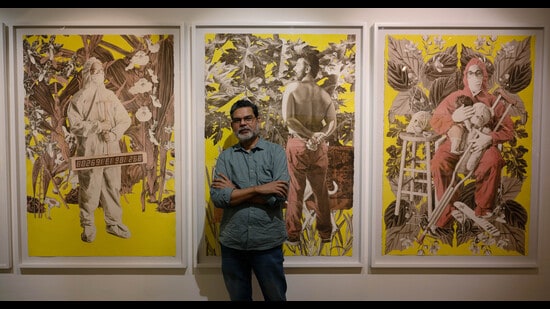
The 55-year-old artist in his show, ‘History Lab and the Elegy of Visceral Incantations’ , on at the Dr Bhau Daji Lad Museum, provides an incisive commentary on the current social and political crises. “Even before you physically step outside, the world comes to your home through various news reports. They act as our extended vision of the outside world that eventually becomes part of our everyday life,” reasons Santosh.
Thus, conflicts and violence become a part of our everyday experience.
A watercolour work depicting a televised war, titled, ‘When world enters your home’, is a striking example. “The work is more about how the turbulent outside world bleeds into our drawing room through television channels. But here, it is a drawing room with a bunch of Ashoka plants in the background, with the hope of healing associated with it,” explains Santosh, adding: “The usual protagonist has gone somewhere without switching off the television. The long table in the work too is a recurring image in my works. Once it was directly associated with da Vinci’s ‘The last supper’. It might have evolved into something else, but it still retains a sense of enigmatic prophecy that Christ had said during his last supper.”
The work emerges from the silent observations and conversations Santosh has with himself in an attempt to comprehend the violence-obsessed world we inhabit.
A closer look at the text one reads in the work, ‘The protagonist with his unending monologue’, reveals a small write-up Santosh had jotted down, “at some point of self-talking.” According to him, the work is a pessimist’s view of the world through his tinted glass that brings out its darker side. “It is a kind of monologue which is not about the personal worries but rather angst about the world; why no one learns anything from history, and why war is a constant,” says Santosh. “It is an act of sharing a kind of monologue that a theatre artiste would have effectively performed on the street.”
With the performative element, Santosh revisits a time in Kerala in the mid-80s, when he performed as an actor and a mere spectator of historical injustices. In the work, he urges the viewer to ponder and hold a dialogue, stating, “My attempt is to understand why history is infested with stories of conflicts and war, which is almost like an endless chain of actions and reactions, perplexing dynamics that often exposes the darker side of humanity,” he says. “But when you look at things from a larger humanist point of view, you realise that there is always an alternative way; a solution to all the unrest the world is dealing with.”
One of the sculptures in this show, titled, ‘History lab IV’, is about a process of understanding history from the perspective of progress, as defined by industrial and technological advancement, and how these advancements in turn become yardsticks to measure the extent of damage caused by man against its own kind. “The history of war could be read as a parallel phenomenon to the development of weapons technology. History has its multiple complex narratives,” says Santhosh.
‘History lab and the elegy of visceral incantations’ comprising 31 artworks has been in the making for the last five years, exploring the overarching theme of historical injustices through a range of material. “Watercolour process is a kind of balancing act between control and accidents. Before I paint, I work on the pre-image by staging the central image of the protagonist. Like in a one-act play wherein the protagonist interacts with objects that determine the progress of its narrative, I choreograph the act of the protagonist in order to shape-shift his identities through the history and its landmark events,” says Santosh of his process.
From an army personnel to a political prisoner, from an activist to a victim of violence, he transforms himself to tell stories with the aid of various props, including a rat trap, weapons, bones and even prosthetics. In many senses, Santosh’s complex creative process is his personal journey, resulting from a continuous dialogue at various levels of image-making defined by the materials, methods and other linguistic systems involved. “What I am addressing here is some of the questions that we can ask at any point in history, yet they will always be relevant: ‘Who is the real enemy, after all?”
‘History lab and the elegy of visceral incantations’ can be viewed at Dr Bhau Daji Lad Museum till February XXX, 2024.

Stay updated with all the Breaking News and Latest News from Mumbai. Click here for comprehensive coverage of top Cities including Bengaluru, Delhi, Hyderabad, and more across India along with Stay informed on the latest happenings in World News.


