
 E-Paper



Decoding the sect that has swayed Maha
Nanasaheb belonged to an agrarian family, owning fair parcels agricultural land. He worked as a purohit and an astrologer on the side. Aided by sound oratorical skills, he became popular as a religious preacher and popularised the Shree Baithaks to propagate Ramdas’s literature


REVDANDA: The grand show set up on Sunday last week for Union Home Minister Amit Shah to confer Maharashtra Bhushan, the highest civilian award, on 77-year-old Appasaheb Dharmadhikari, in Kharghar, Navi Mumbai, drew in over 10 lakh of the spiritual leader’s followers, 14 of whom perished from heat stroke. In the course of the week, Chief Minister Eknath Shinde, himself a follower of Appasaheb, has not been able to live down the criticism stemming from the tragedy, which could have been averted if organisers of the event had covered the open area where the followers had converged, to protect them from the searing April heat.
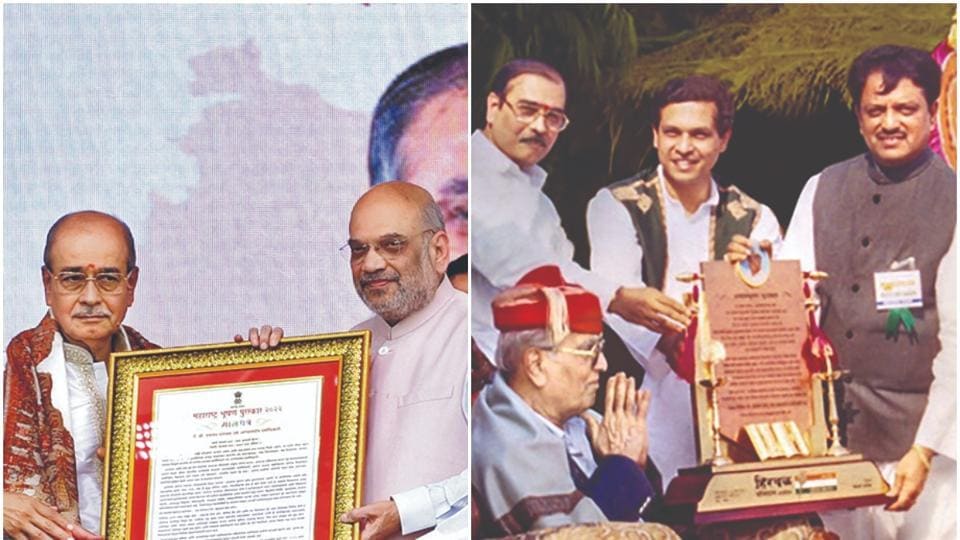
The Kharghar event was also a forum for the ruling combine to strengthen its political ties, in the presence of an electorate from the Mumbai Metropolitan Region (MMR) and parts of Konkan.
Dr Dattatreya Narayan alias Appasaheb Dharmadhikari’s sway encompasses the swathe of Thane, Kalyan, Bhiwandi, Palghar, Raigad and Maval. MMR has nine municipal corporations, including BMC. There are 31 Assembly and 6 Lok Sabha constituencies in Thane, Palghar and Raigad district.
A few days following the Kharghar event, HT travelled to Revdanda, a small town in Raigad district, 112 kilometers from Mumbai, to meet the spiritual leader. It is close to Alibaug.
It is surrounded by lush paddy fields, where the Dharmadhikaris reside in a big house, which is the nerve centre of the spiritual group Shree Samarth Prasadik Aadhyatmik Seva Samiti. The founder of the sect Nanasaheb Dharmadhikari resided here, which now houses his son and successor Appasaheb. The area around the house, which is otherwise abuzz with followers and activity, was quiet, with a group of police officers posted outside the bungalow. Our request for an audience with Dharmadhikari was politely declined.
“No one will meet you. They have closed the gates of the house since the incident in Kharghar,” said a policeman. Sandip Patil, an aide of the spiritual leader, who issued a statement on his behalf after Sunday’s incident, was not reachable on cellphone either.
Apart from Dharmadhikari “expressing grief” over the incident, no other communication was made, nor did he visit families that had suffered loss. His silence has not affected the belief of his followers – many have said they “were saved from any problems that could have arisen from sunstroke by the strength of faith”.
Faith floats
So how did Dharmadhikari become such a powerful spiritual-social leader? Here is the backstory.
His father, late Nanasaheb Dharmadhikari laid the foundation of the group’s work in Raigad district in 1943 by organising a Shri Baithak (meeting) based on the Dasbodh (verses) written by Saint Samarth Ramdas, a 17th century saint, who set up many Hanuman temples and encouraged the youth to focus on physical well-being. Unlike other saints of Maharashtra who are Vitthala bhakts, Ramdas was a Ram bhakt.
Nanasaheb belonged to an agrarian family, owning fair parcels agricultural land. He worked as a purohit and an astrologer on the side. Aided by sound oratorical skills, he became popular as a religious preacher and popularised the Shree Baithaks to propagate Ramdas’s literature. Through this initiative, he also worked on de-addiction, which became popular in the coastal districts of Raigad, Thane and Palghar, where alcoholism was rampant among peasants and fisher-folk.
It is believed that Nanasaheb’s preachings led to a sizeable number of people giving up alcohol and the grateful families joined his already growing faction. He also worked to eradicate superstitious beliefs latent among Koli, Agri, Adivasi and Katkari families, earning him larger numbers.
Even today, followers – called Shree Sadasyas -- speak about his social work at the baithaks. They attend weekly meetings each of two-and-a-half hours.
His popularity reached an acme in the 1990s. On May 1, 2008, then Congress-NCP government led by Chief Minister Vilasrao Deshmukh conferred the Maharashtra Bhushan award on Nanasaheb, however the spiritual leader passed away on July 8, 2008, before his public felicitation. His son and successor Appasaheb received it posthumously on November 25 that year at Kharghar.
Lakhs turned up at the event, which was also reported in the 2010 edition of the Limca Book of World records.
Garnering numbers
After the death of his father, Appasheb came to be regarded as ‘Swari’ (a name given to him by his followers out of respect). He founded Dr Shree Nanasaheb Dharmadhikari Pratishthan in 2008, which carried forward his late father’s vision of doing social good. Welfare activities such as blood donation camps, tree plantations, environment conservation, job fairs, distribution of educational material etc were carried out on a mass scale – it garnered him lakhs of followers.
It eventually had a deep impact on MMR’s socio-political life. Followers rejuvenated wells in Raigad a few years ago and carried out a cleanliness drive across the state. Unlike his father, Appasaheb is not known for his oratory but he excels in management skills. Under him, the group’s network has expanded into the interiors of the state.
A local from Revdanda said: “His father used to mingle with people very easily but Appasaheb speaks less. There is an aura around him. He wears the cloak of a VIP very easy; his fondness of rubbing shoulders with the powers that be has enhanced his equity.”
The earlier well-to-do family prospered immensely after Nanasaheb’s death, added the follower.
Appasaheb meets his followers between 8 am and noon. People who come to him with their problems have to put in a ‘nivedan’ (application-cum statement about the issue) before they can gain an audience.
They seek guidance on family matters, particularly decisions of marriage. If the Swari advises against a union, followers do not disobey him. Once a follower did not allow is son to enter the house as he had married a woman from another caste, against the advise of Appasaheb.
There are other stories too. A woman who works as a household cook has been attending the baithaks for seven years, as it gives her mental peace. “My husband used to drink daily, which affected his employment. But after I started attending the baithaks, he gradually quit drinking. He is back at work.”
The organisation is structured in two tiers: The followers are called ‘Shree Sadasya’ (member) and those who conduct meetings with them are called ‘Shree Das’ (servant). A Shree Das reports directly to the higher authority.
Every Saturday, Appasaheb visits his farmhouse at Samrth Wadi, near Revdanda, where he conducts meetings from 10:30am to 1 pm of several ‘servants’ who come from the various parts of the state.
He is assisted by his son Sachin, who reviews the meetings attended by the followers. A log of the participants is carefully maintained. There is already a database of 45 lakh followers worldwide. It is believed, such is his influence that he can gather a crowd of over 10 lakh with just a single message.
He has three sons Umesh, Sachin and Rahul. Older son Umesh looks after the family’s agriculture business, Sachin looks after the work of the ‘pratishthan’ and Rahul looks after the petrol pump and allied business the family holds.
Today, Appasaheb has a following among NRIs in the United States.
Those who moved to foreign countries have started branches of baithaks in their cities. Multiple baithaks have been organised in the UAE, UK, Singapore, Australia, Nigeria and Iran.
In 2017, Appasaheb was awarded Padma Shri by the government.
Political pull
He has not ostensibly thrown his weight behind any political party, but politicians from all factions turn up at Appasaheb’s doors during elections. While Shinde calls himself a Shree Sadasya, Shiv Sena (UBT) chief Uddhav Thackeray, deputy chief minister Devendra Fadnavis, union transport minister Nitin Gadkari, Raigad MP and NCP leader Sunil Tatkare and NCP MP Supriya Sule have visited Revdanda to meet him at one time or the other.
In fact, at last Sunday’s Maharashrtra Bhushan ceremony, Shinde had said he got “much mental and emotional support” from the spiritual leader when he lost his two children in a tragic incident. During the face-off with Uddhav Thackeray last year, Shinde had again reached out to the followers, and after he became the CM, he spent a whole day at Appasaheb’s residence during Diwali. Last week, he told the gathering of followers, “The political establishment needs the support and inspiration of a spiritual establishment, and this is endorsed by the presence of people at the function.” The crowd cheered.
Followers speak up
While largely, Dharmadhikari’s fandom remains undented despite Sunday’s incident – most of them do not connect the Kharghar lapse with the spiritual leader – notes of dissent are being heard from certain sections, stoked by Appasaheb’s post-event silence.
Sushruta Patil, former sarpanch Ambepur, said her family has adhered to the organisation’s teachings, because “they do not draw caste lines”. “Every worker is disciplined and is self-motivated,” she said.
Hemkant Goyaji, a 47-year-old Zilla Parishad school teacher disagrees with Patil. Goyaji was a devotee of Dharmadhikari for 21 years, until he realised that Manuwad was being discussed in the baithaks. He first felt uneasy when his family approached Dharmadhikari to match horoscopes with a prospective match. He turned to books on rational thought, the Constitution and sociology, which led him to believe “everything taught in the baithaks was fake”.
Goyaji started questioning the spiritual speeches. “Once, the Nirupankar (a preacher) selected by Dharmadhikari related his personal experiences of how God had pulled him out of difficult times. I observed how people related to him and blindly started thinking that those were the words of Dharmadhikari himself,” said Goyaji.
Earlier, Goyaji had helped in the construction of the family’s petrol pump gratis, thinking it was an ‘adnya’, (an order from the Swari). He eventually realised how much money the family had saved by not paying labourers.
Goyaji stopped going to baithaks from 2014, much to the consternation of his family.
Reshma Thosar, a teacher and a former devotee, started visiting the baithaks with her family after her Class XII exams. “I was asked to read at a certain pace and provide a reading report. This was believed to help the family enhance its virtues and wash away its past sins. Good things were attributed to the grace of the guru, while the bad was a result of the devotee’s previous sins,” she said. It did not go down well with her.
Added to this, was the “chaos of various rituals and felicitations, which left us with no time to socialise with our relatives and guests”. “The guru’s orders overwhelmed us. I began planting trees, attending health camps and doing everything I could to obey him, while others in the meeting built petrol pumps, mansions, cars and bungalows,” she said.
She started losing faith as she watched the youth renounce the world and follow him blindly. “There were women following his orders only to save their marriages with unworthy husbands,” she said.
Thosar exited the sect in 2016.
Meanwhile, the voluminous registers at numerous baithaks in the region are continuing to add acolytes.

Stay updated with all the Breaking News and Latest News from Mumbai. Click here for comprehensive coverage of top Cities including Bengaluru, Delhi, Hyderabad, and more across India along with Stay informed on the latest happenings in World News.


