
 E-Paper



Mumbai: Uran’s lost village: 40 years on, resettlement may finally begin
These 256 families, whose land was acquired, stripping them of their homes and livelihoods, have been living in a two-hectare transit camp in Uran


MUMBAI: India’s largest container port will have to make good on a promise it failed to keep 40 years ago, to 256 families who gave up everything so that the shipping terminal could be built in Uran, across the harbour from Mumbai.
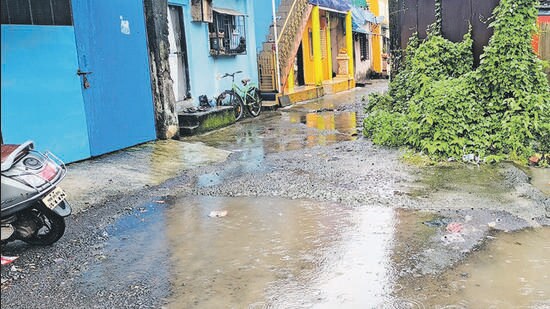
After lifting the villagers in Sehva gaon from their land and homes, and setting them down 12km away in cramped, poorly ventilated and unsanitary transit accommodation in the 1980s, the Jawaharlal Nehru Port Authority (JNPA) will resettle them with dignity, thanks to a lawsuit they filed in June this year.
These 256 families, whose land was acquired, stripping them of their homes and livelihoods, have been living in a two-hectare transit camp in Sheva Koliwada in Boripakhadi village, Uran.
“The wait is almost over,” says Ramesh Koli, general-secretary of the Maharashtra Small-Scale Traditional Fish Workers Union and a resident of Sheva Koliwada. A seasoned campaigner, Koli is pleased but cautious. Leading the fight for rehabilitation of the 256 project-affected families, Koli was just 25 years old when his family and fellow villagers were displaced.
However, there’s hope, at last. On September 4, 2025, the Union ministry of ports, shipping and waterways assured the Bombay High Court that it would soon take a final decision on the rehabilitation.
The ministry admitted before the court that the families had vacated their land in 1986, and that JNPA, which falls under the ministry, had failed to provide alternative plots. However, the ministry claimed, a rehabilitation proposal was under consideration by the department of expenditure and the department of economic affairs. The court has granted the ministry’s request for three months to place the plan before the Union cabinet for its approval.
“Our lands were taken for economic development,” said Koli. “On our land, Kolis, Agris, and Marathas lived spaciously, almost a kilometre apart. Navi Mumbai was created to take the pressure off Mumbai’s cramped spaces, and our land was required for the port. I had to relocate right after my marriage, and since then, my family of five has lived in a small room.”
Giving it all up
In 1982, a government-appointed committee recommended that gaothan lands from Sheva gaon, and four other villages, be acquired for the port’s construction and expansion at Nhava Sheva. The state government had promised to rehabilitate all the affected persons prior to acquisition. Educational facilities, employment opportunities and civic amenities were part of the package.
While the Raigad district collector was initially tasked with implementing the rehabilitation plan, the responsibility was transferred to JNPA under the collector’s supervision.
A government resolution (GR) in 1983 promised plots ranging from 185.81 sq m to 557.42 sq m, depending on family size and whether or not their income depended on agriculture. The resettlement sites were to be equipped with public utilities such as proper roads, water supply, drainage, electricity, schools and healthcare facilities.
“Everything looked good on paper but nothing changed on the ground. The law exists, but justice hasn’t reached us,” says Koli.
Rehabilitation plans were approved in 1985, and by April 1986, families were moved to transit housing in “Hanuman Koliwada,”, also called Sheva Koliwada. Conveniently, the JNPA declared Hanuman Koliwada a “resettled village”, leaving the project-affected persons (PAPs) in small rooms, some without windows, and no basic amenities. The rehabilitation plan was moved to the backburner.
According to Nandakumar Pawar, president of the Maharashtra Small-Scale Traditional Fish Workers Union, a 17-hectare plot in Jaskhar, elsewhere in Uran, was identified for rehabilitation. However, tidal breaches damaged the protective bund, and by 2022, 15 hectares of this land, now covered with mangroves, were handed to the state forest department.
Over the years, the PAPs have been waging a relentless battle that went nowhere, until they filed a lawsuit in the Bombay High Court. They met senior state and central government officials, ministers, as well as the JNPA authorities. Promises were made but never kept. Utterly frustrated, the residents of Sheva Koliwada boycotted the parliamentary and assembly elections in 2024 and, to draw attention to their struggle, and even blocked the navigation channel at the port, on numerous occasions.
“We even blocked the channel to the port to get our names on the revenue records,” Koli said. “But the land became waterlogged, mangroves grew, and the government handed it over to the forest department without consulting us.”
‘Misleading’ the govt
In August 2000, the state sanctioned ₹16 crore for the rehabilitation of these 256 families, promising to roll out the plan within a month. However, a January 2002 letter from then JNPA chairperson, AL Bongirwar, falsely stated that all these families had been rehabilitated on 2.1 hectares, concealing the fact that it was merely a transit site. Villagers say this was a “deliberate attempt to mislead the government”.
There was worse to come. That same year, the Raigad district collector reduced the promised land allocation from 17 hectares to 7 hectares, and slashed the rehabilitation budget to ₹7.8 crore. The state home department later declared these actions illegal. It was also revealed that the 2 hectares used for the transit camp remained under CIDCO’s ownership and were never transferred to the beneficiaries.
The government hasn’t budged despite a 2013 report from the Tata Institute of Social Sciences (TISS) finding that JNPA had failed to rehabilitate the PAPs from Navin Sheva and Hanuman Koliwada. In 2017, the Maharashtra Lokayukta recommended that the state ensure rehabilitation of the displaced families within four months but nothing happened.
At breaking point
Residents continue to struggle with chronically waterlogged, unhygienic and unsafe conditions, suffering the indignity of sewage accumulation, lack or regular water supply and poor ventilation.
“There are news reports of wells and roads that go missing elsewhere. In our case, an entire village has gone missing. What are we supposed to do,” asked Koli. “Governments have come and gone, the authorities who are meant to protect us took our land and turned their backs on us. We have been forsaken.”
A resident who wanted to remain anonymous said, “In the monsoon, half the transit camp goes under water. We have to use public toilets, which are not maintained properly and become inaccessible during rains. The roads leading to the toilets are so overgrown that elderly people and children find it difficult to reach them.”
She says the only school nearby is a primary school with classes up to Class V. “We cannot afford to send our children to schools in Uran, which is also nearly 4km away. We have to use the hospital in Uran for emergencies too.”
With their backs against the wall, residents of Sheva Koliwada approached the high court in June 2025, seeking directions to the authorities to complete the rehabilitation and allot them due plots. They have also sought compensation for the hardship and mental anguish they have endured over four decades. The next hearing in the case is scheduled for December 22.

Stay updated with all the Breaking News and Latest News from Mumbai. Click here for comprehensive coverage of top Cities including Bengaluru, Delhi, Hyderabad, and more across India along with Stay informed on the latest happenings in World News.


