
 E-Paper



Why Yuval Noah Harari is catching them young
With a new children’s book called ‘Unstoppable Us’ out this year, and the illustrated version of ‘Sapiens’ now in Hindi, the author is expanding his reach


Mumbai: Eight-year-olds understand supervillains better than grown-ups. So, according to author Yuval Noah Harari, it isn’t tough to explain the actions of Russian president Vladimir Putin to them. While talking about his new book for children, ‘Unstoppable Us: How Humans took over the World’, he says, “You have to present (complex ideas) in a way that is understandable to them. If you talk about the Russian invasion of Ukraine in big, abstract terms, it’s difficult. But if you compare Putin to a big bully in school, who comes and starts beating a smaller kid, they get it.”
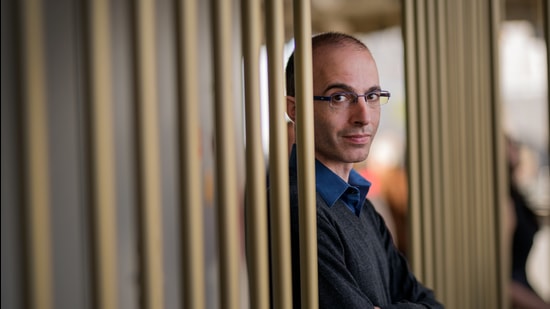
In the past year, President Putin has become a bête noire of sorts for Harari, who has written several op-eds condemning him. “Everybody knows that if the bully can just beat this kid, it becomes the new norm. On the other hand, if the bully is stopped, if Putin is punished for this criminal invasion, then the peace of the world is actually strengthened. Because dictators around the world see: ‘Oh, even Putin couldn’t do it. So I should be quiet.’”
Chastising dictators is a part-time gig for 46-year-old Harari. His full-time operation is explaining the 70,000 years of human existence to humans. His three big novels, ‘Sapiens’, ‘Homo Deus’ and ‘21 Lessons for the 21st Century’ have collectively sold 40 million copies. ‘Sapiens’ alone sits on 23 million bookshelves, and according to his then literary agent, reached people “who read only one book a year”. With ‘Unstoppable Us’, he has taken on the same subject, but packaged it for pre-teens. There’s more action, too, within the pages, with illustrations by Ricard Zaplana Ruiz. “Most scientists don’t write for kids,” he says. “They expect somebody else to write for them. But it’s important for scientists to address children directly. Because when people enter university in their 20s, it’s often hard to change their view of the world. It isn’t impossible, but it’s harder.” Harari knows this first-hand, having been a college professor for two decades.
We meet him at the Taj Mahal Palace, in Colaba, before he leaves for Igatpuri. Since his postgraduate days at Oxford in 2001, he has been a follower of Vipassana and, barring a pandemic, visits Igatpuri every year. On the day we meet, the zen quality extends to his wardrobe. In a cream cardigan, soft-grey pants, and off-white socks, he stands out against the Indian colours of the suite. “In the 21st century, India has an important role to play as one of the leaders of humanity. For that, you need an understanding of the history of the whole of humanity, and that is what these books provide.” Of the 65 languages ‘Sapiens’ is available in, six are Indian. The graphic novel of the book was published in Hindi this year, and the Hindi version of ‘Unstoppable Us’ is slated for an early 2023 release. Local publishers are encouraged to contact his team for additional languages. Because the truth is, if not for a translation, no one outside Israel would have heard of the book.
‘Sapiens’ was conceived in a lecture hall at the Hebrew University of Jerusalem. In 2003, they launched an undergraduate course called ‘An Introduction to the History of the World’. Harari was placed in charge. “I was a specialist in mediaeval military history, a very specific period and subject,” he says. “I’d never read anything about the Neanderthals, the agricultural revolution, or even the history of India. So it took me 10 years to write the first book.” Harari took notes from archaeology, genetics, and history, and pasted them together “to present the big picture”. Originally published in Hebrew in 2011, the book gained fame only in 2014, when it was translated to English. In his own words, ‘Sapiens’ was “a popular science book, aimed at a large audience” because it “is the responsibility of scientists not just to do research, but also to reach out to different groups of people”.
Given his democratic leanings, it was a matter of time before kids were looped into the conversation. “With computers and smartphones, kids are flooded with enormous amounts of information. What they need today is not more information, but a way to evaluate whether the information is reliable or not. They need to understand evidence,” he says. Like the mosquito-fossilised-in-amber scene in ‘Jurassic Park’, even ‘Unstoppable Us’ spends a fair amount of time explaining the methodology. “With genetics, we tell the story of how archaeologists found a finger bone of a girl in Siberia. By extracting DNA from that finger, they discovered an entirely new human species called the Denisovans. That indicates that this story is accurate.” What made him popular among grown-ups might also work for kids: he tends to skip the jargon and focus on the stories. “You need to know history to understand yourself. I’m not talking about long lists of names and dates and kings and battles. If you’re a 10-year-old, and you wake up in the middle of the night because there is a monster under the bed, you call your mom. This is an historical memory. Tens of thousands of years ago, when humans lived in the wild, there were actual monsters such as tigers and cheetahs who came to eat kids in the night. If you woke up and called your mom, you could survive. If you continued sleeping, you were eaten. This is history coming up in you.”
Daily parental evidence will also corroborate that kids are a far more curious audience. “A good, positive quality about kids is that everything is new to them. They question things that adults take for granted. I see on the news, what’s happening in Iran, with teenagers and girls rising against the oppressive regime. They are questioning, ‘Why do we have to live like you say?’ The adults have already accepted this. But the new generation wants change,” he says. That’s the thing with knowledge. Once eight-year-olds start understanding the nature of supervillains, can they be far behind in becoming superheroes?
Stay updated with all the Breaking News and Latest News from Mumbai. Click here for comprehensive coverage of top Cities including Bengaluru, Delhi, Hyderabad, and more across India along with Stay informed on the latest happenings in World News.


