
 E-Paper



Ghaziabad ‘most polluted’ city for third time since October 15
Ghaziabad was listed as the ‘most polluted city’ on October 16 with the AQI recorded at 349 -- for the first time after the implementation of the graded response action plan (Grap) on October 15 this year, on Friday (October 29) with the AQI at 321, and on Monday (November 1) with the AQI at 363 -- the highest so far


The air quality index (AQI) in Ghaziabad has been worsening ahead of the festival of Diwali on Thursday (November 4 this year), with the city being listed as the “most polluted” one for the third time since October 15 this year, according to the Central Pollution Control Board on Monday.
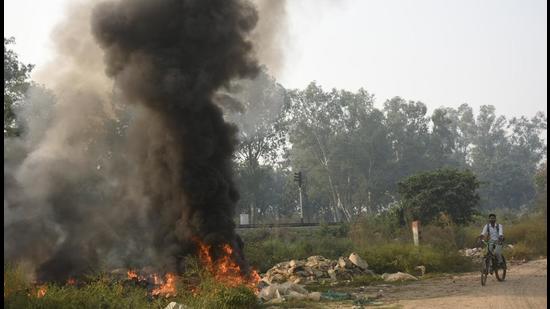
Ghaziabad was listed as the “most polluted city” on October 16 with the AQI recorded at 349 -- for the first time after the implementation of the graded response action plan (Grap) on October 15 this year, and on Friday (October 29) with the AQI at 321.
The AQI figures released by the CPCB shows that Ghaziabad recorded the AQI at 363 -- the highest so far -- under the ‘very poor’ category, with the primary pollutants being PM10 and PM2.5.
An AQI reading between zero and 50 is considered ‘good’, 51 and 100 ‘satisfactory’, 101 and 200 ‘moderate’, 201 and 300 ‘poor’, 301 and 400 ‘very poor’, and 401 and 500 ‘severe’.
Officials of the Uttar Pradesh Pollution Control Board (UPPCB) said that they faced issues in streamlining data at two of the four monitoring stations. “We faced some technical issues at our two monitoring stations at Vasundhara and Loni, and morning figures were shown in the afternoon. So, we are adopting rectification measures. Our patrolling teams are also monitoring the air in industrial areas and construction sites regularly,” said Utsav Sharma, regional officer of UPPCB.
According to the System of Air Quality and Weather Forecasting and Research (Safar), Delhi’s AQI was recorded in the ‘very poor’ category on Monday, and it is likely to improve to the upper end of ‘poor’ in the next two days. This is due to the prevailing winds from west/southwest direction, and the reduction in transport of emissions from stubble burning.
“The share of crop residue burning emissions in PM2.5 is low, about 7% (effective fire count being 3,971) due to unfavourable wind transport. The prevailing mixing layer height (MLH), which is shallow, reduces the dispersion of pollutants,” according to the Safar statement on Monday.
Akash Vashishtha, a city-based environmentalist, said, “Instances of garbage burning and heavy traffic movement on roads have led to the spike in the particulate matter in the air. It seems that there is a lack of coordination among different agencies to act on this at the ground level. High volumes of traffic movement and snarls are leading to the increase in the pollution, too.”
According to the Air Quality Early Warning System for Delhi, Union Ministry of Earth Sciences, the air quality in Delhi-NCR is likely to be in the ‘poor’ to lower end of the ‘very poor’ category between November 2 and 3. “In the outlook for the subsequent five days, the air quality is likely to deteriorate significantly between November 5 and 6, and it may reach the upper end of the ‘very poor’ category. PM2.5 will be the predominant pollutant,” it said.

Stay updated with all the Breaking News and Latest News from Mumbai. Click here for comprehensive coverage of top Cities including Bengaluru, Delhi, Hyderabad, and more across India along with Stay informed on the latest happenings in World News.


