
 E-Paper



‘Hindon river water a health risk for Ghaziabad Chhath devotees’
The Hindon river presently falls under the lowest ‘E’ category which makes its water only usable for the purpose of irrigation, industrial cooling, etc. The UPPCB officials said that the fresh water discharge into the river may temporarily elevate its category to ‘D’ (for propagation of aquatic life) or ‘C’ (drinking water source after conventional treatment and disinfection)


Thousands of devotees in Ghaziabad and Noida will have no choice but to use the contaminated water of river Hindon where they will arrive in huge numbers on Sunday afternoon and on Monday morning to take part in Chhath Puja rituals.
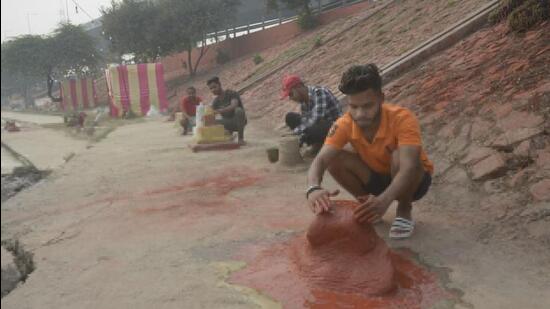
The banks of Hindon are already lined up with decorations for Chhath Puja but experts say the faecal coliform contaminants in the river water pose a major challenge.
The presence of faecal coliform bacteria in streams and rivers indicates contamination by faecal material from human or animal sources. Contact with such water can result in exposure to pathogenic bacteria, often associated with faecal contamination, they added.
“The river water is filthy like previous years even though the authorities have promised that fresh water will be released into the river from the Upper Ganga Canal. Each year, devotees face contaminated conditions and stay away from standing in the water for long. Many devotees have also stopped taking the holy dip. The water causes skin irritation and is absolutely unfit for consumption. Still, we have no alternative but to visit the river banks to complete our puja,” said Pandit Rakesh Tiwari, national general secretary of ‘Purabiya Jan Kalyan Parishad.’
Tiwari added that almost 200,000 to 300,000 people will arrive at the banks of river Hindon near the GT Road to offer prayers at various ghats.
“Devotees from almost all high-rises in Ghaziabad avoid going to river Hindon and perform rituals in swimming pools. There is a tradition to offer prayers in rivers but contamination is slowly restricting the culture. Devotees have no option but to avoid the filthy and foul-smelling river water. Nothing has been done to save the river and revive it,” said Alok Kumar, founder member, federation of association of apartment owners, Ghaziabad.
A look at the official sampling data of the Uttar Pradesh Pollution Control Board (UPPCB) indicates that the presence of faecal coliform stood at an average of 197778 most probable number (MPN)/100ml at Karhera; 193333 MPN/100ml at Mohan Nagar; 1036667 MPN/100ml at Chijarsi in Ghaziabad and 864444 MPN/100ml at Kulesara in Noida for the nine months from January to September this year.
Similar high ranges were also found by UPPCB at four sampling locations in 2020 and 2021.
“The standard limit for faecal coliform is 1000 MPN/100ml and its presence in river Hindon water is very high. This is a result of untapped drains which directly get discharged into the river. The UP irrigation department is expected to release fresh Ganga water for the festival. It will only dilute the contamination in the river and not completely eradicate it,” said Utsav Sharma, UPPCB regional officer.
The officials of the UP Irrigation department said that the fresh water supply has been discharged from the Jani escape into the Hindon river on Thursday.
“The water will reach Ghaziabad soon. About 1,800 cusecs have been released,” said NK Lamba, executive engineer from the irrigation department (Meerut).
The Hindon river presently falls under the lowest ‘E’ category which makes its water only usable for the purpose of irrigation, industrial cooling, etc. The UPPCB officials said that the fresh water discharge into the river may temporarily elevate its category to ‘D’ (for propagation of aquatic life) or ‘C’ (drinking water source after conventional treatment and disinfection).
The 10 major untapped drains which fall into the river run through Indirapuram, Kaila Bhatta, Pratap Vihar, Rahul Vihar, Dasna, Arthala, Karhera, city forest, Nandgram and Hindon Vihar.
“The contaminated water of river Hindon is highly infectious and there’s presence of faecal coliform. This can result in all probable water-borne diseases and other skin ailments. The devotees should avoid prayers here and should perform rituals at home. The claim that the river has been revived is just on paper. Officials are aware about the various sources polluting the river from Saharanpur to Gautam Budh Nagar but nothing has materialised to stop these,” said Dr Chandravir Singh, a retired scientist and convener of ‘Doaba Paryavaran Samiti,’ which has submitted several petitions in the National Green Tribunal against the contamination of river Hindon.

Stay updated with all the Breaking News and Latest News from Mumbai. Click here for comprehensive coverage of top Cities including Bengaluru, Delhi, Hyderabad, and more across India along with Stay informed on the latest happenings in World News.


