
 E-Paper



Ram, Sita idols installed at Ravana temple in Bisrakh, Greater Noida
The new deities were placed in the temple’s long corridor, next to the sanctum where the Shiva Lingam is installed, and that area will henceforth be known as the “Ram Darbar (the court of Rama)”, said the village priests

 Prefer HTon Google


On the day when the country saw the consecration of Ram Lalla (infant Rama) temple in Ayodhya, 600 kilometres away in Greater Noida, a temple dedicated to demon king Ravana in Bisrakh village, also welcomed Rama, Sita, and Lakshmana for the first time in its centuries old history.
The village Bisrakh is named after Ravana’s father Vishrava, and legend has it that both of them were born there.
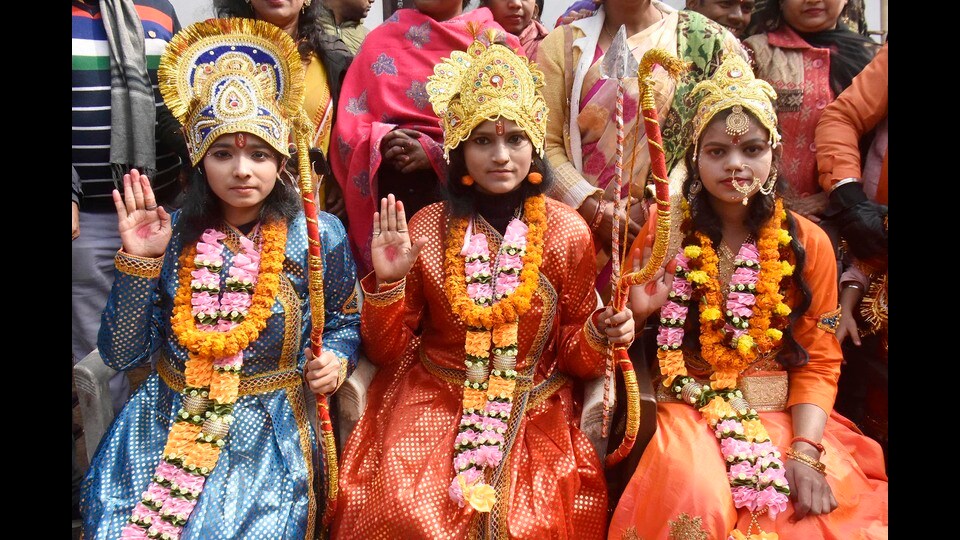
On Monday, in the presence of about 2,000 people, the idols of Rama, his wife Sita, brother Lakshmana, and Lord Hanuman were installed at the temple complex.
The new deities were placed in the temple’s long corridor, next to the sanctum where the Shiva Lingam is installed, and that area will henceforth be known as the “Ram Darbar (the court of Rama)”, said the village priests who took part in the consecration.
According to Ramdas, 67, head priest of the Shiva temple, known locally as the “Pracheen (ancient)” Shiva temple, it is believed that the 10-headed demon king Ravana used to worship Lord Shiva there.
The “Shiva Lingam (Shiva in the phallic form)” exists there in the sanctum and locals believe that both Lord Brahma and Ravana’s grandfather Pulastya Muni meditated at the place where the temple now stands and the Shiva Lingam broke forth from the earth as a result of their devotion.
On Monday, narrow by-lanes of the village leading to the temple, said to be at least 7,000 years old, were flooded with throngs of people chanting ‘Jai Shri Ram’ and carrying saffron flags sporting Rama’s images on them.
Huge billboards announcing the installation of a grand ‘Ram Darbar’ were set up in and around the village, now surrounded by multi-storey residential complexes.
According to temple priests, the new idols were brought from Jaipur in Rajasthan.
“The temple committee had been planning to install the ‘Ram Darbar’ for the past two years at this Shiva temple. However, once the ‘Pran Pratishtha (life establishment)’ ceremony of the Ram Lalla idol in Ayodhya was announced, we decided to organise the consecration of the new idols at our temple too on the same date,” one of the priests said.
Head priest Ramdas said that the orders for the new idols were placed four months ago and they were brought from Rajasthan last month, and kept covered on the temple premises.
Talking about the village and its unusual connection with Ravana, he explained that the village is believed to be the birthplace of Vishrava, the father of Ravana, Vibhishana, and Kumbhakarna.
Vishrava is believed to have built the temple in the village to house the Shiva Lingam that he came across in a forest grove, the priest said.
“Today, for the first time, idols of Rama, Sita and Lakshmana were installed with due rituals inside the temple complex. The consecration ceremony was held by 11 priests, following a grand procession across the village on Monday around 11am, around the same time when a more grander ceremony was taking place for the installation of the Ram Lalla idol at the temple in Ayodhya,” Ramdas said.
“Ravana is worshipped at the temple every day. But the temple has an idol of Vishrava, and not of the demon King himself,” he said.
Ramdas shared that the saga of Ravana’s life is carved on the walls of the sanctum sanctorum where the Shiva Lingam rests.
“Everything that happened from the time of his grandfather Pulastya Muni, his parents Vishrava and Kaikashi, and during the time of Ravana himself -- including his birth, his penance to obtain the boon of multiple heads, his departure to fight the war with Rama -- is depicted here,” said Ramdas.
On Monday, once the consecration was over, a community lunch was served for all around 1pm.
Village elders, seated with Ramdas, who has been serving the temple for the past 40 years, said they now look forward to Dussehra this year.
“This Dussehra, we will hopefully install an idol of Ravana next to the idol of Lord Rama here. Both would be worshipped together here,” the priest said.
The villagers said they believe that Ravana was their ancestor.
“For us, the Lanka ruler is our ‘Dada (grandfather)’ or ‘Baba (father)’. We have never celebrated Dussehra. In fact, for us , Dussehra is a day of mourning for us. This legend has been passed on for thousands of years, from generation to the next. That is how it has been and will go on,” said Karan Singh Bhati (72), a resident of Bisrakh village.


