
 E-Paper



Worse post-Diwali pollution in past four years in Ghaziabad and Noida
Officials of the Uttar Pradesh Pollution Control Board (UPPCB) attribute the scenario to adverse meteorological conditions and slower dispersal of pollutants this season


Post-Diwali pollution this year in Ghaziabad and Noida has been the worst since 2018, according to the Central Pollution Control Board (CPCB). Diwali was celebrated on November 4 this year.
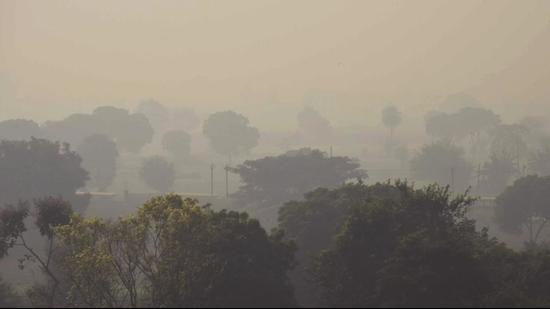
This year, Ghaziabad recorded an average Air Quality Index (AQI) reading of 449.4 from November 4 to November 8. Average AQI readings for the city for five days after Diwali (including the day of Diwali) in 2020, 2019 and 2018 were recorded at 302.6, 439.4 and 400.2, respectively.
For Noida, the average AQI readings for five days after Diwali (including the day of Diwali) were recorded at 439.6, 298.8, 419.2 and 398.6 in 2021, 2020, 2019 and 2018, respectively.
An AQI reading between 0 and 50 is considered “good”, 51 and 100 “satisfactory”, 101 and 200 “moderate”, 201 and 300 “poor”, 301 and 400 “very poor”, and 401 and 500 “severe”.
On Monday, Ghaziabad, as well as Noida, continued to record an AQI in the “severe” category with a reading of 437 and 412, respectively, while Greater Noida recorded a slightly better reading of 328 in the “very poor” category.
According to CPCB figures, Greater Noida’s post-Diwali pollution this year was worse than last year’s with an average AQI reading for the five days after Diwali (including the day of Diwali) of 378.6, which is higher than the previous year’s average of 290.2.
Officials of the Uttar Pradesh Pollution Control Board (UPPCB) attribute the scenario to adverse meteorological conditions and slower dispersal of pollutants this season.
“The current wind speed is about 6-7kmph and has slowed down at night post-Diwali. Further, stubble burning started late this year and coincided with Diwali due to the prolonged monsoon season. Further, the count of stubble fires has spiked post-Diwali,” said Utsav Sharma, regional officer, UPPCB, Ghaziabad, who is also officiating for Noida.
According to official statistics from the Consortium for Research on Agroecosystem Monitoring and Modelling from Space (CREAMS) Laboratory of the Indian Agricultural Research Institute, stubble fire counts on November 4 (Diwali), 5, 6 and 7 totalled 3032, 5327, 3942 and 5199, respectively, in Punjab.
The stubble fire counts were 228, 331, 219 and 182 on November 4, 5, 6 and 7, respectively, in Haryana.
“So, all these factors affected the AQI this year. In the past two years, there has been a spell of rain post-Diwali, which brought down the pollution levels. Apart from the macro-level factors, vehicular pollution, dust and local pollutants also contributed to poor air quality this year,” he added.
Environmentalists said that despite the efforts of different agencies, pollution levels failed to decline during the Diwali festival.
“With adverse meteorological conditions, it will worsen further during the peak winter season. For the past several years, agencies claim that they have done a lot to combat pollution but the figures tell a different story every time. It also means that efforts have been lacking at ground-level and a detailed study of the NCR region needs to be taken up to assess causes of pollution and remedial measures,” said Akash Vashishtha, a city-based environmentalist.
Steps to combat ‘severe’ air
Officials said on Monday that the sub-committee of the Commission for Air Quality Management in the NCR and adjoining areas directed taking steps to combat “severe” air quality in Delhi-NCR.
“The commission in an order has directed us to take steps to combat ‘severe’ air, besides other directions previously given to combat ‘very poor’ and ‘poor’ air. It has directed increasing the frequency of road sweeping and identification of road patches with high dust-generation,” said Utsav Sharma, regional officer of UP Pollution Control Board.
The sub-committee, in an order late Monday night, also directed the closure of all brick-kilns and hot-mix plants and stone crushers in Delhi-NCR.
The committee also gave directions to intensify public transport services while introducing differential rates to encourage off-peak travel.
“We are forwarding the directions to different agencies in Ghaziabad and Noida for immediate implementation,” Sharma added.

Stay updated with all the Breaking News and Latest News from Mumbai. Click here for comprehensive coverage of top Cities including Bengaluru, Delhi, Hyderabad, and more across India along with Stay informed on the latest happenings in World News.


