E-Paper



Amid Omicron threat: Elaborate health arrangements in place for Magh Mela-2022
The Mela area has reported 39 positive cases by the night of January 12 which includes 37 policemen and security personnel

 Prefer HTon Google


PRAYAGRAJ: Within next 48 hours, the Sangam city will begin playing host to the 47-day annual religious fair--Magh Mela-2022, being seen as the toughest edition of the fair to be held till date due to the rising cases of Covid-19 and its new variant Omicron.
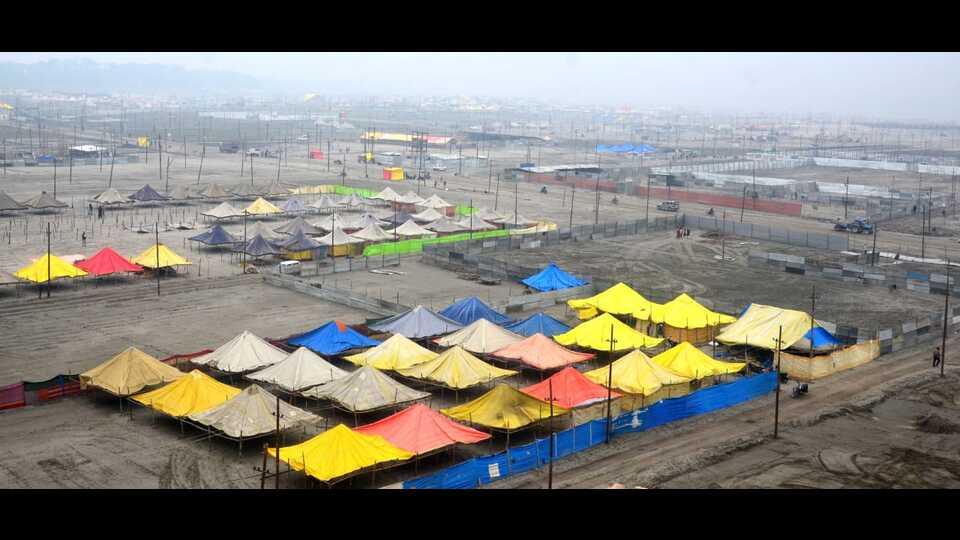
The Mela area has already reported 39 positive cases by the night of January 12 which includes 37 policemen and security personnel. However, the officials have made elaborate health arrangements for the devotees, who are arriving here for the first official bathing of the fair on Makar Sankranti (January 14) on the banks of Sangam.
“Latest RT-PCR tests declaring an individual to be free from the Covid-19 virus are a must for all including the pilgrims, saints and seers as well as visitors. Just on January 11 we removed 51 individuals from the mela area who did not have the RT-PCR reports with them. We have already informed all not to enter the mela area without an all-clear RT-PCR report,” said chief medical officer, Prayagraj, Dr Nanak Saran.
Chief minister Yogi Adityanath had chaired Magh Mela-2022 review meetings in run up to the fair—a development that has the officials doubly alert. “In view of the pandemic and the necessary precautions to be taken thereof, we have made proper arrangements of sampling centres and ambulances in adequate number for the fair. Each government staff in the mela is being deputed only after proper screening,” informed Magh Mela Adhikari Shesh, Mani Pandey.
For proper hygiene and cleanliness, 15,000 toilets have been built in the mela area. Of these, there are around 1500 pre-fabricated steel toilets, 3,000 tent toilets, 300 urinals, 9,000 institutional toilets and 900 at camps of government institutions, he added.
“For the devotees, we have also constructed 10 major ghats stretching from Nagvasuki to Quila Ghat near Sangam in order divert devotees to avoid overcrowding at one place,” he added.
Magh Mela Covid-19 Nodal officer Dr Rishi Sahai said that taking note of the challenges, 30 ambulances including 28 with basic life support and two with advanced life support capability have been parked in the mela area, besides two ambulances each for Covid patients in each of the five sectors of the tent city.
“A total of 12 static sampling centres will function daylong in the mela area besides 20 mobile testing teams that will be reporting at sites and camps after being alerted by the 82-member surveillance teams set up to identify potential cases and vulnerable points. The mela also has two hospitals of 20-bed capacity each and both have one bed ICU each also,” he shared.
The mela area has 16 entry points and all have screening teams in place that are checking the RT-PCR reports of the pilgrims and saints arriving in the mela area.
“Those having latest negative RT-PCR reports are only being granted entry into the mela area. At these points we also have thermal scanners. Five thermal cameras too have been installed to identify persons suffering from fever,” Dr Sahai said.
Recognizing the challenge that kalpwasis (people who camp in the tents to perform various religious rituals over a month-long period) present, the Mela officials have developed a system where all kalpwasis would be tested for Covid-19 once every week in the camps where they are staying, besides administering Covid vaccines to those who are eligible for a second or a booster dose, he said.
Permanent vaccination centres would operate in the Mela area at the two mela area hospitals, besides one in each of the five sectors of the tent city. A doctor would also be available at each of the first aid points (FAPs) that exist in every circle of each sector of the Mela area.
Those found Covid-19 positive would be isolated away from the mela area and for which Level-1 facilities including the CHC of Kotwa and Prayagraj Unani Hospital have been identified, Dr Sahai said.