
 E-Paper



Court discharges Sharjeel,Tanha in 2019 Jamia violence
Additional sessions judge Arul Varma, while discharging the accused people, criticised Delhi Police for initiating the prosecution against them in a “perfunctory and cavalier fashion”

 Prefer HTon Google


New Delhi
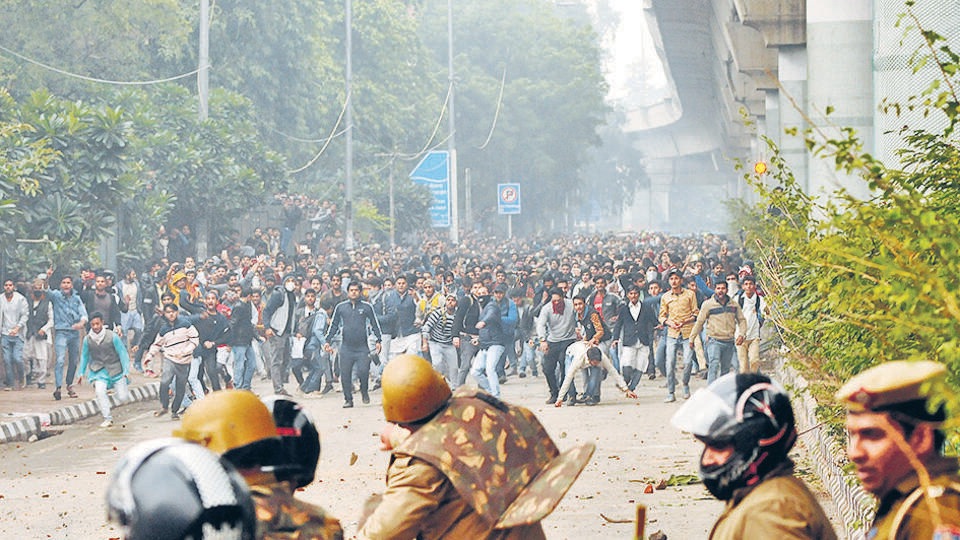
A Delhi court on Saturday discharged Sharjeel Imam, Asif Iqbal Tanha and nine other people from allegations that they were involved in violence near Jamia Milia Islamia University on December 13, 2019, observing that the right to dissent was part of fundamental protections under the Constitution, and that the police charged these people to scapegoat them.
Additional sessions judge Arul Varma, while discharging the accused people, criticised Delhi Police for initiating the prosecution against them in a “perfunctory and cavalier fashion”. The court noted in the order that allowing those charge sheeted in the case to undergo a long-drawn trial was not a good sign for the criminal justice system of the country.
Delhi’s Saket Court was hearing a matter regarding the violence that broke out near Jamia Milia Islamia University on December 13, 2019 when a gathering of approximately 700-800 people were protesting the Citizenship Amendment Act (CAA). The police indicted 12 people, including Imam, Tanha and Safoora Zargar, under various sections of the Indian Penal Code and Prevention of Damage to Public Property Act.
“There were admittedly scores of protestors at the site. It cannot be gainsaid that among the multitude, some anti-social elements within the crowd created an environment of disruption and did create havoc. However, the moot question remains: whether the accused persons herein were even prima facie complicit in taking part in that mayhem? The answer is an unequivocal “no”.”
The court came down heavily upon Delhi Police. “Marshalling the facts as brought forth from a perusal of the chargesheet and three supplementary chargesheets, this court cannot but arrive at the conclusion that the police were unable to apprehend the actual perpetrators behind commission of the offence, but surely managed to rope the persons herein as scapegoats.”
The court also pointed out in the order that the police should have made use of technology and gathered credible intelligence prior to bringing them before the court. It was further pointed out that despite filing three supplementary charge sheets in the matter, the police had nothing new to offer.
Judge Varma observed in the order that such police actions are detrimental to the liberty of the citizens who exercise their right to protest peacefully, highlighting that the police and investigating agencies need to know the difference between dissent and insurrection.
Varma pointed out that though insurrection must be “quelled indisputably”, dissent should be given space as it is reflective of something which pricks a citizen’s conscience.
Quoting Chief Justice of India (CJI) Dhananjaya Y Chandrachud , the court stated: “Recently, the Hon’ble Chief Justice of India, Hon’ble Justice D Y Chandrachud observed that ‘the destruction of spaces for questioning and dissent destroys the basis of all growth-political, economic, cultural and social In this sense, dissent is a safety valve of democracy. The subtext is explicit i.e. dissent has to be encouraged not stifled. However, the caveat is that the dissent should be absolutely peaceful and should not degenerate into violence.”
The court thus, due to lack of conclusive evidence, discharged 11 people, although it refrained from discharging one Mohd Ilyas.
Both Imam and Tanha were earlier granted bail in the matter. Imam would, however, continue to be in jail under the stringent Unlawful Activities (Prevention) Act, or UAPA in the conspiracy case related to the February 2020 northeast Delhi riots.


