
 E-Paper



Delhi’s Houses: The Jains of Daryaganj
Tracing the soul of a city through its homes, this column looks at houses as living archives of the millions of people who make Delhi

 Prefer HTon Google


Daryaganj was an early modern urban threshold of Delhi. The neighbourhood sits at the southern edge of Shahjahanabad. Here the Mughal capital begins to dissolve. Beyond it emerges the commercial and colonial city that expanded during the late 19th and early 20th centuries. Daryaganj therefore occupies a transitional position. It mediates between Old Delhi and the colonial city that followed. The houses here still preserve early Indian modernism in their structures.
Today, Daryaganj is increasingly described as an older part of the city. For many, a degree of obscurity has become a form of protection. To remain slightly forgotten is to remain largely untouched.

Historically, Daryaganj developed as a mercantile extension beyond the Mughal city walls. Over the 20th century, it became home to a significant Jain community. Merchant families settled here in large numbers, establishing businesses that ranged from bullion trading to publishing. Religious and social institutions followed. Temples, charitable organisations, and community schools anchored neighbourhood life. Commerce and faith remained closely aligned.
Many of the houses constructed during the mid-20th century reflect the architectural ambitions of this mercantile class. Daryaganj became an important site for the circulation of Art Deco and early Indian modernism. The buildings absorbed international design vocabularies while remaining firmly local in organisation and use.
One such house was built in 1951 by a Jain bullion merchant family. The structure survives largely intact. It is now occupied by four brothers who continue to live together as a joint household. Such arrangements have become increasingly rare in Delhi.
When I entered the house, I was welcomed by all four brothers. Lunch was served immediately. A thali arrived with several sabzis and curries, accompanied by the well-known bedmi poori of Old Delhi. The stories were inseparable from the wider Jain community that still shapes the social fabric of Daryaganj.

Within the neighbourhood, the house carries a reputation. The grandmother of the family had been awarded the title “Shrestha Shravika” in recognition of her work in the Jain community. Jain monks travelling through the neighbourhood frequently mapped their routes so they could stop here for aahaar – the ritual offering of food. The house’s courtyard therefore became familiar to many area residents. Locally, the address is simply remembered as “Saat Number ka Ghar.”
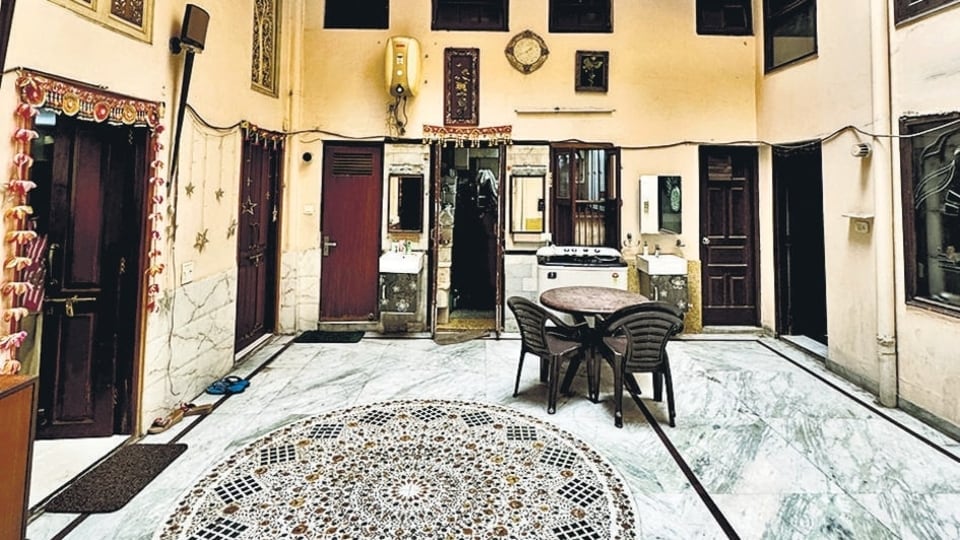
Architecturally, the building follows the grammar of the classic north Indian urban mansion. The house rises four floors. Each floor is occupied by one of the brothers. At the centre lies the defining architectural element: the aangan, or courtyard.
The courtyard functions as the spatial and social heart of the house. Its floor is laid in marbled terrazzo with floriated patterns embedded into the surface. The delicacy of the inlay approaches the refinement associated with pietra dura. Around the courtyard sit the kitchen, inner family rooms, and the formal drawing rooms used for receiving guests.

The outer drawing room presents the most visible traces of mid-century design. Pastel terrazzo surfaces, geometric ornament, and a stylised decorative insignia appear across the floor and walls. These details situate the house within the broader moment when Art Deco circulated through Delhi’s residential architecture. Global design vocabularies arrived through magazines, travel, and mercantile networks. Local builders translated them through available materials and domestic traditions.
Daryaganj thus became one of the city’s quieter sites of Indian modernism. The architecture was neither purely colonial nor strictly traditional. Instead, it negotiated between both worlds.
The courtyard remains the active centre of family life. Conversations travel easily between floors as voices move across the open space. Family gatherings still take place here. The aangan functions as the everyday theatre of the house.
Rooftops extend that domestic life outward. They are used for festivals, for kite flying, and for preparing jars of seasonal pickles left in the sun. From the roof, the skyline reveals the domes and minarets of Zeenat-ul-Masjid rising above the surrounding houses. The view makes visible the historical layering that defines this neighbourhood.
Daryaganj’s identity has long been tied to the world of books. For much of the 20th century, it served as one of India’s most important publishing districts. Major publishing houses and newspaper offices operated here. Printers, bookbinders, and distributors formed an entire ecosystem around them.

Sundays became synonymous with the Daryaganj Book Market. Pavements filled with second-hand books laid out in long rows across the street. Writers often arrived carrying cloth jholas filled with manuscripts. Publishers moved between offices with leather briefcases. Books were produced here, circulated here, and frequently rediscovered here.
Collectors searching for rare first editions negotiated carefully with pavement sellers. The real treasures were often hidden in storerooms behind the stalls. Those who were persistent were occasionally rewarded.
Despite the rapid transformation of Delhi, fragments of this older intellectual culture remain. Houses such as this one continue to anchor families across several generations.
Anica Mann works on archaeology and contemporary art in Delhi. The views expressed are personal.


