
 E-Paper



Gender gap in vaccination: J&K doing well say officials, but data disagrees
For every 1,000 men who received the shot in the state, only 708 women have been vaccinated, according to official data


Officials say Jammu and Kashmir is doing fairly well in terms of inoculating the women population against Covid-19, but the data begs to differ.
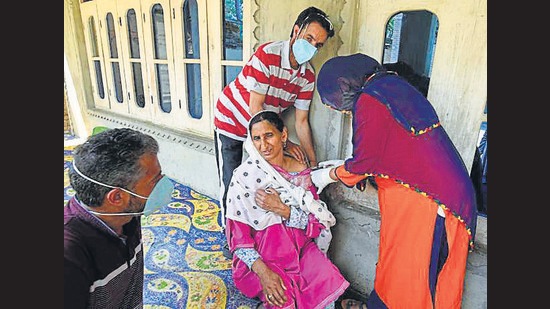
According to family welfare and immunisation director general Dr Saleem-ur-Rehman, J&K is among the best performing states and UTs and has been lauded for vaccinating 67% of its 45-plus population.
Be that as it may, J&K accounts for one of the highest gender disparities among its counterparts.
According to the data, till June 5, as many as 34,56,698 people were inoculated against the contagion in J&K. Of these, 11,99,427 are women and 16,91,829 men — a difference of 4,92,402.
This shows that for every 1,000 men who received the shot in the UT, only 709 women have been vaccinated.
As per Census 2011, the UT has a sex ratio of 889 per thousand males.
Lactating mothers adding to deficit
When asked about the significant deficit in the inoculation of the two genders, Rehman attributed it to the lakhs of lactating mothers who were yet to take the jabs in the UT.
He said, “J&K sees around 2.50 lakh births per year. This accounts for nearly as many lactating mothers, taking the approximate number of women yet to be vaccinated to over 4.50 lakh.”
Ruling out stigma and vaccine hesitancy, the official, said, “There is neither any stigma nor reluctance among women to get inoculated,” urging pregnant and lactating mothers to take the vaccine shots. “It has now been proven beyond any doubt that the vaccine does not affect a lactating mother’s milk,” he assured.
Rehman said he could not think of any other possible reason for the deficit.
Research has come a long way
Rehman said that medical research on Covid-19 has evolved in the due course of time with there being a much better understanding of the disease.
“Initially, the guidelines didn’t endorse vaccine for lactating mothers. But in the past one and a half years, we have come to know that it does not affect their feed. I am sure they will come on board soon,” he said.
Speaking about administration’s measures to tackle vaccine hesitancy among other groups, Rehman said, “We came up with a foolproof implementation plan. We roped in religious leaders, influencers, medicos, women senior officials and applied every method there is in the book,” he said.


