
 E-Paper



HT Readers’ take: End the wait for non Covid patients
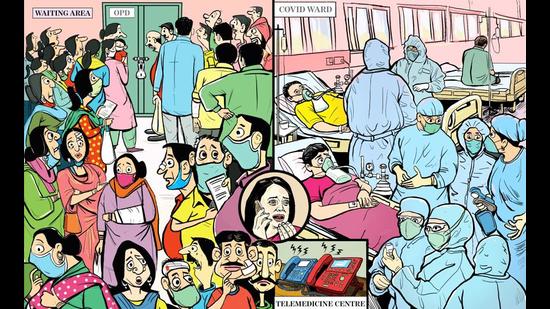
Non Covid patients are perhaps the invisible casualty of the pandemic. Neglected, they suffered silently for months as hospitals shifted all their resources to Covid care. With the Covid situation seemingly under control, readers say it is the right time to resume and scale up OPD services and elective surgeries, before the third wave comes


Private hospitals minting money
Amid the suspension of OPD services by PGIMER, private hospitals are minting money by charging exorbitantly for tests and consultation. Some of the hospitals charge almost 10-fold the amount charged by PGI. It is surprising that even after a year-and-a-half of the pandemic outbreak, PGIMER’s OPDs remain closed.
DS Banati,Mohali
Don’t neglect non-Covid patients
Persons suffering from chronic diseases are suffering due to the closure of OPDs by government hospitals as private consultations cost a fortune. It is prudent to make arrangements for the impending third wave of the pandemic, but at the same time, authorities must not neglect other patients. Hospital administrations must work out modalities to resume OPD services in a safe manner.
Kidar Nath Sharma, via email
Tele-consultation lacks reach
Medical and paramedical staff have done a commendable job during the first and second waves of the pandemic. It is now time to focus on other patients, particularly those from poor and rural backgrounds, who may not have been able to access teleconsultation services or private healthcare facilities.
Subhash Chugh, via email
Affordable healthcare must be accessible
Suspension of OPD services and elective surgeries during the peak of the pandemic left many high and dry. Government-run hospitals, such as PGIMER, are crucial in providing affordable healthcare to those who can’t shell out heavy consultation charges of private doctors. It is thus imperative that non-Covid services must be resumed at the earliest.
Vineet Gandhi, Chandigarh
Telemedicine no match for in-person diagnosis
It is high time that Post Graduate Institute of Medical Education and Research (PGIMER) resumes OPD services and elective surgeries as it caters to patients from at least six states. Telemedicine services cannot match in-person diagnosis. Doctors should rise to the occasion and get the authorities to resume the services at full scale before another wave strikes.
Pardeep Sapra, via email
Normalcy in all walks, why not in hospitals?
When normalcy has returned to all other walks of life, why can’t hospitals resume healthcare services in a phased manner. Though private hospitals gave resumed most services, with SOPs in place, the government ones have been lagging behind. It is understandable to be cautious amid the looming threat of a third wave, but non-Covid patients must not be neglected. PGIMER and other hospitals must resume their services, beginning with critical patients. Prior registrations can be made mandatory to avoid unnecessary crowding.
Surinder Paul Wadhwa, Mohali
Imperative for timely diagnosis, treatment
It is imperative to open walk-in OPDs for patients, who have not been able to receive timely treatment after pandemic outbreak, to avoid further deterioration of their health. The poor have suffered the most as going to expensive private hospitals is not an option for them. The walk-in patients should be asked to provide their vaccination certificates or get themselves tested on site. Such measures would reduce the risk of Covid infection and spread.
Gurnoor Grewal, Chandigarh
More delays will increase patient load
PGIMER must live up to its reputation and lead the way in resuming OPD services for patients. The over-cautious approach in anticipation of a third wave will harm non-Covid patients whose health condition may worsen in the absence of affordable healthcare that only government-run institutions can provide. Currently, Covid cases are low so doctors can shift their attention to other patients in need of care. More delays in reopening OPDs will only increase the patient load.
SC Luthra, Chandigarh
Rethink healthcare delivery systems
The Covid-19 crisis seemingly provides a sudden glimpse into a future world, one in which digital has become central to every interaction. Now is the time to rethink healthcare delivery and adopt operations management strategies with demonstrated success that are most promising. This will allow us to be better prepared for future waves of the Covid-19 pandemic.
Khushboo Singla, Mohali
Streamline patient inflow for safety
Post Graduate Institute of Medical Education and Research must resume OPD services but certain steps must be taken to avoid the risk of infection spread. Online tokens must be issued to streamline patient visits. Only one attendant must be allowed to accompany a patient so as to avoid unnecessary crowding. All Covid protocols, such as wearing of masks, maintaining social distancing and regular hand sanitising, must be strictly followed to avoid infection spread once the services are restored. Sumesh Kumar Badhwar, Mohali
Chronic patients need regular care
With a gradual decline in Covid cases over the past few days, it would be advisable to resume OPDs and elective surgeries in government hospitals and PGIMER. Senior citizens are more likely to have chronic health problems. Due to the closure of OPDs, the condition of many patients has worsened. Patients with serious ailments such as cancer, diabetes, heart disease, need regular medical care. Resuming the services in government hospitals will provide relief to the common man as private hospitals are looting the public. To cut short the patients’ waiting time, the OPD timings must be increased.
Vijay Malia, Chandigarh
Non-Covid patients took a backseat for long
For the last several months, the world, especially our medical professionals, have been focused on fighting the pandemic. While Covid patients were treated on priority, the others had to take a backseat. However, now as the Covid cases are going down, it is time to shift focus on other ailments. At such a crucial juncture, when we are looking at a possible third wave in the coming months, we should not let our guard down. Hence, hospitals must impose all Covid protocols, such as maintaining social distancing, following mask norms, and proper hygiene while opening up OPD services. If we take adequate measures to check infection spread, we can treat all patients while keeping patients and doctors safe from the virus.
Usha Verma, Chandigarh
Crucial time for hospitals to prepare for third wave
When the pandemic started last year, hospitals worldwide diverted their resources to battling Covid. This resulted in resource constraints. Further, clinicians and non-Covid patients deferred “non-urgent” visits, evaluations, diagnostics, surgeries and therapeutics due to fear of infection. With another wave still on the cards, hospitals must be on the stand by to deal with it. So, this would not be the right time to scale up non-Covid services.
Ishita Nara, via email
No more delays for non-Covid patients
It is reassuring to know that Covid cases have started declining in the city. In view of this, all government-run hospitals, including the Post Graduate Institute of Medical Education and Research, must be reopened at the earliest. Any further delay in treatment for non-Covid patients may push us into a health crisis. While it was important to suspend these services in the initial months of the pandemic when the world was facing and unknown, invisible enemy, it is time that all institutions work out modalities to restore normalcy, be it schools, hospitals or workplaces.
Kundan Lal, Mohali
Clear non-Covid backlog, prepare for third wave
As the pandemic is relatively under control, it is the right time for open hospitals to restart routine OPD check-ups and elective surgeries. People have postponed their routine visits for chronic ailments since long and they need to be addressed now. There is a backlog of elective surgeries that need attention. At the same time, in view of the threat of a third wave, a parallel system should be put in place to cater to Covid patients so that in case there is sudden surge in cases, the system should not collapse. We should make use of the time to put our healthcare system back in place.
Mukesh Wadhwa, via email
Phased reopening must to avoid healthcare crisis
Though the threat of the third wave still looms large, we must not forget the economically weaker sections who cannot afford treatment at private hospitals or avail of services such as online consultation, online appointment booking etc. For their ease, it is critical that government-run hospitals resume their services in a phased manner to avoid a health crisis. OPDs at GMSH-16 and GMCH-32 are already functional, so there is no reason for PGIMER to not do the same.
Subhash Nagpal, Zirakpur
Not all are tech savvy for tele-consultation
With a visible drop in Covid-19 cases, it is the right time for Post Graduate Institute of Medical Education and Research and other institutions to gradually open and then scale up outpatient department treatments and elective surgeries. While it may not be possible to go back to the pre-pandemic ways, the hospital can still take some measures to alleviate the patients’ suffering while also keeping infection at bay. Though PGI has decided to resume OPD services on appointment basis, all patients are not able to avail it as they are unable to get prior appointment online. If the hospital resumes the services to a certain extent, patients of chronic diseases such as liver-related issues, diabetes, hypertension, heart-related disorders can avail of treatment before their condition deteriorates. To prevent the overcrowding in outpatient departments, inflow must be streamlined at the entry point and distancing measures must be taken.
Prabhjot Nagpal, Zirakpur
Covid situation seems under control
In the initial months of the pandemic, shutting down walk-in OPDs was inevitable. Teleconsultations came to the rescue then. But now that the Covid situation is under control, walk-in OPDs must be made operational as non-Covid patients have been suffering in silence for months on. To avoid risk of infection, strict SOPs must be put in place. But we certainly cannot turn a blind eye to the pain of non-Covid patients.
SS Arora, Mohali
Can’t put off non-Covid treatment forever
Lots of surgeries and treatments have been put off during the first and second waves. Many patients themselves avoided visiting hospitals for fear of contracting the virus. They have suffered silently and are perhaps the invisible casualties of the pandemic. While we have the count of Covid infections and deaths, we have no idea about how many died and endured pain due to diseases other than the Covid, in the last over 18 months. With a large part of the population already vaccinated, and Covid cases also remaining low, it is now a good time to shift focus on non-Covid patients before the third wave hits. We don’t know how long the pandemic will continue, so we can’t put off non-Covid treatments forever.
Karan Gaba, via email
Resume services but avoid overcrowding
With Covid-19 infection count falling to single digit in the tricity, it is certainly the time for hospitals to concentrate on OPD and elective surgeries. But at the same time, care should be taken to avoid overcrowding at OPDs as we are still facing a threat of the third wave. A multi-pronged approach is required for this. While the entry may be controlled by taking temperature by infrared scanners etc. rather than elaborate testing procedures, the basic approach should be to strengthen the primary and secondary healthcare system in the tricity so that people don’t reach Post Graduate Institute of Medical Education and Research as their first port of call for medical attention. Telemedicine facilities need to be strengthened. Universal affordable healthcare shouldn’t simply remain a mission statement, it needs to be achieved in concrete terms.
Lt Col GS Bedi, Mohali
All lives precious, deny treatment to none
After the pandemic outbreak, the administration had to take urgent steps to prevent the spread of the virus. At the time, it was important to suspend other operations to focus on the pandemic. All three government hospitals in the city stopped admitting non-Covid patients. But it has been over a year-and-a-half, and the world has learnt to live with the pandemic. Now, the pre-pandemic show must go on. For this, it is important to restore all medical health services, including walk-in OPDs. Each human life is precious. So treatment must be made available with any discrimination- Covid or non-Covid. Telemedicine consultancy must continue to reduce footfall in hospitals but all facilities must be restored with proper standard operating procedures. Col SK Aggarwal (retd), Panchkula
No patient should suffer due to lack of medical facilities
As Covid cases have decreased, government must make arrangements to treat non-Covid patients. They should resume the OPD services and elective surgeries and gradually scale it up in a phased manner. Patient inflow must be controlled. Besides, government hospitals can use any vacant building in the city for these services. For surgeries, patients must be given priority after giving due consideration to their health condition. No patient should die or suffer due to non-availability of medical facilities.
Avinash Goyal, Chandigarh
Let no one suffer
It is high time that hospitals are opened for the general public. The situation is currently under control as far as tricity’s Covid status is concerned. There are people who are suffering due to problems other than Covid and were not given full attention in terms of medical help. Out patient departments at government-run hospitals should be opened with strict protocols, such as masking, distancing and hand hygiene. Let no one suffer.
Garv Bhupesh, Panchkula
Poor have suffered due to suspension of services
The poor have suffered the most, mentally as well physically, due to non-availability of medical, oupatient department services and surgeries at Post Graduate Institute of Medical Education and Research and other government hospitals. With the pandemic situation showing a slight improvement in the tricity, it is a good time to resume these services for the benefit of the poor, who can’t afford the exorbitant costs of private hospitals. However, Covid norms such as wearing masks, hand sanitising and social distancing must be strictly followed at the hospitals to avoid risk of infection.
Col TBS Bedi (retd), Mohali
Time to focus on non-Covid patients
With Covid cases on the decline, non-Covid services must now be opened up since these patients are also suffering. While resuming the services, strict precautions should be observed. There should be clear demarking of the Covid and non-Covid wards and doctors to avoid spread of infection. Prior online appointments and teleconsultation services can help reduce footfall in hospitals. We must not forget that all patients are equally important.
Saikrit Gulati, Chandigarh
Reader of week
Resume OPD services with SOPs in place
For the past several months, many patients with serious ailments had to suffer as government hospitals discontinued their OPD services amid the escalating Covid situation. All major hospitals, including the PGIMER, must resume walk-in OPD urgently for the benefit of such patients. They should also take care to ensure that Covid protocols are not violated at any cost, to pre-empt chances of the looming third wave.
Ramesh K Dhiman, Chandigarh
Experts’ take
Alleviate patients’ pain
Non-Covid patients have already suffered a lot. Since infections are now declining, it is high- time to resume walk-in OPDs and elective surgeries.
Dr VK Nagpal, medical superintendent, GMSH, Sector-16.
Risk of infection
Covid cases are fluctuating daily. As per experts, complacency in following protocol can invite the third wave in October. If we start walk-in OPDs now, infection can spread easily.
Dr AK Gupta, dean (research)-cum-medical superintendent, PGIMER.
Safety measures
For crowd management, steps, such as increasing OPD hours or mandating prior registrations, can prove useful. Count of elective surgeries’ must be increased as it is done in an OT where crowd management is not a problem.
Dr KK Talwar, former PGIMER director
Screening & vax
Preference may be given to vaccinated persons at OPDs. Also, proper screening and Covid-safety protocols may reduce the risk of infection and help hospitals scale up non-Covid health services.
Dr Rajesh Gulia, acting CEO, Mayo Hospital, Mohali
Partial restoration
This is the right time for PGI to start walk-in facilities but with a cap on crowding. Full-fledged resumption can increase risk of infection but partial resuming of services will give some relief to the poor patients.
Dr Sudhir Garg, medical superintendent, GMCH-32.


