
Sign in

HT interview: ‘Want to ensure that Gurugram emerges as the cleanest city,’ says Naveen Goyal

Nearly 200 party functionaries quit with me when I was denied a ticket and decided to contest the election as an independent. A number of senior leaders across Haryana have also left the BJP due to poor ticket distribution and definitely this will impact the organisation both at the local level and the state level, said Goyal

Updated on: Sep 15, 2024, 05:12:03 IST
Share
Share via
  • facebook
  • twitter
  • linkedin
  • whatsapp
Copy link
  • copy link

Gurugram: Independent candidate from the Gurgaon assembly constituency, Naveen Goyal, who was a senior BJP member till a few weeks ago, decided to quit the party on being denied a ticket and contest the election on his own. He remains confident that his social and political work spanning the last 13 years in the city, will fetch him strong support from the people and ensure his victory. Goyal spoke to Leena Dhankhar and Abhishek Behl and outlined his strategy for the assembly election on October 5. Edited excerpts:
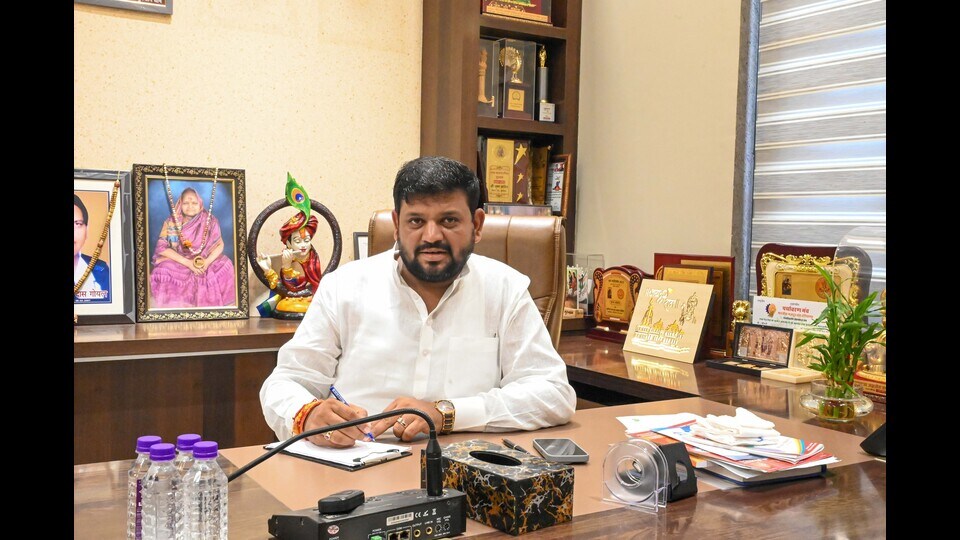
Naveen Goyal, independent candidate for the Gurgaon seat during an interview at his office in Sector-17, in Gurugram. (Parveen Kumar/HT)

What led to your decision to quit the Bharatiya Janata Party (BJP) and contest the election as an independent?

I have been working for the party and the organisation for the last 13 years and the only objective is to work for the development of Gurugram in a holistic manner. I have worked for the party across the state and the decision of the party to give a ticket to a candidate, who has fought elections from Badshahpur twice and shifted only recently to Gurugram has hurt me a lot. Not only me, but several other senior leaders have not been able to accept it. If the ticket was given to a candidate who had worked locally, then it would have been a different matter. The ticket should have been given on merit. I decided to contest because the people of Gurugram want me to do that.

How do you plan to contest against well-established parties such as Congress and BJP, which have strong organisational set-up?

I have created a team of workers in the last 13 years and they are in the field reaching out to people in the civil society. We will have a team of booth level workers, and the election will be fought in a planned and strategic manner. We will have a strong social media outreach to tell the people what we stand for. The experience of working in the party organisation is already coming in handy.

What has been the impact of your resignation on the BJP locally since you quit with a number of functionaries?

Nearly 200 party functionaries quit with me when I was denied a ticket and decided to contest the election as an independent. A number of senior leaders across Haryana have also left the BJP due to poor ticket distribution and definitely this will impact the organisation both at the local level and the state level. With several key functionaries at the booth, mandal and district level deciding to leave, it will certainly impact the party fortunes in the upcoming elections.

What is your vision for Gurugram and how do you see the city in the next five years?

I want to ensure that Gurugram emerges as the cleanest city in the country and the problem of waste management is resolved on priority. The issues of damaged roads, poor sewage system and waterlogging will be resolved by taking help from experts in these fields. A holistic plan will be developed to ensure all round development of the city. We will ensure that metro lines are extended, bus stands are built, and hospitals come up in the city and don’t remain a promise on paper.

A large number of people attended the nomination rally. How will you ensure that this turnout transforms into actual votes on polling day?

The supporters who are pushing me to contest elections and the people of Gurugram showed great energy on nomination day and I am fully confident that these people will come out in full strength to vote for me as an independent candidate. I am contesting because the people of Gurugram want me to fight the election and it is a collective decision. I am not in the electoral contest to gain money or political power but only to serve the people of this city.

Gurugram has traditionally voted on community lines and depending on the candidate, the people vote. How do you plan to get votes from all sides as it will be crucial for electoral victory?

No doubt Gurugram has a number of dominant communities but in the last 14 years of my political career as a worker, party functionary and leader, I have always reached out to people of all communities. I have support from 36 communities and that is my strength. I have carried out political and social work without giving any thought to caste and community. During the nomination rally, people from all communities had supported me and I am confident they will vote for me without any such consideration.

What is your message for the people of the city?

I want the people to vote on the basis of merit and consider the work done by me in the last 13 years. The party may not have given tickets on merit but the people should vote only on performance and ensure that the best person wins.

  • Leena Dhankhar
    ABOUT THE AUTHOR
    Leena Dhankhar

    Leena Dhankhar is Senior Editor and Bureau Chief, Gurugram, at Hindustan Times, where she has spent over 17 years chronicling the transformation of one of India's fastest-growing urban regions. From starting her career as a crime reporter to leading the Gurugram bureau, her journalism has been defined by investigative reporting, in-depth storytelling and an unwavering focus on public interest. Over nearly two decades, she has reported extensively across crime, politics, civic governance, elections, real estate, environment, courts, sports, education and entertainment, covering Gurugram, Faridabad, Nuh and Palwal. Her reporting has exposed several major scams and systemic failures, including insurance frauds, waste management irregularities, illegal arms manufacturing units in Nuh, illegal mining in the Aravallis, organised crime networks and governance lapses affecting millions of residents. Known for her investigative work and exclusive stories, Leena has reported on high-impact national issues, including the Nicaragua charter flight carrying Indian migrants that was turned back amid allegations of human trafficking, exposing the growing network of illegal immigration rackets. Her work has also focused on gang wars, prison administration, juvenile crime, women and child protection systems, the functioning of the Juvenile Justice Board and Child Welfare Committee, and environmental challenges such as pollution, waterlogging and deteriorating civic infrastructure. Beyond hard news, Leena has extensively documented Haryana's rich heritage, forests and wildlife, bringing attention to the state's historical landmarks, biodiversity, conservation efforts and ecological challenges through immersive reportage and feature writing. Her journalism has consistently gone beyond breaking news. She has documented Gurugram's rapid urbanisation through long-form narratives and enterprise reporting on issues ranging from pothole-ridden roads, flooding and waste management to the changing social fabric of India's Millennium City. She also writes widely read feature columns, including The Outsider, Changemaker, and Concern for Gurugram, profiling people, places and ideas shaping the city's identity. Leena is the author of Gurugram School Murder, published by Juggernaut Books, a deeply reported account of one of India's most high-profile school murder investigations. She is currently working on her second book, an investigative work exploring some of India's most significant scams and fraud investigations. Beyond print journalism, she has expanded her storytelling through public speaking and digital media. She is a TEDx speaker and has produced podcasts exploring Gurugram's transformation, civic challenges and untold stories. Her work reflects a commitment to narrative journalism that combines rigorous reporting with compelling storytelling. A law graduate with an MBA in Human Resources, Leena brings a multidisciplinary perspective to her reporting, particularly on governance, public policy and legal affairs. She has travelled extensively across India to pursue investigative assignments, often reporting from remote locations and conflict-prone areas in search of stories that matter.Read More

  • Abhishek Behl
    ABOUT THE AUTHOR
    Abhishek Behl

    Abhishek Behl is a Special Correspondent with Hindustan Times, Gurugram bureau. With over a decade of experience in journalism, he reports on Gurugram's rapid urban transformation, covering the city's changing infrastructure, governance, and planning landscape. His reporting spans major civic agencies, such as the Gurugram Metropolitan Development Authority (GMDA), Department of Town and Country Planning (DTCP), Haryana Shahari Vikas Pradhikaran (HSVP), and the National Highways Authority of India (NHAI). Behl has reported on key urban development issues such as RRTS projects, metro expansion, road and highway projects, water supply, drainage, mobility, environmental concerns, land use planning, affordable housing, and the city's real estate sector. He closely tracks policy decisions, infrastructure implementation, and their impact on the city and its residents. He also covers regulatory action against illegal constructions, urban flooding, traffic management, and initiatives aimed at improving civic services and sustainable development. Behl has also written on political developments in south Haryana, focusing on elections and governance. His journalism is driven by fact-based reporting, ground-level coverage, and an understanding of the social and economic dynamics of Gurugram. Apart from work he is a cyclist and a cricketer and a resident of Palam Vihar since 2010.Read More