E-Paper



Closely-located shops, lack of safety arrangements major obstacles to fire op
The figure is set to go higher as the flames couldn’t be doused despite the best efforts of firefighters.

 Prefer HTon Google


KANPUR In less than 48 hours, the fire which erupted in Kanpur’s Basmandi area damaged 800 shops and claimed a man’s life. The loss at the time of filing this report was estimated at over ₹2,000 crore. The figure is set to go higher as the flames couldn’t be doused despite the best efforts of firefighters. In fact, the blaze is not confined to the city’s biggest hosiery market anymore, it is expanding to areas in proximity.
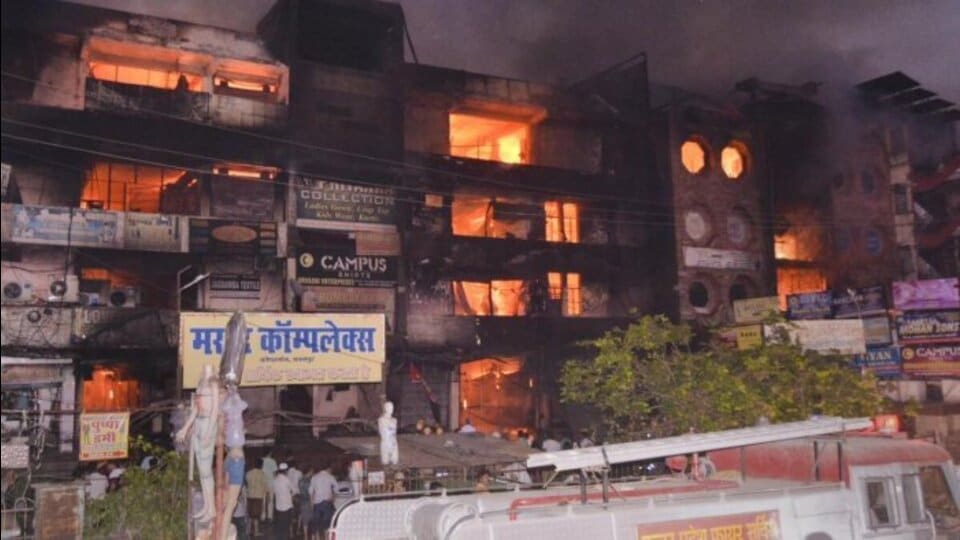
According to senior authorities -- including Anand Prakash Tiwari, joint commissioner of police, and chief fire officer Deepak Kumar -- several factors are hindering the fire operation. They said that all the heavily stocked shops in the market were closed when the fire broke out. While the stock inside caught fire, the firemen were unable to push the water inside due downed shutters. As the temperature was high, the firemen couldn’t even go inside to contain the flames.
Significantly, the walls got heated to a level that the fire rekindled and started spreading further. To add to this, closely-located shops made it difficult for the firefighters to spray water at each point meticulously. Fire officer Ajay Singh pointed out that all the shopping complexes stand next to each other with no mandatory set back of 2 metres. The closeness of structures allowed the fire to spread rapidly. Similarly, all the staircases are less than 1 metre in width in all seven complexes even as the law mandates a minimum width of 1.6 metres in commercial structures.
Besides, none of the building were equipped with fire safety arrangements. The structures lacked smoke detectors and water sprinklers. The makers of these complexes focused on carving out the maximum number of shops in the buildings rather than spending on fire safety measures, said authorities. The inferno managed to damage AR Tower 1, Masood complex 1 & 2, and Hamraz complex completely. Officials said these structures would be brought down for general good after the inside temperature settles.
Meanwhile, winds fanned the fire, making it more intense and causing it to spread more quickly than anticipated. Eyewitnesses say that the fire broke out in the transformer close to the AR Tower. Subsequently, policemen came to the site and alerted the fire station. Later, only one fire tender was sent. Due to sluggish attempts in the initial minutes, fire kept spreading and soon, enveloped the entire area.
AKHILESH YADAV DEMANDS COMPENSATION FOR AFFECTED TRADERS
Taking cognisance of the fire incident, Samajwadi Party president Akhilesh Yadav reached the Basmandi market. The SP chief asked the government to provide instant compensation to affected people. Although his visit was mired by the chaos caused by his supporters, Yadav met the traders. He said that the government should also take a call on giving temporary space to these traders and build a new market for them. He estimated the loss at ₹3,000 crore.