E-Paper



Odisha beach sees record mass nesting of 6.41 lakh Olive Ridley sea turtles
Around 6.41 lakh Olive Ridley sea turtles have laid eggs on the Rushikulya sea beach between Podampeta to Bateshwar till Friday night

 Prefer HTon Google


Bhubaneswar: A record 6.41 lakh Olive Ridley sea turtles have laid eggs at the Rushikulya rookery in Odisha’s Ganjam district till Friday night during the mass nesting season that began this week and lasts till March first week. Wildlife officials and conservationists said on Saturday that this makes an all-time high for the mass breeding site at Rushikulya rookery, which is the largest such site in the country.
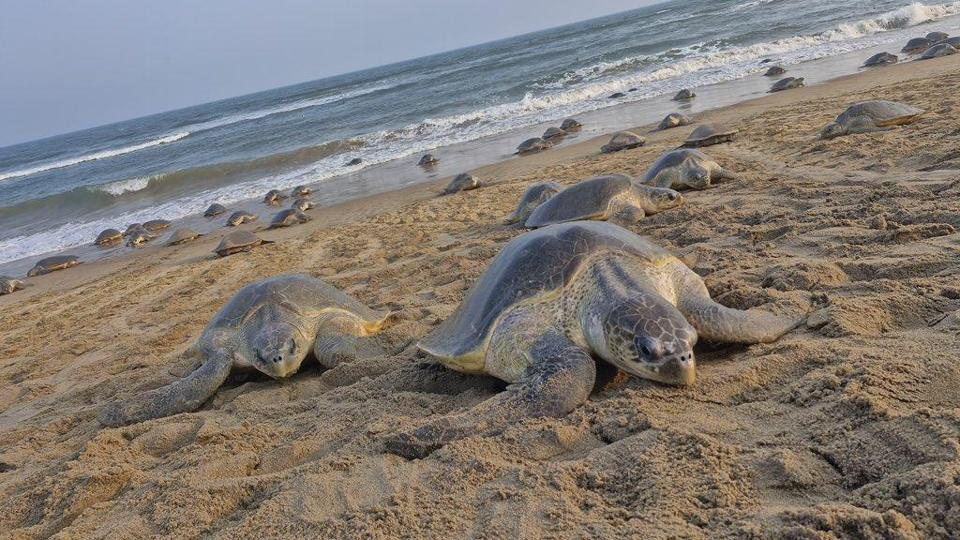
The Oidhsa principal chief conservator of forests (PCCDF) (wildlife), Prem Kumar Jha, said that around 6.41 lakh turtles have laid eggs on the Rushikulya sea beach between Podampeta to Bateshwar till Friday night, surpassing the previous highest nesting of 6.37 lakh Olive Ridleys in the 2022-23 season.
Jha said by the time the nesting season, called arribada (Spanish for arrival) gets over on Rushikulya by March first week, the number may go upto 7 lakhs.
Olive ridley turtles are the smallest of the marine turtles in the world. The turtles lay their eggs in flask shaped nests about a foot and a half deep, which they dig with their hind flippers. On an average, one turtle lays 50-100 eggs during a season.
The eggs incubate under the sand for a period of 45-55 days depending on the weather conditions. After the arribada, the females head back into the sea and typically migrate back to their foraging grounds. After about 45-65 days, the eggs begin to hatch and the baby turtles crawl towards the sea.
As per the forest department data, Olive Ridleys had skipped mass nesting at Rushikulya in 2015-16, 2018-19, 2020-21 and 2023-24 over the past decade.
Turtle researchers say no one knows why Olive Ridley turtles skip a nesting ground. “What we know for sure is once they do mass nesting on a beach, they skip it for a couple of years. There are several environmental reasons such as unseasonal rain, absence of southern winds and El Nino. But it’s difficult to say why the turtles skip mass nesting a particular year,” said Bibhash Pandav, a turtle researcher at Wildlife Institute of India, Dehradun.
Though Gahirmatha beach in Odisha’s Bhitarkanika district was one of the world’s largest mass nesting sites along with the coasts of Mexico and Costa Rica, beach erosion has reduced the area, forcing most of the turtles to migrate to Rushikulya river mouth.
State wildlife officials said that to facilitate smooth nesting this season, fencing was done over a 5-km stretch along the coast while joint sea patrolling was intensified. As the turtles get disoriented due to lights, the ports and industrial establishments have been asked to dim the string lights of their facilities near the nesting sites till the hatchlings move out to the sea.
Forest staff, coast guard, marine police and marine fishery departments patrolled the sea jointly to prevent fishing within 20 km from the nesting site on the coast from November 1, when the turtles congregate offshore for mating, to May 31.
The Indian Coast Guard recently inaugurated ‘Operation Olivia’, a comprehensive initiative aimed at safeguarding the turtles during their nesting period in Paradip. Using drones, Coast Guard vessels, and Dornier aircraft, Coast Guard officials tried to prevent any alien intruders into the riverbeds where the turtles are laying their eggs.