E-Paper



Study finds evidence of prosocial behaviour in wild elephants of northeast India
On two separate occasions, adult male elephants rescued adult females that were sedated by the research team as part of their study, which highlighted their social intelligence and cognitive capabilities.


A new study, published by a team of wildlife scientists, has shown strong evidence of prosocial behaviour among wild elephants in northeast India. On two separate occasions, adult male elephants rescued adult females that had been sedated by the research team as part of their study, which highlighted their social intelligence and cognitive capabilities.
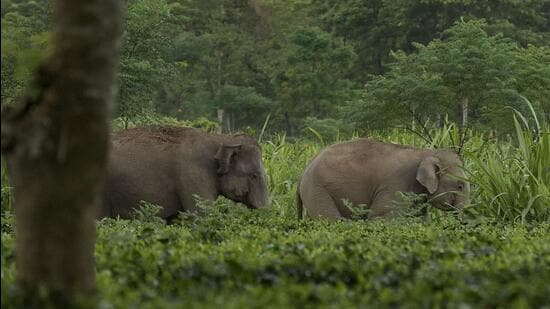
The study, led by researchers from the World Wildlife Fund (WWF) India, the Assam Forest Department, University of Cambridge, the IUCN Asian Elephant Specialist Group, and several other NGOs and government bodies, was published last week in Biotropica, an international peer-reviewed scientific journal.
“This study adds perspective to the long-standing question of whether altruistic behaviours exist in animal society by documenting these infrequent and notoriously challenging-to-observe events. The conventional notion is that animals help each other only if they are related or they can be of help in the future, though this does not always need to be the case,” the findings of the study revealed.
As part of their ongoing project to GPS-collar wild elephants and study their movement patterns and the causes of human-elephant conflict, the researchers conducted fieldwork in Sonitpur, Assam. Their study sites included the Sonai Rupai Wildlife Sanctuary and Addabarie Tea Estate.
In both locations, the team tranquillised an adult female elephant from a larger herd to safely fit her with a GPS collar. While the rest of the herd moved away from the research team, an adult male elephant approached the sedated female (in both locations).
In Sonai Rupai, it was a tuskless male, known as a ‘makhna’, and in Addabarie, it was a tusker. Despite the perceived threat posed by the study team’s presence, both males intervened by pushing the female out of sedation and away from the team — an entirely unexpected action.
“This counter-intuitive behaviour fits the criteria considered necessary to be ‘rescue behaviour’ and highlights an understudied aspect of their behavioural ecology,” the study said.
The researchers noted that such altruistic actions could stem from emotional contagion or empathic concern, a phenomenon in which individual animals respond to the emotional or physical state of other individuals, or even reciprocal altruism — a behaviour where help is extended without immediate benefit but with the potential for future rewards could be driving this.
“This study provides a difficult-to-document insight into cultural behaviours in the animal world, which in turn could help us better understand the ethical implications of how we manage wildlife. For instance, this underscores the need to look not only at numbers when framing elephant conservation goals but also at securing their quality of life,” it added.
Arjun Kamdar, lead author of the study and an MPhil student at the University of Cambridge said, “Elephants’ incredible ability to empathize, understand complex coordination tasks, give names to each other, and use tools has long been established. These findings underscore the need to consider their social and emotional intelligence when framing their conservation management” said.
Nitin Sekar, senior author on the study and a senior fellow at Conservation X Labs stated that the observations of the study add to the considerable evidence that elephants and many other non-human animals are thinking, feeling individuals with personalities.
“In total, this evidence should push us to shift how we treat sentient non-human animals– not as machines or possessions, but as individuals whose quality of life is worth promoting and protecting when possible.” he said.