
 E-Paper



FTII students protest inequalities in admission process for reserved quota
On July 26, the FTII published their final merit list for the academic year 2021, and the students pointed out that the authorities are making a mockery of the provisions of reservation under which these admissions are to be carried out


A group of students from the Students’ Association, Film and Television Institute of India (FTII), held a silent protest outside the FTII holding placards against inequality in the admission process for students from the reservation quota.
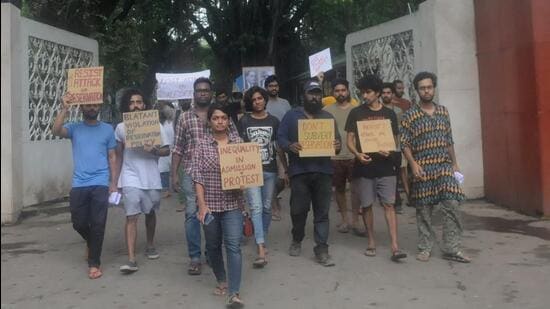
On July 26, the FTII published their final merit list for the academic year 2021, and the students pointed out that the authorities are making a mockery of the provisions of reservation under which these admissions are to be carried out. “Many seats (this time, there are 11 seats for every department with the inclusion of the economically weaker sections/EWS category) as well as waitlist positions in the other backward classes/OBCs, scheduled castes/SCs and scheduled tribes/STs categories have not been filled, citing reasons of ineligibility,” said Samadrita Ghosh, general secretary, Students’ Association, FTII.
“There is no transparency about how these figures are arrived at and by whom, not to mention that the validity of this criteria itself is disputable. This is a consistently growing trend that we have observed over the years as an effort to put a filter on incoming institute members and to mute our voices against their attacks on our basic social rights. The student community considers this a blatant violation of the laws of reservation, hiding under the garb of self-made rules of the institute. We firmly stand against their values reflected in the merit list and ask that they re-evaluate the result,” said Ghosh.
Questioned about the discrepancy, the administration sent a message to the students which read, “Many candidates did not pass their cut-off percentages namely 45% for OBC (NCL) and general EWS, 40% for SC and ST and gen PwD, and 50% for general.”
The students alleged that due to such arbitrary rules, the authorities can claim every year that they did not find suitable candidates in the reserved categories and fill the reserved seats with students from the general category. The students said it is questionable how only candidates from privileged, upper castes aspiring for general seats are able to clear the cut-off while those belonging to the OBC, SC and ST categories are not able to do so. This way, seats supposed to be left open for all in the general category, too, remain closed to those from other categories.
The students questioned the method of admission with the orientation and interview process accounting for 80% of the total grade for admission to the institute. The students called it ambiguous and claimed that a bias exists in how candidates are evaluated and deemed ineligible as reserved seats remain unoccupied by aspirants from the respective categories across departments. “Additionally, the orientation and interview was conducted online this time, highlighting further inequalities in the admission process,” said Avanti Basurkar, president, Students’ Association.


