
 E-Paper



How an engineer’s innovative gun made plastic surgeons’ work easier
Saiprasad Poyarekar, 36, launched Pacify Medical Technologies in 2018 to give shape to his idea on speeding up healing of skin grafts. Today, his spray gun is widely used by plastic surgeons.

 Prefer HTon Google


Startup mantra: Biotech
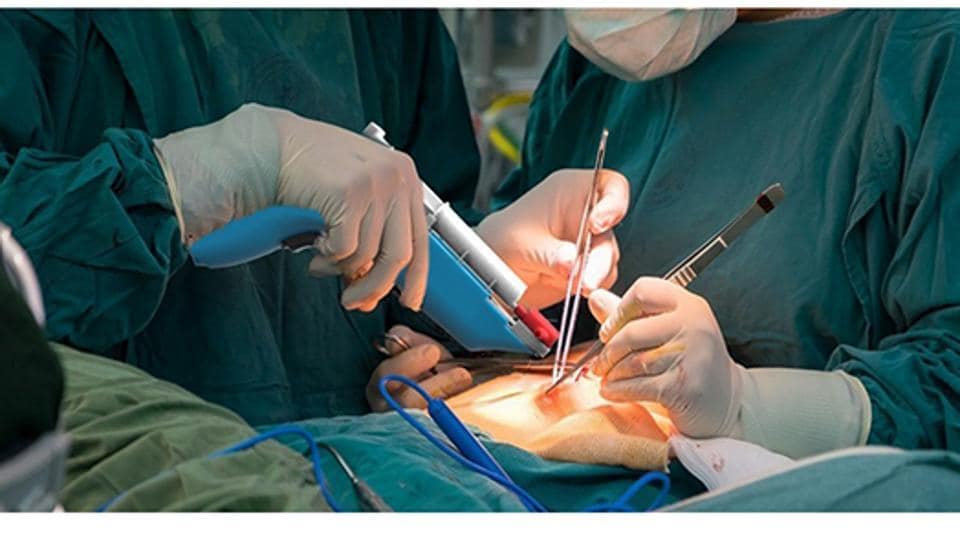
Pune: Pacify Medical Technologies was born out of a necessity to address a gap in the Indian dermatology spectrum. Wounds, big or small, leave scars. While superficial ones such as those caused by acne can be faded with specific cream or lotion application, deeper and larger ones such as those caused by burns shrink the skin and leave permanent scars unless they are treated with advanced medical care such as skin grafting.
But, herein lay the problem in the pre-Covid ear. There was a scarcity of good quality skin grafts in the Indian market and dermatologists, cosmetologists, and plastic surgeons kept flagging concerns that the existing few options were just not good enough.
When engineer Saiprasad Poyarekar heard this, the entrepreneur in him saw an opportunity. And the keen observer in him studied the market deeply and came up with a solution. But, first, he set up ‘Pacify Medical Technologies’, the company where he would nurture the idea planted in his mind till it blossoms and bears fruit.
Background check
Poyarekar is a mechanical engineer and had served some time as a project research assistant at the Biomedical Engineering and Technology Innovation Centre (BETIC) lab at COEP Technological University in Pune - experiences and training that would come handy while giving shape to his idea.
In his own words: “My journey began in Pune at the intersection of clinical insight and engineering. While I was a research
assistant at BETiC-COEP under Dr Sandip Anasane, we had collaborated with Dr Nikhil Panse, plastic surgeon at Sassoon General Hospital, to understand the ground reality of the surgery theatre.That gave me an insight into what a surgeon wants. So, I didn’t just want to build a tool; I wanted to solve problems surgeons face.”
Market study
Knowing where to start made it easier for Poyarekar to study the market carefully. Soon he realised that in India, the prevalence rate of people needing skin grafts for large wounds such as trauma, burns, chronic wounds, including diabetic ulcers, is 15.03 per 1000. Such wounds are treated with skin grafts that are often harvested from the patient’s own healthy skin area or from a donor site. While it may seem fairly easy, this typical solution comes with its own set of problems.
Sourcing skin tissue from the patient or a donor is done through a surgical procedure in an operating room under anesthesia, which creates a secondary wound at the donor site and also increases the costs of wound care. While this was a challenge that the medical fraternity dealt with in their own ways, it was nevertheless a problem.
Poyarekar started looking into it more closely by visiting hospitals and meeting doctors to get their views.
“I realised that skin tissue needed for large wounds was the problem. For example, a 20-sq-cm wound needed the same amount of healthy skin tissue which was often harvested from the patient’s own healthy skin as it was very difficult for doctors to procure such large-sized skin tissue from a donor,” he explained. “Then, again, the standard of care for extensive wounds such as severe burns or trauma often faces a ‘healthy skin crisis’. When a patient has a large wound but very little healthy skin left to harvest for a graft, traditional methods like ‘meshing’ reach their limit. This leads to delayed healing, high infection risks, and prolonged hospital stays.”
Engineering a solution
Poyarekar took an engineering approach to the problem. If the same pathway was not working, he had to look for a different pathway.
“So I thought, what if the skin tissue was used in a liquid form? But, then, I realised that liquid will not stay on the wound; it will find its own path due to its flowing property, and the human body is cylindrical. It was just not working!” he said, reminiscing about those times.
Poyarekar then thought of using the concept of fluid dynamics which he learned during his Mechanical Engineering days.
What if he could cut up the liquid into drops and then use a gas medium to spray it to cover a large surface? But, what should be the dimension of the skin tissue that is used? These and several other questions started befuddling him.
He said: “Generally, they use skin tissues that are the same size as the wound. But I pondered on how the size could be
reduced.”
Closing in on the gap
Poyarekar had seen many skin grafting surgeries first hand and knew exactly how a wound heals - the process it goes through.
He said, “I realised something significant. The wound heals from the outer rim to the centre. The healing starts from the ‘boundary’ and then moves inwards. The boundary is the decision maker. So I thought, what if I dice the skin into more parts so that every part gets its own boundary that will start the healing. The more the boundaries, the greater the area that the skin tissue will cover.” That was the viola moment! Dicing the skin tissue into equal sizes helped to increase the efficiency of skin grafting.
“When I saw this, I filed for a provisional patent in 2017. If you take a 5-sq-cm skin graft, it will give you 5x5 cm i.e. 25 sq cm. But, if you dice the same 5-sq-cm skin graft into five parts, you will be able to cover 225 sq cm because each ‘cut’ part will start healing from the boundary giving much larger coverage,” Poyarekar said, excitement still lighting up his eyes as he remembers that moment of truth.
Solution in a spray
Poyarekar calls it precision farming in the human body. He explained: “We take a tiny sample of the patient’s skin, process it into a tissue-rich solution, and use our proprietary spray system to distribute it evenly across the wound. The science is that each droplet contains microscopic seeds of skin tissue, and the result is that when the droplets spread uniformly, the skin regenerates from thousands of points simultaneously, covering large areas with minimal donor tissue. Human skin can regrow. These particles act like ‘seeds’, helping new skin grow naturally over time.”
But, how does one make the skin tissue sit where it is required? Poyarekar said, “When you pour oil on water, it will float at the top because the densities of water and oil are different. So before spraying, I took to matching the density of tissue solution with the density of body fluids to ensure that the solution does not separate.”
The trials
Since this was a medical innovation, it had to pass many trials. Dr Nikhil Panse and Dr Vinita Puri of KEM Hospital in Mumbai did the first graft on cadavers. “Doctors often use cadaver skin to cover a wound like a band-aid, so that there is no infection. Cadaver skin trials lasted for about a year. Early clinical feedback from surgeons was consistently positive, giving me the confidence that this approach could improve outcomes,” Poyarekar said.
However, not everything went smoothly. There were several usability issues such as how to hold the spray gun (since this was something new to the doctors) and how to control the force of the spray.
Pause for pandemic
But, before Poyarekar could iron out these issues, the pandemic arrived with a bang, causing a stir and a pause.
Post Covid, Poyarekar started the human trials after getting the necessary regulatory approval.
“You have to do this in NABL labs, where each test is repeated 80 times. After that, the plastic surgeons along with the pharmacology department, in consultation with our company, will write the protocols, which will then have to be approved by the Ethics Committee. And finally, only after getting insurance for the patient, the human trial begins,” Poyarekar elaborated, stressing how it was a tricky path to navigate.
Human trial
In 2024, the company did its first human trial at KMC Manipal under Dr Joseph Thomas.
“It was a male patient, a victim of an accident. The feedback was positive. Thirty more trials later, it was published in the Asia Pacific Burns Conference. The spray gun technique using diced skin tissue particles in liquid form was working!” Poyarekar said, recalling that defining moment.
Sourcing funds
The project cost him ₹3 crore so far. In the initial stages, grants and CSR funds helped him set his plans in motion. Later, he was able to raise more money from the market which helped to reduce the early-stage risks. Currently, he is on the verge of closing another round of fund-raising to build the sales engine and clinical data repositories.
How much? Pat came the reply: “I cannot reveal the amount at the moment.” “But”, he continued, “SINE IITB played a pivotal role in supporting us during the development stage. We are moving from validation to commercialisation. Our early clinical feedback from surgeons has been the wind in our sails, confirming that the device is not just technically sound, but practically
superior in an OT environment. Hence, we have received purchase orders from some government hospitals in Maharashtra.”
The Indian Council of Medical Research (ICMR) is also helping him take his technology forward with real world clinical evidence creation. “I want it to be part of the National Health Mission,” Poyarekar said.
He also offers this technology to the Armed Forces “at nominal charges”. He said he charges normal rates from private hospitals which barely covers his operating expenses.
Looking ahead
But, he is hopeful of breaking even in three years. “To be profitable, I will need to scale up. The aim is to make this technology affordable so that one can use it in a Minor OT under local anesthesia. If we can move to that stage, this can go to even smaller towns that don’t have tertiary care services,” said Poyarekar.
Plans are aplenty, but, as of now, he is looking for a co-founder who has experience in surgical commercialisation to help lead the
next chapter in marketing and scale-up.
He explained why: “A co-founder to take care of marketing will free me up to focus more deeply on the technology.”
Competition
As for competition, Poyarekar said there are many players in the market using different technologies. “They are much like petrol and diesel engines - some use artificial skin, some use skin sourced from animal or plant, or collagen alternatives. But, there is no large player. Most are still in the experimental stage. So, we will have to compete with our own technology,” he quipped.
Expansion plans
Poyarekar first wants Pacify Medical Technologies to reach all of India. “Once that’s done, we will approach the regulatory bodies abroad, starting with the European Union (EU), and take our services there also,” he said.
Sky is not the limit for Pacify, it seems, as its creator does not believe in being confined within boundaries. He has crossed barriers, raised bars, and opened a new pathway to reach where he is today, with patience, resilience, and a knack for detecting an opportunity in a problem. He, like many of the same ilk, somehow manages to always see the proverbial silver lining in a cloud!


