
 E-Paper



Khadakwasla nears overflow as heavy rain lashes ghats; IMD retains red alert
Pune:The second active spell of the southwest monsoon has intensified across the western ghats; bringing heavy to very heavy rainfall to Pune’s ghat areas over the past two days, and causing the Khadakwasla dam stock to once again cross the 80% mark

 Prefer HTon Google


Pune:
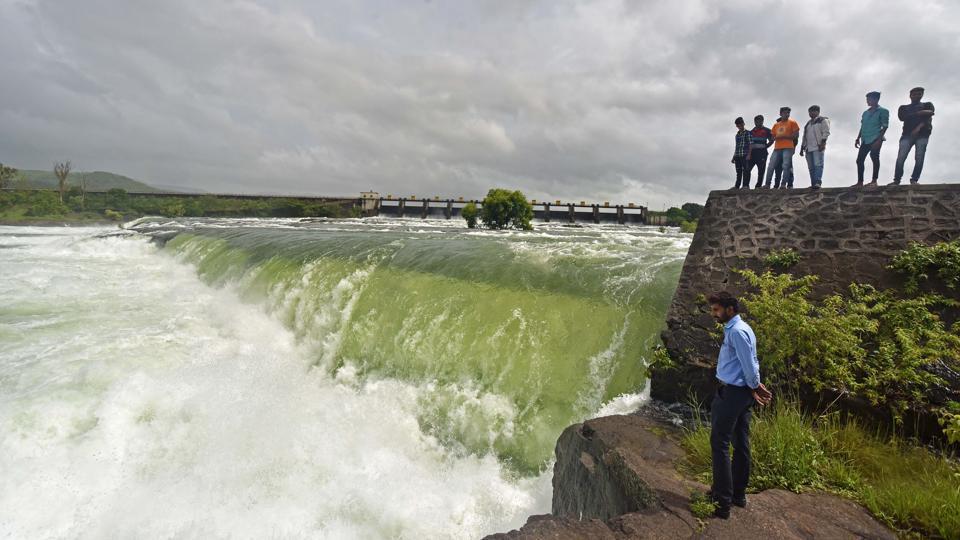
The second active spell of the southwest monsoon has intensified across the western ghats; bringing heavy to very heavy rainfall to Pune’s ghat areas over the past two days, and causing the Khadakwasla dam stock to once again cross the 80% mark. Whereas Pune city has witnessed intermittent rain from Tuesday evening, with light showers continuing through Wednesday. According to India Meteorological Department (IMD) data, Shivajinagar recorded 7.1 mm rainfall till 5.30 pm; while Pashan received 8.6 mm; Chinchwad 13.5 mm; and Lohegaon 3.8 mm.
S D Sanap, senior meteorologist at IMD Pune, said that active monsoon conditions are expected to continue for the next two to three days, with heavy rainfall likely over Pune’s ghat areas before the intensity gradually eases. “The IMD has issued a red alert for heavy to very heavy rainfall over the ghat sections of Pune on July 23 and an orange Alert for July 24. Pune city is not under any significant warning, although cloudy conditions with light rain are likely over the next two days,” Sanap said. He advised commuters travelling through the ghat sections to exercise caution as intense spells of rain could reduce visibility and trigger landslides, rockfalls and waterlogging. Authorities have also appealed to tourists to stay away from overflowing waterfalls, swollen streams and other vulnerable locations until the weather improves.
Rainfall data for the 24-hour period ending 8.30 am on Wednesday showed exceptionally heavy rain across the Sahyadri belt. Bhira in Mulshi tehsil recorded the highest rainfall (309 mm), followed by Tamhini (275 mm), Davdi (264 mm), Shirgaon (255 mm), Dongerwadi (197 mm), and Ambone (185 mm). Within Pune district, the Mulshi-Tamhini belt remained among the wettest regions. Mulshi Camp recorded 151 mm of rainfall; while Lonavla office received 142 mm; Walvan 123 mm; and Lonavala (Tata) 106 mm during the same period. The cumulative rainfall this monsoon has also been exceptionally high across the western ghats. Bhira has received 5,386 mm so far this season; followed by Tamhini (4,239 mm); Davdi (3,714 mm); Shirgaon (3,568 mm); and Dongerwadi (3,525 mm), reflecting sustained monsoon activity in the region. Meanwhile, persistent rainfall has boosted inflows into reservoirs supplying Pune and neighbouring districts, while streams and waterfalls across the Sahyadris are flowing at full capacity. With monsoon activity over Maharashtra growing stronger, the IMD has retained a red alert for Pune’s ghat sections on Thursday.
Meteorologists have attributed the active spell to a combination of favourable synoptic systems. The monsoon trough remains south of its normal position, strengthening the monsoon flow over central India. An upper-air cyclonic circulation over north Madhya Pradesh, extending up to the middle troposphere; and an east-west shear zone along 22°N are enhancing moisture incursion from the Arabian Sea, leading to widespread rainfall over Maharashtra. A western disturbance over Jammu and Kashmir and another upper-air cyclonic circulation over northeast Assam are also influencing the country’s weather pattern.
Khadakwasla dam crosses 80% storage, again; irrigation dept. warns of possible water release
Continuous heavy rainfall in the catchment areas has led to a sharp increase in water storage across the Khadakwasla dam complex, prompting the irrigation department to issue a precautionary advisory.
By 5 pm on Wednesday, the combined live storage in the four reservoirs — Khadakwasla, Panshet, Varasgaon and Temghar — had reached 20.16 TMC (69.17%); up from 18.31 TMC (62.80%) recorded 24 hours earlier.
Khadakwasla dam witnessed one of the steepest rises, with storage rising from 1.28 TMC (64.75%) Monday evening to 1.56 TMC (79.11%) by 5 pm on Wednesday. By around 7 pm, the reservoir had crossed 80% of its live storage capacity again, prompting officials to warn that spillway gates may have to be opened depending on further rainfall and inflows.
The irrigation department has advised residents living along the Mutha river to remain alert, avoid entering the riverbed, and shift livestock and belongings from low-lying areas, as controlled releases from the dam may become necessary if the heavy rain continues.
.


