
 E-Paper



Monday Musings: Doubts surround 50:50 formula, more clarity needed
The government needs to think before it moves ahead with converting the in-principle decision into a formal order


Earlier last week government announced that it is reconsidering admissions to professional and technical undergraduate courses with 50% weightage each to Common Entrance Test (CET) score and Class 12 results.
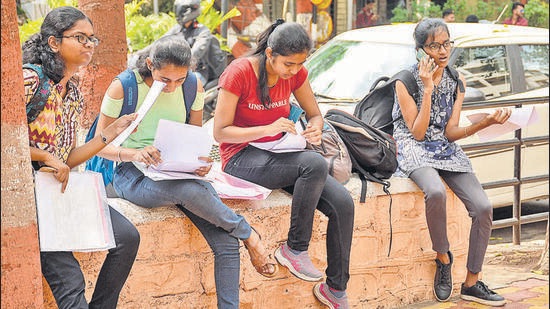
At present, Class 12 marks are considered only to determine the student’s eligibility to appear for the CET, while their admission to courses such as engineering, law and pharmacy among others, are based on their CET score.
This isn’t the first time that the Maharashtra government is considering such a proposal. In 2012 when Prithviraj Chavan was the chief minister, Maharashtra had introduced a similar formula though it did not work. Before that, a similar proposal was mooted in 2004 when Dilip Walse-Patil, the current home minister was then the minister for technical education, though the proposal was struck down in the court.
What prompted the government to consider such a formula when they know the CET score will determine admission to engineering and other professional courses. What is needed is clarity here as the revised formula has its pros and cons.
The 50:50 formula can offer a better chance to those working hard for the Class 12 examination as well as CET. The dual weightage system can offer them another chance to make up if they perform poorly in either of the two. It will also keep the board exams relevant when their importance is diminishing.
But it takes away a level playing field. The purpose of the entrance examination is to offer students a common platform to compete. Currently different boards - Higher Secondary Certificate (HSC), Central Board of Secondary Education (CBSE), Council for the Indian School Certificate Examinations (CISCE,) International Baccalaureate (IB) – have varied exam patterns, subjects, and marking. Will it, therefore, be possible for the government to bring parity while considering the 50% score from the Class 12 exam? The issue here is how will the government normalise marks across diverse boards. There is also a lack of clarity on whether the overall score of all subjects for Class 12 would be considered or just marks in sciences and math, as all boards do not have the same number of subjects at the Class XII level.
Unfortunately, there is no simple answer
At the same time, normalisation of rank through the 50:50 formula could result in a student with a high score in JEE (Main) and not so low percentage in Class XII (say 90%) getting a rank much lower than his friend who scored less in JEE (Main) but had a higher percentage in the board results.
At the same time, using CET as the sole criterion may look more complex and the subtle ways in which seemingly equal opportunities are in fact not at all equal, are not always obvious. In India, a hierarchical system of schooling that corresponds with children’s social and material status reproduces, rather than erases, discrimination and exclusion, rendering the competition for college admissions unfair and already biased. Considering the available evidence on high-stakes testing, it is highly likely that children coming from disadvantaged backgrounds and poorly funded schools will lose out on more than just college admission. This is more true in rural parts of Maharashtra. Students in rural areas often focus on Class 12 board exams as they cannot afford to pay high fees for private classes to prepare for CET exams. This decision will not help such candidates.
There’s another apprehension - the outcome based on multiple-choice questions (MCQ) test can override all other evaluator methods such as teacher’s assessment.
Overall, the government needs to think before it moves ahead with converting the in-principle decision into a formal order.


