
 E-Paper



New uGMRT images most detailed yet of galaxy cluster Abell 2256
The new uGMRT images reveal previously undetected regions where plasma processes such as turbulence and shocks accelerate particles


Researchers have produced the most detailed images yet of the galaxy cluster Abell 2256, using the upgraded Giant Metrewave Radio Telescope (uGMRT) in India. The new uGMRT images reveal previously undetected regions where plasma processes such as turbulence and shocks accelerate particles, causing radio emission. The images show a large, complex filamentary structure in the north.
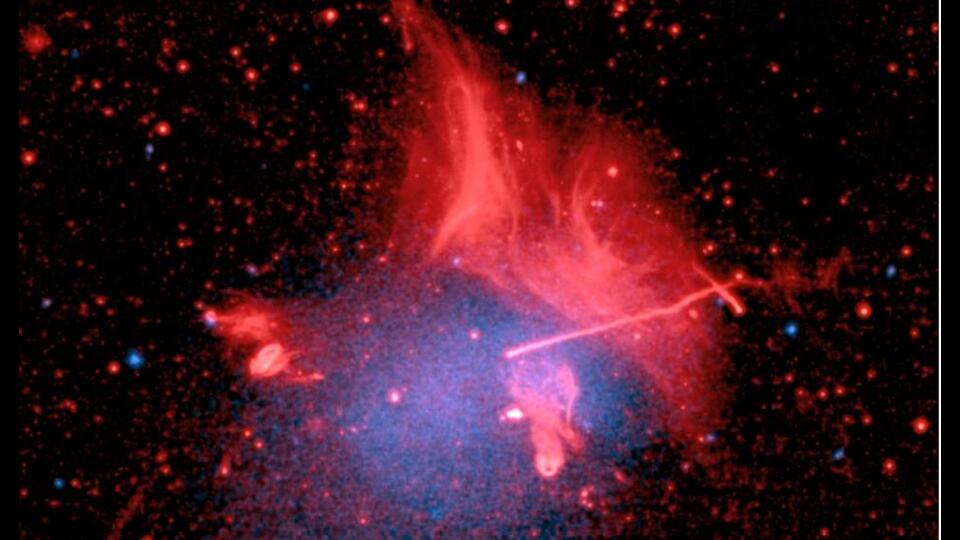
An international team of astrophysicists led by Kamlesh Rajpurohit from the University of Bologna used some of the most powerful telescopes in the world, including the uGMRT, the Low-Frequency ARray (LOFAR), the Karl G Jansky Very Large Array (VLA), Chandra, and XMM-Newton, to study the peculiar radio features of the galaxy cluster Abell 2256. The team used these telescopes to capture different types of light, which allowed them to map finer, never-before-seen details and gain new insights into the properties of Abell 2256, including how particles like electrons are accelerated on very large scales (about mega light-years).
The observed radio emission morphology at the cluster centre resembles that of X-ray emission, suggesting strong links between them. Further investigation with state-of-the-art X-ray telescopes revealed that radio emission is connected to past merging events such as cold fronts, gas motions, and shocks. The high sensitivity and resolution of GMRT also allowed the astronomers to map unusual numbers of radio galaxies, with monstrous, supermassive black holes at their centres.
The new uGMRT images reveal new emission features, and that radio emission is about two to three times more extended than previously known.
Rajpurohit said, “Before planning the uGMRT observations, there were no other hints of such a large-scale radio emission in this system; we were pleasantly surprised to see this huge extension as well as filamentary morphology below GHz frequencies. Galaxy clusters are enormous collections of hundreds or thousands of individual galaxies immersed in giant oceans of extremely hot (with a temperature of ten million kelvin or even higher) gas, and are considered to be the largest structures in the Universe held together by gravity. Collisions and mergers between galaxy clusters release tremendous amounts of energy unlike anything witnessed since the Big Bang. Abell 2256 is located approximately 1,000 million light-years away from Earth and is known for its complex structure and high level of activity, including mergers between its member galaxies, which release tremendous amounts of energy. These characteristics make Abell 2256 an interesting object of study for astronomers.”
GMRT is a leading international radio telescope operated by the National Centre for Radio Astrophysics (NCRA), Pune. The high sensitivity of uGMRT also allowed the astronomers to map weird radio galaxies and at least 50 previously undetected, compact sources. The team continues to analyse their data to learn more about these mysterious radio galaxies, the complex histories of collisions, and the physical processes at work in such encounters. Yashwant Gupta, centre director, NCRA, said, “The uGMRT offers a window into the universe at low radio frequencies with high sensitivity and resolution, revealing previously undetected regions and structures, such as extended radio emission in several objects like Abell 2256.”


