
 E-Paper



Sutradhara’s Tales: The endangered abode of Pune’s Narasimha!
Unlike temples of Shiva, Vishnu and different goddesses, temples of lord Narasimha are relatively rare in the city

 Prefer HTon Google


The growing city and the chaos of urban sprawl make most compelling demands on the city’s heritage. In spite of the rules and regulations and development plans and processes, heritage protection comes in direct conflict with the ever-growing needs for solving traffic woes. The case in point here is a lone temple of Lakshmi Narasimha at Sadashiv peth or Karkolpura of yesterday years.
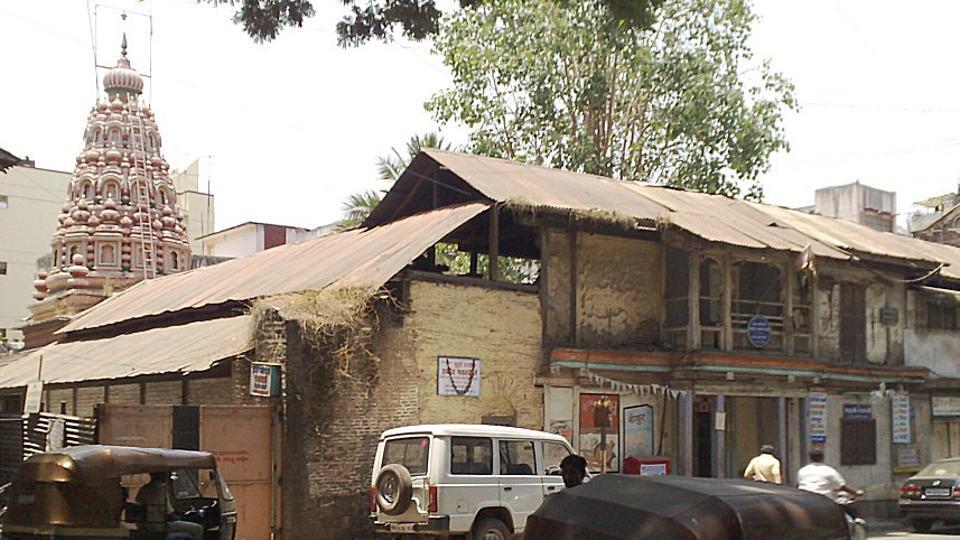
Unlike temples of Shiva, Vishnu and different goddesses, temples of lord Narasimha are relatively rare in the city.
Few families in Maharashtra have lord Lakshmi Narasimha as their family tutelary deity. One such was Ganesh Dikshit, who originally belonged to Sangameshwar, shifted to Udupi in Karnataka and then migrated to Pune to settle down in Peshwa-period city. His descendent, Ganesh Bhat Joshi, was a learned scholar of Sanskrit and Vedas.
Joshi was concerned and unhappy that his family deity was unavailable for worship in the vicinity of Sadashiv peth or Karkolpura. The local legend informs us that lord Lakshmi Narasimha appeared in his dreams and pointed him in direction of Kashi. The lord advised Joshi to rescue him from the cactus trees where the former’s idol was left unattended.
Accordingly, the idol of Lakshmi Narasimha was fetched from Banaras by Joshi who personally carried it on shoulders and walked back to Pune.
He laid the foundation of temple near present-day scout ground in Sadashiv peth and initiated the temple building to house the Narasimha idol in 1774. In the 1780s, this area was surrounded by private gardens of Sardar Raste, Nagarkar and Parchure, and was at one end of the city.
Finally, during the reign of Sawai Madhavrao Peshwa in 1788, the construction of Narasimha temple was completed and the idol of deity was installed following the ritualistic fanfare.
The temple was built in Maratha style of architecture and included a rectangular wooden sabha mandapa or hall in the form of sanctum. The roof is wooden and the pillared hall was intercepted by regular cypress columns and cusped arches in wood. The total length of the hall is 6o feet by 20 feet. The left and right aisles have slopping roof and was decorated with arched wooden windows opening on both the sides. This brought in optimum sunlight and lit of the interiors to have a pleasing effect. The corners of roof are decorated with wooden floral ornamentation. The entrance facade is wooden and has wooden drum house or Nagarkhana on the top. One section of the aisle houses a staircase to access the top.
The conical shikhara consist of three tiers made up of rows of Maratha kutas or miniature shikharas in lime stucco and bricks. It is topped with fluted kalasha and is similar to many Peshwa period spires built in 18th century in the city. The entire campus is enclosed with brick wall and houses the rooms of priests.
The temple has Panchayatana arrangement where the main deity is placed in the centre and secondary deities of pantheon are places around it to make an arrangement of five. Accordingly, the idol of Lakshmi Narasimha is placed in the centre inside the sanctum. The other deities occupying the niches include Virbhadra, marble Ganesha, lord Surya, goddess Mahishasur-mardini and Shankara in the form of marble linga. Devotee Pralhada is housed in a shrine in front of the sanctum.
Lord Narsimha is the considered to be the fourth incarnation of lord Vishnu. The main act of salvation featured in this incarnation is killing of tyrant king Hiranyakashipu by lord Narasimha as he appears from wooden column to protect his devotee Pralhada. This incarnation is usually depicted in zoo-anthropomorphic form of lion and man. The fierce act of slaying and tearing the intestine of the demon Hiranyakashipu by holding him on his lap is the usual representation of this incarnation, also known as Vidarana Narasimha. However, we also find icons of Narasimha in yoga sadhana (Yoga Narasimha), a lone Narasimha (Keval Narasimha), Girij Narasimha (in complete lion form) with his consort, goddess Lakshmi. The combine formed with goddess Lakshmi is the calmer form and represents strength and prosperity.
The idol at Narasimha temple at Sadashiv peth is of calm nature and is represented in a charming form of Lakshmi seated on the lap of Narasimha, on the throne. The idol is made in white marble. The icon is four-armed holding vaishnava attributes of shankha (conch), Padma (lotus flower), gada (mace) and chakra (wheel) and seated in padmasana posture. The decoration has a silver five-headed serpent as a chhatra/umbrella on the idol. On most days, the idol is covered with rich paraphernalia of colourful costumes.
The temple houses a brick brought by Joshi descendants from the historical temple at Multan which is known as Mulasthana (origin place of Narismha) or Kashyapanagari, original city of bhakti Pralhada and his ancestors.
Sant Samarth Ramdas’s follower, Shridhar Swami, used to reside in the temple during his student days. Similarly, the great revolutionary, Damodar Chapekar, too lived on the temple premises for a while.
The temple is famous for residence of the prominent revolutionary, Vasudev Balwant Phadke (1845-1883), who was inspired by lord Narasimha and practiced Baloapsana (physical exercise). He had installed paduka of his guru on the platform of peepal tree on the premises.
Phadke was an Indian independence activist and revolutionary. He was moved by the plight of farming community and believed that Swaraj (self-rule) was the only remedy for their ills. With the help of various sub-communities of Hindu society, he created a movement against the British rule. The group started an armed struggle to overthrow the colonial government, launching raids on wealthy European businessmen to obtain funds for the purpose. Phadke came to prominence when he got control of the city of Pune for a few days after catching colonial soldiers off-guard during a surprise attack. Phadke was a tenant at the temple for fifteen years, from 1865 until 1879.
The Narasimha temple had a yearly income of about ₹400 during colonial period, chiefly from the offerings. Vows of walking a number of times round the shrine, usually a hundred thousand times, are made by women to get children or to get cured of evil spirits and bodily ailments. Some families with surnames such as Sardesai, Joshi, Mandke and Deshpande worship Lakshmi Narasimha as family deity.
Narasimha Jayanti Utsav is an important festival celebrated by the temple’s devotees. The temple organises kirtans and bhajans, along with various Hindustani musical performances and its premises are decorated with glass chandeliers.
The temple is under threat after PMC’s development plan proposed the demolition of a part of wooden hall and Nagarkhana for road widening in 2017. Various heritage lovers, activists and temple trustees have voiced their opposition and protested the move. This has led to Pune heritage committee proposing to protect the graded heritage temple against demolition. However, the threat of demolition is still eminent after five years, until the chief minister of Maharashtra gives consent to spare the temple against demolition and work on road widening excluding the temple precincts. Hope the precious heritage of Pune is saved against the never-ending demands of urbanisation and traffic woes.
Saili Palande-Datar is an indologist, environmentalist, history researcher and farmer. She can be reached at sailikdatar@gmail.com


