
 E-Paper



Taste of Life: Mushroom found a welcome taste for Europeans, Americans and Indians
While many cultures were mushroom loving, for diverse reasons, Britain, in the 19th and the early 20th centuries, stood far on the mushroom hating side

 Prefer HTon Google


Pune: In June 1911, “The Bombay Chronicle” published several advertisements informing its readers in Poona that a gentleman named Mr Barr was in the city to “instruct” those interested in the cultivation of mushrooms. Barr, a resident of London, was a known name at the Fulham Farmer’s Market and was in India to visit his son who served in the army.
The advertisement is interesting considering the British were traditionally largely mycophobic, a term coined by Mr Gordon Wasson and Dr Valentina Guercken. While many cultures were mycophilic, mushroom loving, for diverse reasons, Britain, in the nineteenth and the early twentieth centuries, stood far on the mycophobic, mushroom hating, side. In Britain, fungi were often associated with death and rot and referred to as the “pariahs of the plant world”.
But the French, the Germans, and the Italians loved mushrooms. So, when French cuisine became a mark of sophistication and finesse, the British, grudgingly, began including mushrooms in their diet in the nineteenth century.
One pragmatic British officer who endorsed mushrooms in India was Robert Riddell. Riddell spent many years in the “mofussil” and Bombay, Aurangabad, and Poona, and published a wonderful cookbook titled “Indian Domestic Economy and Receipt Book” in 1849. He knew it was very difficult for a British “housewife” in India to cook meals the British way. The ingredients were hard to procure and costly. Wives of “low-ranking” officers often found it strenuous to manage the household on the salary their husbands earned. Hermetically-sealed provisions were always in season, if not always very fresh, and the ham, salmon, pates-truffees, mushrooms, green peas etc, that eked out the native fowls and saddle of mutton, were put before the Anglo-Indian at a cost far exceeding their mean price in Britain.
Many British women in India, always under pressure to not lose their “Britishness”, often clung to European ingredients and cuisine and stayed away from the native variety. Riddell’s recipes were largely “hybrid”, featuring a mix of European and Indian cooking styles and ingredients. He liberally used mushrooms in several of his recipes and urged his readers to develop a taste for the fungi since they could be cultivated in India. He noted that wealthy Europeans preferred morels to mushrooms. Morels were principally imported from France and Italy in a preserved state. They were found in old white-ant nests in and around Poona and were flavourful when fresh and delicate. The Europeans, however, preferred tinned morels available at shops like Treachers & Co in Poona. They were added to stews and sauces.
Captain Arthur Robert Kenney-Herbert in his “Culinary Jottings”, published in 1878, urged his readers to give up using “native” ingredients in their cooking. Not all his recipes were “British”; many were French and did not use ingredients like curry powder. French cuisine was a rage in Britain and cookbook writers like Kenney-Herbert and Flora Anne Steele, the author of “The Complete Indian Housekeeper and Cook” (1888) wanted their readers to “reform” the Anglo-Indian cookery which, they thought, was tainted by the use of Indian ingredients. According to them, the British housewife was expected to create her home environment in the colony by shunning everything native; she had to be mindful of her and her husband’s superior race. She was supposed to cook dishes like kidney pie, Yorkshire pudding, Filets de pigeon a la Bordelaise, Tourtes de cerises instead of curries, kormas, and naans. “Hybrid” dishes like Italian pilaf, mulligatawny soup, and kedgeree were considered outcasts. However, one ingredient which did not stand in the way of the erasure of the Indianness of the British food in India was mushrooms, because the French loved them.
Mushrooms were added to curries, pies, and omelettes. Mushroom ragout was used to stuff fowls. Puree of white and brown mushroom was used in several dishes too. Mushroom ketchup was quite popular. “Pure Mushroom Catsup” and white mushrooms, in the canisters, “prepared as they were gathered at Lewes in Sussex”, where Crosse & Blackwell had a factory for the purpose, were popular in the Bombay Presidency. Mrs John Gilpin, the author of “Memsahib’s Guide to Cookery in India” provided a recipe for mushroom ketchup in “The Bombay Chronicle” on February 25, 1914. She urged her readers to make sauces in their kitchen instead of buying them in stores and to grow mushrooms in their gardens.
Mushrooms were not cultivated by Indians. The orthodox Hindus detested mushrooms. Those who ate mushrooms were considered the most despicable of deadly sinners. The “Apastamba Dharmasutra”, one of the oldest dharma-related texts of Hinduism, prohibited eating garlic, onions, and mushrooms. The “Manusmriti” asked to avoid onions, garlic, and all plants growing on an impure piece of land, such as mushrooms.
The native tribals of Thane and Lonavla were the custodians of wild edible fungi. The giant mushroom of Khandala (Lepiota altissima Massee) was a very large, pure white and wholesome fungus of the umbrella form. It attained a foot in height and 6 inches in width of cap and grew in open pastures at Khandala. It was regularly eaten by the natives living in the ghats. But the mushroom was mildly flavoured and did not make a very good sauce. The European community of Bombay and Poona had no contact with the tribals and thus relied on store-bought mushrooms.
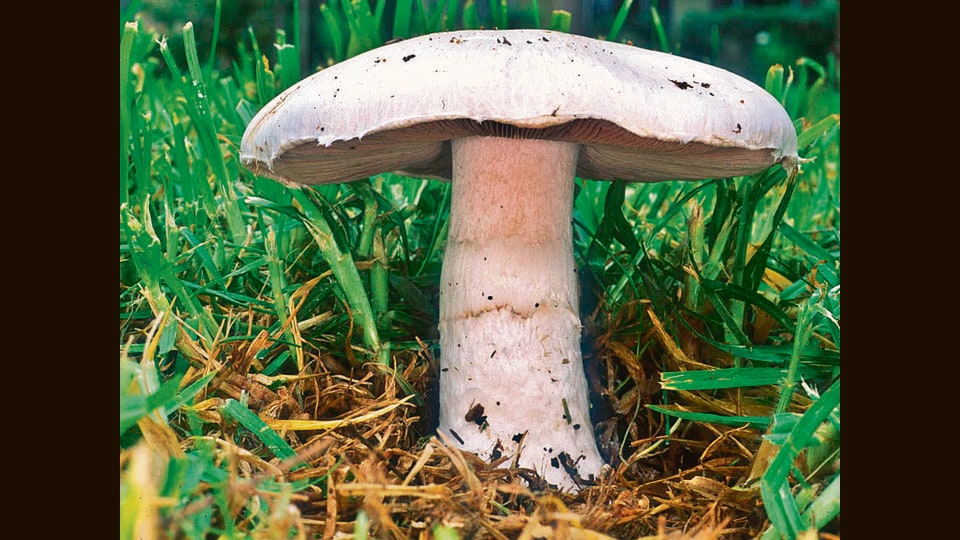
The Common Mushroom (Agaricus campestris), The Horse Mushroom (Agaricus arvenis), and St George’s Mushroom (Agaricus gambous) grew in the mountains of northern India. The gills of the Common Mushroom were at first pink, or salmon-tinted, but deepened to a purplish-brown. It had a characteristic fragrance and grew in open pastures. The Horse Mushroom was less delicate in flavour, larger, whiter in the gills, and with a smooth white cap. St George’s Mushroom appeared in spring; it had no ring on the short, thick stalk, smelled of new meal, and was greatly esteemed.
They were cultivated by some Europeans in Poona in the nineteenth century, but the mean yearly temperature at which they thrived was much lower than that of southern India, practically making their cultivation impossible. Another difficulty was to get good mushroom spawn: when imported from Europe, it often spoiled during the voyage.
George Marshall Woodrow, the British botanist who lived in Poona, tried to encourage the cultivation of mushrooms in the city. Not only did he experiment with the cultivation of edible mushrooms from the north, he urged the European population in Poona to try and cultivate the local variety of mushrooms found in the city, which was named after him.
The Brown Mushroom of Poona was Agaricus woodrowii Massee. It was reported by Woodrow and George Edward Massee, the English mycologist, in 1903. It appeared abundantly on the Golf Links at Yerawada, and similar open pastures, about the end of September, during a very short season, varying with the rainfall. It attained about 4 inches in height, and the same in width as the cap, but was often gathered, and was preferred, before opening. It was an oval, smooth, yellowish-brown mushroom, as large as a person’s thumb, with an agreeable odour and a firm truffle-like consistency. It kept in good condition for several days. Woodrow could not cultivate it because he left for his country.
The mycophobia of Indians started waning after the economic reforms in the 1990s. The Europeans and the Americans loved mushrooms, and the Indians slowly learned to like their mushroom masala.
The Brown Mushroom from Poona, unfortunately, was never cultivated on a large scale.
Chinmay Damle is a research scientist and food enthusiast. He writes here on Pune’s food culture. He can be contacted at chinmay.damle@gmail.com


