
 E-Paper



Taste of Life: When Poona was famous in India for its mulberries
Hundreds of horticultural and agricultural reports published between 1830 and 1890 mention the cultivation of mulberries for silk in Deccan, and especially in and around Poona

 Prefer HTon Google


Pune: In 1842, just before Christmas, two “native” men reached Ellichpore (Achalpur) in the Berar province. They were carrying with them some mulberry syrup and a container of the mulberry jam they had brought from Poona. Upon reaching the town, they were promptly arrested.
Berar province then was under the governance of the Nizam. The two men had come from Poona which was governed by the British and, hence, they required a special permit to sell their products on Nizam’s territory.
They were eventually released from jail and given a permit to conduct business in the province. They also managed to secure a certificate from the local authorities vouching for the quality of the mulberry syrup and jam. After all, Poona was famous in India for its mulberries.
Hundreds of horticultural and agricultural reports published between 1830 and 1890 mention the cultivation of mulberry for silk in Deccan, and especially in and around Poona.
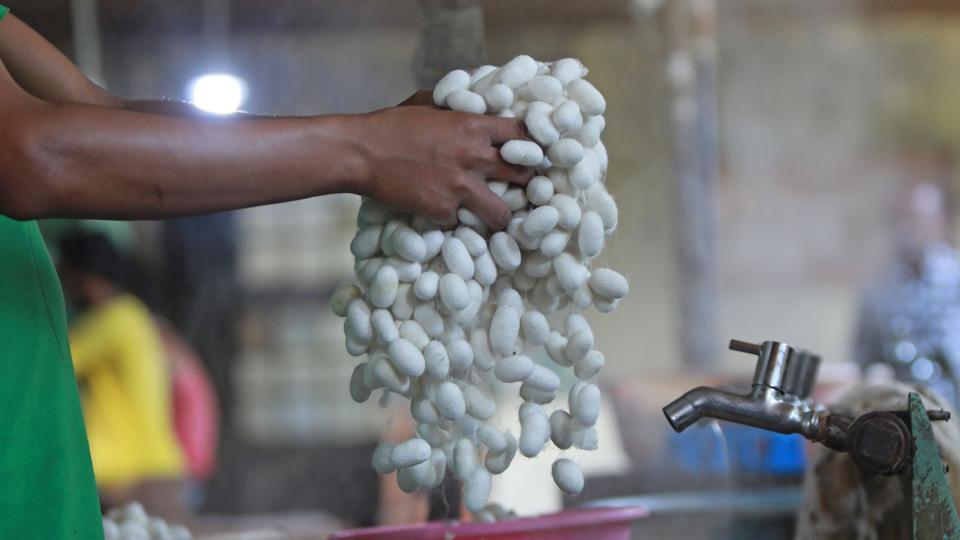
Mulberry leaves, particularly those of the white mulberry, are the sole food source of the silkworm (Bombyx mori, named after the mulberry genus Morus), the cocoon of which is used to make silk.
Bengal raw silk attracted the interest of European trading companies since the seventeenth century. In the eighteenth century, the English East India Company decided to expand its trade in Bengal raw silk as part of its efforts to transfer its Indian territorial revenues to Britain since raw silk was considered one of the “choicest” goods with potentially high returns.
In the aftermath of the Battle of Plassey (1757) and the assumption of the “dewani” of Bengal, Bihar, and Orissa, the company decided to manufacture silk in Bengal. This move was also induced by the British government’s support of the domestic silk industry in Britain. The histories of the British and Bengal silk industries were thus intertwined.
But neither the British nor the Bengal silk industry were leaders in the production of silk items in the eighteenth century. Trade was hindered by the low quality of silk that did not find widespread use by the European silk-weaving industry. Italian silk was considered the best in the world, and hence, when Signor Giuseppe Mutti submitted a proposal to plant mulberry trees and manufacture silk in Bombay, his proposal was accepted immediately.
It is not known when Mutti arrived in India. However, he was fluent in Hindustani, Persian, and Arabic. He had written and published a book to teach conversational Arabic to Europeans.
At about the beginning of 1830, Mutti was living in Bombay. He was unemployed which was not a flattering situation for an Italian in India. He began to consider to what purpose he could turn the little talent he possessed to ameliorate his condition. Silk was the first object of his attention and experiments, having for many years engaged himself in that branch of commerce in Italy, where he was employed as an agent for purchasing silk, and as a traveller in that line of business.
He offered his services to the Bombay government as superintendent of any establishment that might be formed for the cultivation of silk. The government declined his offer but made him understand that liberal encouragement would be given to anyone who might wish to grow silk on his own account. Encouraged by this, Mutti resolved to attempt to grow silk in Bombay.
It was on the island of Salsatte, on the farm of one Mr B Fernandez, with whom he had entered into a partnership, that he commenced his plantation of mulberry trees before making any application for government lands. In Bengal, it was believed that by feeding the worm with the leaf of the mulberry tree, the silk became coarse. But, according to Mutti, in Italy, where the finest silk in the world was made, the worms were fed only with the standard leaf. He followed the same Italian pattern.
After succeeding in manufacturing silk, at the expiration of three months, he decided that he wanted to shift to Poona. He was confident that he could manufacture better silk at Poona than in Bombay.
Surprisingly, the government wholeheartedly supported him this time. The interest of the government extended only to introducing the industry to the notice of the natives; when they had once been made acquainted with its value, the government would leave it to be carried on as a commercial speculation.
Lord Clare, the then Governor of Bombay, had taken a keen interest in the project and gave him an advance of ₹6,000. The Chamber of Commerce presented him with ₹500.
On his application in April 1830, Mr G Giberne, the Collector of Poona, was directed to make over to him the Kothoor (Kothrud) garden free of rent for 15 years, on condition that the ground should be applied only to the growth of mulberry.
Kothoor Baug then contained about 16 bighas, or 12 English acres, with houses and buildings upon it. Wassau baug, a nearby large farm containing 60 bighas, was afterwards granted to him on the same terms; and finally, Gouka Baug, twice as large as the latter, with plenty of water, was given to him.
It was assumed that the “standard” mulberry tree would not grow successfully in Deccan. But Mutti proved his detractors wrong. Within a decade, Mutti had 75,000 mulberry trees thriving in Deccan. He built a manufactory to make silk. He claimed that the silk of Poona was far superior than Bombay and Salsette, particularly in the richness of the colour.
Following the success, Mutti was appointed as the Superintendent of Silk Culture in the Deccan by the Bombay Government. Many years of toilsome and mostly unaided exertion had at length enabled him to prove beyond doubt the capabilities of Poona and its neighbourhood for the growth of mulberry on a much more favourable scale than it could be reared elsewhere in India and other British colonies.
Mutti tried to induce the natives themselves to adopt a more improved method of growing mulberries, rearing silkworms, winding silk, and manufacturing silk fabric. Two natives, whom he got to make silk for a manufacturer in Poona, obtained ₹14 for the silk which was pronounced to be of excellent quality. He also got another native gentleman from Saswad to make silk handkerchiefs and established a regular manufactory of similar kinds of cloth at Kothrud. Within a few years, he had at Kothrud several men whom he had instructed in all the branches of mulberry cultivation and sericulture.
In the Italian mode of cultivation, the growers of mulberry trees would pluck the leaves without injury to them. The leaves would be sold to the breeders of the worms. Leaves from older trees and hard ones were thought to be preferred by worms. As a result, along with the leaves, mulberry fruits were harvested too.
Mutti saw the immense potential in the harvest of the mulberry fruit. He, while encouraging Indian cultivators to plant mulberry trees, started explaining the benefits of mulberry fruits. The fruits could be used to make jams, syrups, wine, and sherbets. Or the fruits could be eaten raw.
The mulberry tree was extensively cultivated in the Nabob’s gardens at Ellichpore. The Horticultural Society’s report of 1844 mentions that two gentlemen from Poona were requested by some locals to teach them how to make mulberry jam and syrup. While it is not known if they were the same men who were arrested for selling mulberry jam without a permit or if they were trained by Mutti, it could be safely assumed that they had taken up the trade following Mutti’s success with the mulberry tree.
More about this next week.
Chinmay Damle is a research scientist and food enthusiast. He writes here on Pune’s food culture. He can be contacted at chinmay.damle@gmail.com


