
 E-Paper



32k farmers get ₹156mn under Jharkhand madua mission
Tirkey further said the Jharkhand government is focusing on boosting Madua (the local name for millet) production as it yields higher profits than other crops.

 Prefer HTon Google


State agriculture, animal husbandry and cooperative minister Shilpi Neha Tirkey on Friday transferred ₹156.3 million to the accounts of 32,911 farmers under the ‘Jharkhand Millet Mission’.
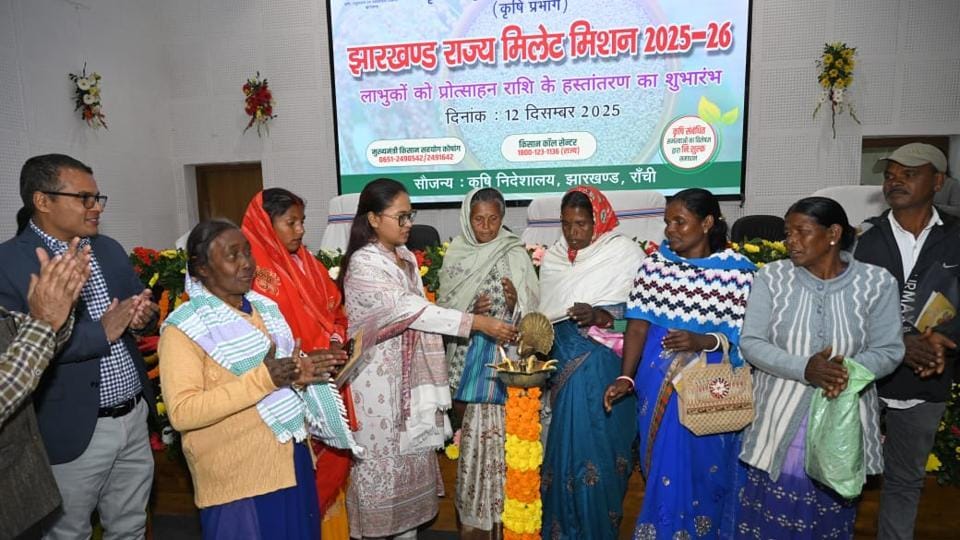
Tirkey conducted direct bank transfer (DBT) to the farmers’ bank accounts during a programme organised in the auditorium of the Animal Husbandry Directorate in Ranchi.
Transferring the amount, Tirkey said the number of beneficiaries under the Jharkhand Millet Mission is increasing every year.
“It should be noted that in 2024–25, 18,000 farmers received incentives for coarse grain cultivation. I have set the next target for agriculture department officials to provide incentives to 60,000 farmers for coarse grain cultivation,” she said.
Tirkey further said the state government is focusing on boosting Madua (the local name for millet) production as it yields higher profits than other crops.
“Previously, Madua was cultivated on 20,000 hectares. Today, this area has increased to over 100,000 hectares. Madua cultivation offers higher profits than other crops,” she said.
The minister also announced the renaming of the ‘Jharkhand Millet Mission’ as ‘Jharkhand Madua Kranti’.
“The Jharkhand Millet Mission will now be known as the ‘Jharkhand Madua Revolution’. This decision was made in light of farmers’ inclination and acceptance of Madua production in rural areas,” she said.
Tirkey said that a centre for Madua procurement is being opened in the state in the same way paddy procurement centres operate, and it will be available to farmers within a week. She said the price will be determined according to the market rate.
“Mahua procurement centres are being opened, similar to paddy procurement centres. In the first phase, the department has identified Gumla, Simdega and Khunti districts for this purpose. Mahua will be procured from farmers through 17 LAMPS-PACS centres in these districts. This facility is expected to be available to farmers within the next week. The price of Madua will be determined according to the market rate,” she said.
She said the state government is planning to establish processing units to produce Madua-based products for distribution in hospitals, schools and Anganwadi centres for better nutrition.
“The department’s objective is not only to increase Madua production and provide incentives to farmers but also to establish processing units in these areas to produce Madua products. Madua products will be prepared according to market demand. These products are planned to be distributed to hospitals, schools and Anganwadi centres. The department aims to provide children with a nutritious diet of coarse grains from an early age. Once considered the food of the poor, coarse grains have now become a favourite staple across all sections of society,” she said.
The minister warned of strict action if any instance of incorrect data collection comes to light.
“I received a complaint regarding incorrect data, which I am investigating. If the investigation confirms the incorrect data, action will certainly be taken against the concerned officials and employees,” she said.
During the programme, Kiran Devi (40), a farmer from Chari village in Ranchi district, said that madua earlier had little demand and sold for only ₹15–20 per kilogram. Its demand has now increased, and prices have risen accordingly.
“Currently, I cultivate madua on one acre of land, and its market price is over ₹30 per kilogram. The incentive amount I received today will be used for fertilisers and seeds,” she said.
Another farmer, Kishore Kumar Manjhi from Dumka, said that cultivating madua on one hectare of land requires 5–6 kg of seeds. “The state government is providing ₹3,000 as an incentive, which is very beneficial for us,” he said.
Vinod Kumar Munda, a farmer from Murmu block, said the government is supporting farmers in two ways — through financial assistance of ₹3,000 per acre and through technical interventions.


