
 E-Paper



Guest Column: Farmers prove their resilience, but need to optimise outcomes
Given the logic of 94 by 6, most states should implement these new reforms. The remaining states, particularly the original Green Revolution areas that have seen less risky and largely assured agriculture, should get time to ponder and engage in dialogue with agitated farmers to settle the way forward.


The spontaneous farmers’ agitation against the three central ordinances to facilitate trade and services in agriculture has surprised everyone. The farmers were quick to understand the implications, which perhaps the architects of these laws could not envisage. True, some misgivings need to be removed, but the full essence of the Agricultural Produce Market Committee (APMC) systems has not been captured in these laws. These systems have successfully prevailed in the states that made the country self-sufficient in food.
APMCs have not promoted monopolies or obstructed reforms in agriculture. Post-1992, regulatory reforms in the most vital sectors of our economy were largely acknowledged. There is certainly a case for such reforms in agriculture also. Agriculture markets are not so perfect that these can be totally unregulated, allowing the vagaries of mighty businesses with no government intervention to stabilise the market.
FARMERS FEAR EXPLOITATION
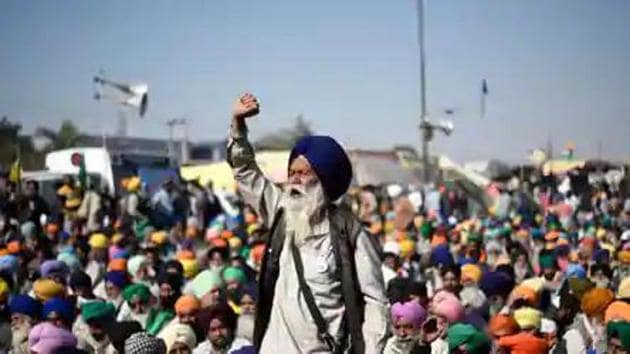
Punjab was chosen for the Green Revolution due to the dynamism and resilience of Punjabi farmers. They have proved it again, with their persevering agitation during a global pandemic. The farm laws were thrust on a community of peasants who are small, local, and subsistent. The premise of these laws built upon notions of transparency, demonopolisation, open market, competition, deregulation, and tax-free marketing did not cut much ice with them.
Farmers fear exploitation by big businesses, attachment of land, withdrawal of minimum support price (MSP), closure of APMC markets, the abolition of commission agents, and loss of state revenues. The framers of the laws could not allay these. They maintain that these were apprehensions of 6% of the total farmers in the country. But the logic of 94% may not be the best way to demolish 6% who led the nation in food security for over six decades. The experiential learning of the 6% should have been used in framing the laws to prevent the situation that has arisen and, all farmers could have gained through a new but different era of the second Green Revolution (GR).
STRATEGY OF CRISIS MANAGERS
The crisis managers of the governments seem to be working on a three-pronged strategy. First, they tried to deflect it to the states, but the states that were badly affected responded quickly by suggesting amendments to the laws, much to the displeasure of the central government. Second, following the middle path, it was proposed to amend these laws to sidestep the crisis. This was possible, but some of those representing interests of the rich and mighty disrupted the dialogue. Third, convert the defeat in withdrawing or neutralising the laws into a victory by becoming a messiah of kisans. This may not be easy because the socio-economic polarisation of Punjab has failed every time it was attempted.
In prolonged parleys, the government has pondered over many possible solutions for farmers. These include making the MSP for food grains a legal right; the introduction of price deficiency support for 21 other crops for which MSP is declared; APMCs as existing should continue; and the states should be empowered to continue with local taxes on buyers in both government and private markets. For other reforms to transform agriculture, a second national agriculture commission or a committee may be set up.
DIVERSIFICATION AND RESILIENT PRACTICES
The agitation has also raised the debate on the drift in federal governance and lack of policy synergy. Encroachment on states’ powers, excessive centralisation of decision making, limiting the states’ ability to raise revenues, and deflection and disruption of the systems that were evolved over 70 years, are some of the other issues being propagated in full view of competitive politics in the country.
Despite sufficient buffers, national food security is still a serious concern. It needs to be strengthened further for nutrition security. The original GR states should be incentivised to diversify and improve their sustainability of agricultural operations. The push for a second GR in other states should encourage new agriculture instead of replicating the Punjab model. Diversification of agriculture in original GR areas and more resilient agriculture practices in new areas for the products that are required more, will lead the country to a new growth trajectory.
FLEXIBILITY IN CONFLICT RESOLUTION
Agitation is no sin. The peaceful protests to express anguish and highlight apprehended threat to livelihood are an accepted norm in a democracy. The farmers deserve appreciation for a peaceful agitation. But, no one has a right to cause public inconvenience.
The governments have also rightly preferred to engage with them through persistent dialogue without any coercive action, vocal or physical. However, they should address the genuine grievances of the farmers. Surely, some of the agitators are perhaps seeing an opportunity to maximise the outcomes, and as a result, there has been a constant shifting of goalposts. The maximisation is a myth and a euphoria that fades over time.
Continued dialogue, flexibility, and dynamism are features of individual and organisational resilience. Stubborn and fastidious individualistic decisions may not yield the best results. The most successful agitations in history have yielded optimum results by maintaining flexibility in conflict resolution. In the present situation, if the agitation is driven to maximise results by negating the government, it may not be in the best interests of the country.
A WAY OUT OF THE QUAGMIRE
The optimum, and perhaps, a pragmatic solution in the present quagmire seems to be reassertion of cooperative federalism, empowering the states to implement reforms on a subject, which otherwise is also so mandated in the country’s Constitution. The central government should retain its policy and statutory framework of reforms. The states would do better by not losing on futuristic reforms. Given the logic of 94 by 6, most states should implement these new reforms. The remaining states, particularly the original GR areas that have seen less risky and largely assured agriculture, should get time to ponder and engage in dialogue with agitated farmers to settle the way forward. The success of other states in implementing these reforms would be a singular factor in uniting the country for purported reforms.
The writer is chief principal secretary to Punjab chief minister Capt Amarinder Singh. Views expressed are personal


