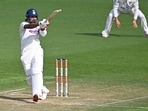
Few cricketers have ever possessed a tactical mind as sharp, cool, or calculating under pressure as Michael Bevan. Emerging from Canberra in the early 1990s, the left-handed middle-order batter fundamentally redefined how limited-overs chases were conducted, earning a reputation as the ultimate "finisher" in world cricket. Rather than relying on brute power, Bevan constructed his innings through precise gap placement, explosive running between the wickets, and a supreme, almost mathematical understanding of required run rates.
The masterclass of his career came on New Year's Day in 1996 against the West Indies at the Sydney Cricket Ground. With Australia reeling at 38 for 6 while chasing 173 in a reduced-overs match, Bevan orchestrated a staggering recovery, culminating in a boundary off the final ball of the match from Roger Harper to seal an impossible win. That iconic moment became the blueprint for his entire international career. He served as the calm heart of two World Cup-winning campaigns in 1999 and 2003, frequently bailing out Australia's star-studded top order when conditions were at their most treacherous.
After injuries forced his retirement in 2007, Bevan transitioned into coaching, taking on mentorship and coaching roles for domestic teams including Tasmania and working as a specialist consultant with the Kings XI Punjab in the Indian Premier League, before establishing his own coaching academies to pass down his unique philosophy on game management.
Across 232 One-Day Internationals, Bevan amassed 6,912 runs at a staggering average of 53.58, featuring six centuries, 46 fifties, and a career-best 108 not out, alongside 36 wickets with his left-arm wrist spin. In Test cricket, he played 18 matches, scoring 785 runs at an average of 29.07 with six half-centuries, while claiming 29 wickets with best figures of 10 for 113 against the West Indies. Long after his retirement, Bevan's nerve and cold-blooded precision remain the gold standard for late-innings batting.


 Live Score
 Teams
 Players

 AUSTRALIA
 ENG
 PAK
 WI
 Australia
 Australia
 Chennai Superstars
 Australia Under-19



 Experience
 Very Bad
 Bad
 Ok
 Good
 Excellent