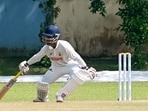
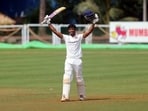
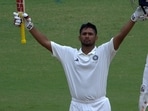
Starting his international career as a slow left-arm orthodox spinner batting down the order, Ravi Shastri executed one of Indian cricket's most dramatic technical transformations into a resolute opening batter. Making his Test debut against New Zealand at Wellington in February 1981, his tall frame and upright stance provided a solid foundation against high-velocity pace bowling.
His defensive organization relied on a disciplined forward press, tight wristwork, and exceptional judgment outside the off stump, allowing him to weather hostile spells through sheer attrition. Across 80 Test matches, he compiled 3,830 runs at an average of 35.79, including 11 centuries, while also taking 151 wickets with his accurate, high-arm bowling action.
Shastri's tactical versatility enabled him to adjust his approach based on the match situation, balancing stubborn crease occupation with sudden bursts of power. Against spin, he used his long reach to smother turn at the pitch of the ball, famously demonstrating his full striking range by hitting six sixes in an over off Tilak Raj during a Ranji Trophy match in 1985.
In One-Day Internationals, his left-arm spin utilized tight stump-to-stump trajectories and subtle pace variations to restrict run rates in the middle overs. This all-round tactical efficiency reached its apex during the 1985 World Championship of Cricket in Australia, where his 182 runs and 8 wickets earned him the Champion of Champions award.
Following his playing retirement in 1992, Shastri applied his sharp strategic mind to broadcasting and eventually team management as India's head coach. His coaching philosophy emphasized aggressive intent, fast-bowling depth, and an uncompromising mindset, which culminated in historic back-to-back Test series victories in Australia in 2018-19 and 2020-21.
Amassing 6,938 international runs and 280 international wickets across 230 matches, he established a rare legacy as a player, commentator, and mentor. Ultimately, his career stands as a masterclass in tactical adaptability, evolving from a teenage spin specialist into a dominant top-order pillar and an architect of modern Indian cricket.


 Live Score
 Teams
Teams Players
 INDIA
INDIA SA
SA AUS
AUS PAK
PAK India
India Experience
 Very Bad
 Bad
Bad Ok
Ok Good
Good Excellent