Sign in

12-year-old boy dies of dengue in Delhi, first death in the capital this year

The boy died at west Delhi’s Sir Ganga Ram hospital on August 1 due to multi-organ failure.

Updated on: Aug 22, 2017, 10:43:38 IST
Hindustan Times, New Delhi | By , New Delhi
Share
Share via
  • facebook
  • twitter
  • linkedin
  • whatsapp
Copy link
  • copy link

Delhi reported its first dengue death this year, when a 12-year-old boy succumbed to the mosquito-borne viral infection.

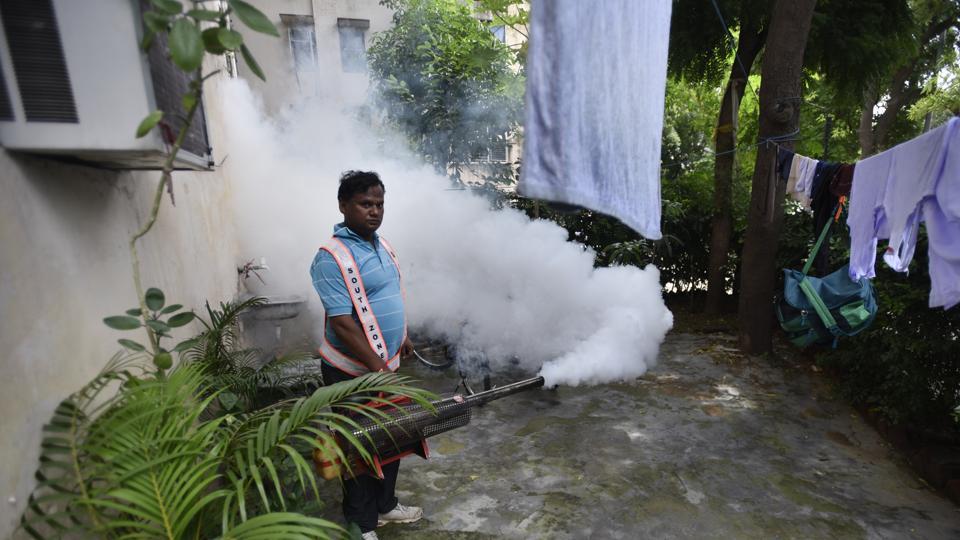
A municipal worker fumigates an area to control mosquitoes causing dengue and chikungunya diseases in New Delhi. (Ravi Choudhary/HT PHOTO)

The boy died at west Delhi’s Sir Ganga Ram hospital on August 1 due to multi-organ failure.

With 161 new cases reported in the past week, 325 people have been affected by the disease in Delhi this year, twice the number in the same period last year (162).

In 2016, there were 4,431 cases of dengue and 10 deaths.

How to duck the mosquito bite
What to do if you are affected by a vector-borne disease and ways to prevent it
SIGNS AND SYMPTOMS OF DENGUE
Sudden high fever, over 103 degrees Fahrenheit
Bodyache
Pain behind the eyes
Nausea and vomiting
Severe headache
Rash, itching in the body
Muscular weakness
STOP MOSQUITO BREEDING
Water-coolers should be cleaned once a week and mopped dry before refilling
Put two tablespoons of Kerosene/petrol (30ml) in 100 litres of water in water tanks
Overhead and other water tanks should be properly covered
Don’t let water collect in your surroundings
Disposable plastic/paper cups, glasses and other articles should be discarded regularly
Use mosquito repellent sprays, creams, coils, mats or liquids to drive away mosquitoes
Use insecticidal spray within the house at least once a week
KEEP YOUR SURROUNDINGS CLEAN
After the outbreak, the corporation listed chikungunya as a notifiable disease, making it mandatory for hospitals to report chikungunya cases to district authorities
Both the mosquito-borne illnesses are spread by the same day-biting aedes aegypti mosquito, which breeds in clean stagnant water. Their population usually increases during the monsoons, raising the number of cases.
"The intermittent showers (this season) create conducive environment for the growth and multiplication of disease-causing viruses and bacteria and also create an ideal breeding ground for mosquitoes," a health department official said
Malaria cases are also going up, with 215 cases reported till August 19. In the same period last year, 165 cases had tested positive

Last year, Delhi witnessed a Chikungunya outbreak, recording 7,760 cases, and this year, too, 194 cases have been reported so far. In the corresponding period last year, 20 samples had tested positive for Chikungunya.

A Delhi government official attributed the high number this year to better surveillance.

“Last year, nobody had expected a chikungunya outbreak as the viral infection does not commonly spread in Delhi,” the official said, requesting anonymity. “It was only after hospitals started receiving hundreds of cases that attempts to collect data were made.”

After the outbreak, the corporation listed chikungunya as a notifiable disease, making it mandatory for hospitals to report chikungunya cases to district authorities.

Both the mosquito-borne illnesses are spread by the same day-biting aedes aegypti mosquito, which breeds in clean stagnant water. Their population usually increases during the monsoons, raising the number of cases.

“The intermittent showers (this season) create conducive environment for the growth and multiplication of disease-causing viruses and bacteria and also create an ideal breeding ground for mosquitoes,” a health department official said.

Malaria cases are also going up, with 215 cases reported till August 19. In the same period last year, 165 cases had tested positive.

  • Rhythma Kaul
    ABOUT THE AUTHOR
    Rhythma Kaul

    Rhythma Kaul is the national health editor of the Hindustan Times. She has been reporting on public health, medicine, and medical research, with a particular focus on how government decisions and health system reforms shape people’s lives. Rhythma has over 25 years of journalistic experience. She joined Hindustan Times in 2008, and has since covered everything from pandemics and infectious diseases to cutting‑edge medical research and climate‑related health challenges. Her stories routinely track the work of the Ministry of Health and Family Welfare, department of pharmaceuticals, and key national health programmes, making complex medical science and policy accessible to a wide audience. One of her prominent news breaks has been the 2012 Baby Falak case: A two-year-old brutally battered baby girl was admitted to AIIMS-Delhi with severe head injuries, multiple fractures, human bite marks, and burns. The police investigation revealed this to be a case of multi-state human-trafficking racket. She was profiled by The Wall Street Journal for breaking this story. Rhythma holds a Master’s degree from Jawaharlal Nehru University, Delhi. Prior to Hindustan Times, she worked with the India Today Group. Rhythma can be contacted at rhythma.kaul@hindustantimes.com. Her X handle is @RamblingBrook.Read More