
 E-Paper



Art of living through the Covid crisis
Thousands of people from varied backgrounds are turning to art for emotional succour in these difficult times in a country where children have never been encouraged to take up arts as a subject. Will the coronavirus crisis mark a shift in the general attitude towards art?


Parvesh Bansal was known for her sketching skills in her teens. But her artistic pursuits got no encouragement from her parents, who always told her not to waste time on doodles and rather focus on studies. By the time Bansal was in college, she had given up her hobby.
Fifty-two years on, at 70, a few days back, she borrowed a pencil from her neighbour’s school-going son and drew again—a house in the hills, surrounded by the towering pine trees.
“My son lives in the United States and I live alone. I was feeling anxious and restless, having remained holed up in my apartment, all alone, for almost two weeks now,” says Bansal, a retired teacher who lives In Noida. “I wanted to distract myself from all that is happening in the world. Drawing immediately soothed me. I have done a few sketches in the past three days and exhibited them on Facebook. My relatives gave encouraging comments, and I felt 18 again. Believe me, there is no better way than art to deal with isolation.”
Parvesh is not the only one – thousands of people from various backgrounds and age-groups — doctors, lawyers, teachers, students , are taking to art, giving expression to their experiences of social distancing and lockdown. Social media – especially Facebook and Instagram-- are full of such artwork these days.
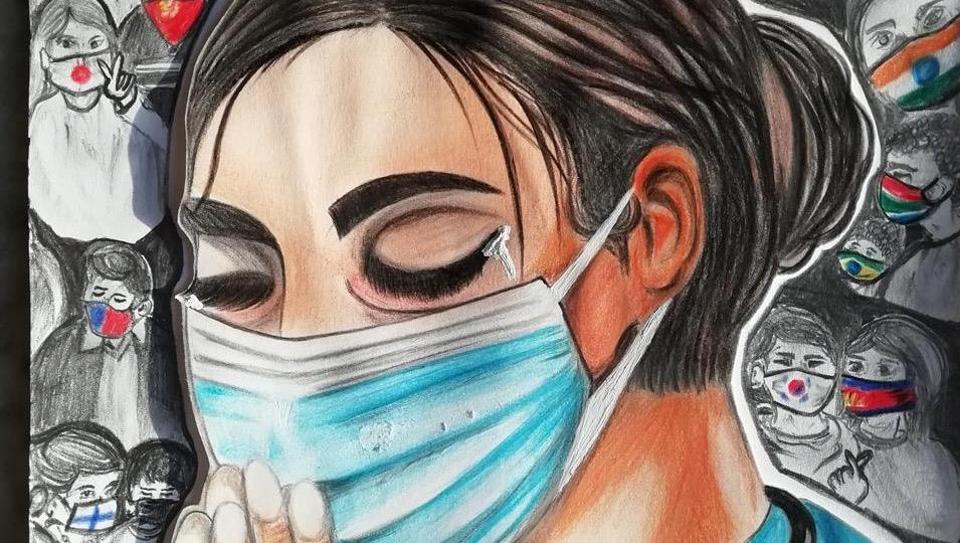
Take for example the works of Muskan Sharma, a Delhi University BCom student, who has done a series of paintings, depicting doctors’ importance in society. One of her paintings on Sunday showed a doctor surrounded by a multitude of people of different nationalities, wearing masks depicting their national flags. “I wanted to show how doctors are critical to our survival and how the world is rallying around them,” says Sharma.
While doctors may be a subject of many artworks these days, many doctors themselves are turning to art for its therapeutic effects.
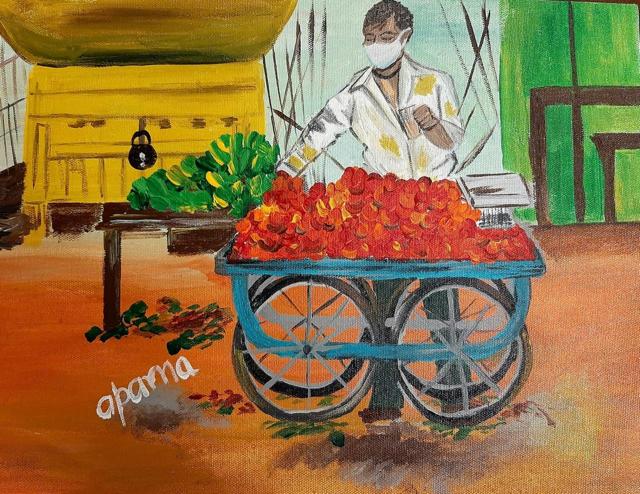
Dr. Aparna Govil Bhasker, a Mumbai- based bariatric surgeon, has done a series of paintings in the past few days dealing with various aspects of lockdown—the stigmatisation of health care workers, including doctors, the condition of migrants, the role of invisible heroes such as sweepers and vegetable vendors in easing lives of people. “ Today we all want to say something but we get caught up in taking sides. For me art is the most effective medium of expression. It allows me to say whatever I want to say; people can interpret it however they want. Art keeps me sane in these fraught times”.
Similarly, Dr. Rajesh Gupta, a pulmonologist with Fortis hospitals, likes to paint for an hour every evening after work. “These days I get an enormous number of queries from family, friends, neighbours and patients who fear they might have contracted Covid-19. A doctor’s job is always stressful even in normal times, but currently it is much more so. Art allows me to relax, prepare for the next day,” says Gupta. “The right brain qualities, which are related to imagery, visual and drawing skills also hold me in good stead in today’s digital, image-based world of medicine.”
Vasvi Srivastava, co-founder, Abhyaantar, a Delhi-based organisation that facilitates wellness and healing through creative arts, says that the lockdown has given people an opportunity like never to discover their creative selves, and to do things they always wanted to do, but never got time.
“Art puts you in a meditative state, relieving depression, general anxiety, and a host of other mental health issues. Even science has proved its healing powers,” says Srivastava, also a psychologist and an expressive arts therapy facilitator. “Art is the first thing we do as a child, much before writing, but unfortunately children have never been encouraged to take up art. I hope the current lockdown eventually will lead to a better appreciation of arts in our society.”
Krishna Das, who runs Kriya, an organisation that encourages artists from different walks of life, has launched an initiative, Artists of Kovid -19, to showcase works done by both professional as well as amateur artists during the lockdown. “The best art happens when artists have time and solitude to look within and be themselves. In normal times, we never introspect or retrospect, which requires both solitude and courage. The lockdown has given people that rare opportunity,” says Das.
She refers to legendary American psychologist Abraham Maslow’s hierarchy triangle, comprising a five-tier model of human needs, which also puts emphasis on the need for creative activities as a means of self-actualisation. “ Art is very important for us to become a better society, ” says Das.
One of the many artists who have contributed to Artists of Kovid -19 project, is Simran Wadhwa, a professional artist. Among the many works that she created during the lockdown is a brightly coloured face of a woman against a pitch dark background.
“The dark background represents the difficult times we are going through, and the bright colours on the face represent positivity of the person, her ability to see light at the end of the tunnel,” says Wadhwa, adding that in the past two weeks she has seen a change in the attitude of people towards art. “ A lot of parents are contacting me these days to do online art sessions for their children, which they feel is a creative way of spending time. But only time will tell if this change in outlook towards art will last.”
Manroop Chawla, another contributor to the Covid-19 project, has painted a young girl with long dark hair standing against a blue background, her face painted light blue.“The blue in the background conveys a sense of solitude that pervades all around us, and the blue on the face of the girl represents how people are getting affected by the bleak atmosphere around them,” says Chawla. “ Art is helping me fight my own blues.”
In fact, not just Das, many other art organisations have also launched several projects and competitions related to Covid-19, social distancing and quarantine. On 25th March, the day the country-wide lockdown began, Mumbai-based Milind Sathe, an art promoter, who runs Indiaart , an online art platform, launched “Art in the time of Corona - hope and positivity through creativity”, a project exhorting people to create and share their work -- be it a doodle, sketch, painting or anything else--- during the lockdown.
“I have always believed in the power of art in tackling negativity and despair. At a time when there is constant negative news all around, I thought that people should create something positive and not be just passive listeners to the stories of doom. Apart from the joy of creation, art can also soothe the stressed minds and give everyone a strong reason to live another day,” says Sathe.
The response to Sathe’s initiative has been overwhelming, with people from diverse age-groups and backgrounds-- homemakers, doctors, IT professionals, school children and college students and others sending their entries.
“I have been pleasantly surprised by the quality and depths of some of these works,” he says.
On Tuesday, Aparna Bhasker put up a new piece of art on her Facebook page. This time, it had a message:
“In the end we washed the virus off
And no evidence of infection did we find
But deep down, the feeling of being stigmatized was somewhat left behind
#EndCoronaStigma”

Stay updated with all top Cities including, Bengaluru, Delhi, Mumbai and more across India. Stay informed on the latest happenings in World News along with Delhi Election 2025 and Delhi Election Result 2025 Live, New Delhi Election Result Live, Kalkaji Election Result Live at Hindustan Times.


